


Key cautions
- Use known edible cultivars; common names and fruit colour do not establish suitability.
- Keep fruit-food and fragrant-leaf pandan products separate.
What’s inside
Fruit tissue contains carbohydrate, fibre and cultivar-dependent pigments. Some yellow/orange selections have been analyzed for carotenoids, but colour alone is not a nutrient assay.
Uses in brief

- Edible fruit pulp
- Processed local food
History, folklore and reported uses
History, folklore and traditional uses
Pandanus fruit is especially important in Micronesian and atoll food systems, while other places emphasize leaf craft uses. University and local-food research show that the same broad species name contains substantial practical diversity.
Traditional, historical and reported uses
- Edible fruit pulp
Food or household practiceWhy this label?
Sources document this named food or material use; no therapeutic outcome is claimed.
The Pacific Food Guide records pandanus among important Marshall Islands foods. The food reference concerns selected edible fruit, not all leaves or seeds.
- Processed local food
Food or household practiceWhy this label?
Sources document this named food or material use; no therapeutic outcome is claimed.
Pohnpei’s local-food research includes edible pandanus varieties and preparations in its community nutrition work. This reflects existing food knowledge rather than a universal processing recipe.
2 narrowly supported uses; no clinical efficacy or universal preparation is inferred.
Historical-use additions reviewed 2026-10-09
Regional reading paths
These sourced notes describe cultivation, trade, food traditions or material history. A regional connection does not claim exclusive origin.
Australia & Oceania
native/cultivated; Marshall Islands and Kiribati
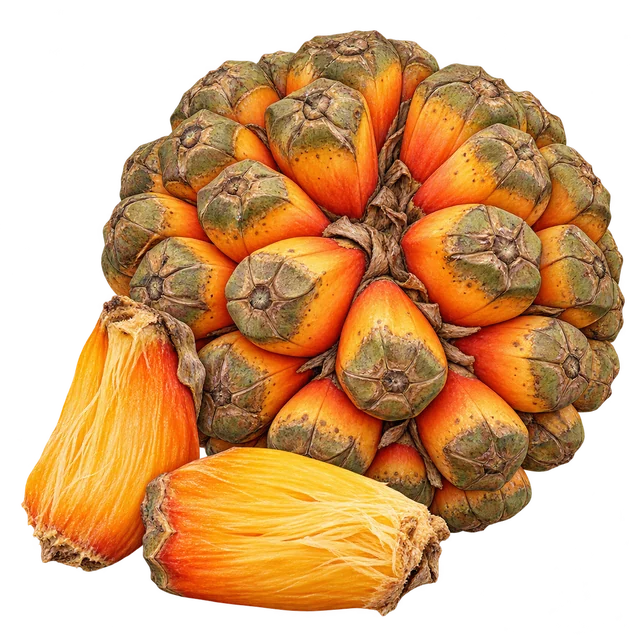
Fruit segments and prepared pulp.
Identity & detailed reference
Identity
Pandanus tectorius edible-fruit cultivars; a variable Pacific species complex, not fragrant Pandanus amaryllifolius cooking leaves.
Ingredient details, preparation and research
Source plant or material
Pandanus tectorius edible-fruit cultivars; a variable Pacific species complex, not fragrant Pandanus amaryllifolius cooking leaves.
Plant family / material: Pandanaceae
Forms and route
Identified edible fruit keys/segments, prepared pulp and locally processed fruit foods.
Vitamins and minerals
No single provitamin-A value applies to all pandanus. The consumed soft portion, cultivar and processing must match the analytical record.
Absorption and preparation
Extracting pulp changes the edible portion and fibre content. No standardized absorption benefit or deficiency-treatment dose is supplied.
Practical preparation
Use food cultivars obtained through knowledgeable local or commercial supply. Follow established preparation for that fruit; do not assume every fibrous ornamental pandanus fruit is a suitable food.
Traditional and reported uses
- The Pacific Food Guide records pandanus among important Marshall Islands foods. The food reference concerns selected edible fruit, not all leaves or seeds.
- Pohnpei’s local-food research includes edible pandanus varieties and preparations in its community nutrition work. This reflects existing food knowledge rather than a universal processing recipe.
Contraindications and cautions
- Use known edible cultivars; common names and fruit colour do not establish suitability.
- Keep fruit-food and fragrant-leaf pandan products separate.
A variable species complex
The university botanical account documents broad distribution and different fruit forms. Cultivar selection is therefore important when moving from a botanical label to an actual edible product.
Do not overgeneralize carotenoids
The community research analyzed named varieties after local informants identified relevant foods. Its measured results should remain attached to those varieties; they cannot become a generic supplement dose for any orange fruit.
Evidence limits
This is a food/material reference, not evidence of disease treatment. Geographic and customary-use records do not establish a medicinal dose. Nutrient quantities are omitted unless a matching food form and serving have been verified.
Entry sources
- University of Hawaiʻi: Pacific Food Guide, Food Preferences
- University of Hawaiʻi: Pandanus tectorius botanical account
- Island Food Community / FAO: Pohnpei food research and local-food program
Reference entry 506 · Recorded content review: 2026-10-09 · Review scope and dates