


Key cautions
- Rehydrate hygienically and refrigerate if overnight soaking is necessary; cooking does not reliably destroy preformed bongkrekic acid.
- Imported wood-ear products have been implicated in Salmonella outbreaks; follow recalls and cooking/storage advice.
What’s inside
Carbohydrates, especially polysaccharides, are prominent constituents; protein and mineral content vary with cultivation. Isolated polysaccharides are not equivalent to a cooked serving.
Uses in brief

- Textural food
- Cultivated food from wood and crop residues
History, folklore and reported uses
History, folklore and traditional uses
Black wood ear’s importance rests first on food and cultivation. Its firm, gelatinous texture has a distinctive place in East Asian cooking. Chinese wood-ear cultivation records include a cut-log tradition discussed in the Compendium of Materia Medica; modern growers also use formulated substrates.
Molecular taxonomy changed the interpretation of that crop’s name. The principal Chinese black wood ear, A. heimuer, was long called A. auricula-judae, a species originally described from Europe. Other wood-ear trade names can refer to A. cornea or additional species. Research on corncob cultivation continues the agricultural story without requiring a list of unproven medical effects.
A closer look at its history
An old crop gets its own name
Naming A. heimuer in 2014 did not mean growers had just discovered the food. It resolved a mismatch between a long-used Chinese crop and a European species name. Genome research then worked with the newly clarified organism, demonstrating how traditional cultivation and modern taxonomy can describe the same crop at different levels.
Additional history reviewed 2026-10-09
Traditional, historical and reported uses
- Textural food
Food or household practiceWhy this label?
The claim documents textural food as a culinary, craft, gardening, or practical material use; it reports neither a treatment outcome nor measured nutrient content.
Cooked fruiting bodies supply a characteristic firm, gelatinous texture in Chinese and other East Asian food.
- Cultivated food from wood and crop residues
Mixed/contextual sourcesWhy this label?
The claim combines established food cultivation with controlled substrate-development trials; agricultural production context is broader than a verified human or laboratory treatment study.
A. heimuer is grown on wood-based substrates. Controlled cultivation trials have also tested corncobs as a partial substitute for sawdust, connecting food production with use of agricultural residues.
The documented roles here are textural food, cultivated food from wood and crop residues. Fewer than five distinct uses are listed because additional medical claims are not needed to explain this fungus’s importance.
Story sources
- Genome analysis of A. heimuer, historical cultivation introduction, 2020
- Auricularia heimuer cultivation and taxonomy review, 2022
- Hong Kong Centre for Food Safety: improperly soaked black fungus
- FDA prevention strategy for imported enoki and wood-ear mushrooms
- Primary global Auricularia taxonomy and phylogeny, 2021
- Primary study: A. heimuer on corncob substrates, 2023
Features and lookalikes to study
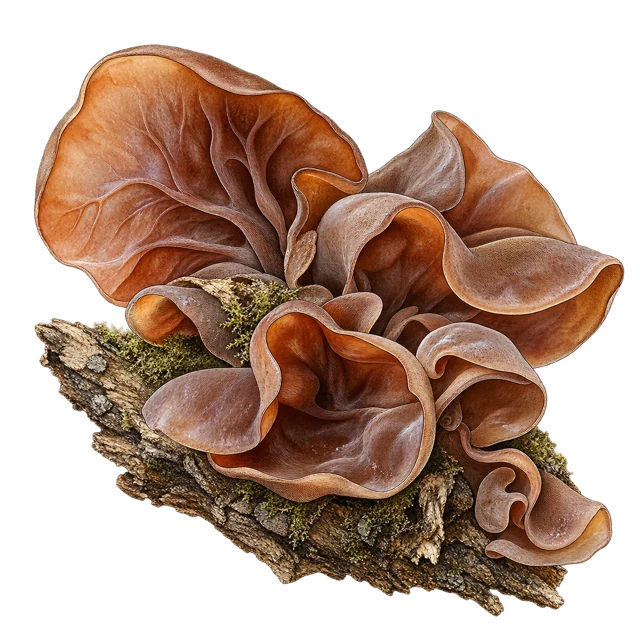
Auricularia heimuer F. Wu, B.K. Cui & Y.C. Dai. Chinese cultivated black wood ear formerly often misidentified as European A. auricula-judae. Cloud/wood-ear trade names also cover A. cornea and other species.
Black wood ear, cloud ear and wood ear are overlapping market categories, not globally consistent species names.
Morphology described in sources
- Auricularia heimuer produces brownish gelatinous, ear-like or folded fruiting bodies on wood. Drying changes colour, shape and texture; a dried dark “ear” is not species-diagnostic.
- Habitat and substrate
- See the source-linked morphology and comparison notes below; a separate habitat summary has not been verified for this card.
- Geographic scope
- A complete regional range is not established here. Broad common names and commercial labels can span different species.
- Season in the cited region
- No region-specific fruiting season has been verified for this card. Do not infer a local season from trade availability.
Auricularia auricula-judae and Auricularia cornea
The cultivated Chinese fungus long called A. auricula-judae was clarified as A. heimuer using morphology and molecular evidence. A. cornea is a separate wood-ear fungus; hair length, internal medulla, basidia and spores contribute to expert separation.
Species share conspicuous ear-like form and colours. Hair and internal tissue characters require proper microscopy, and historical synonyms in regional databases can conceal old misapplications.
Limits and regional differences
- Use a microscope and, where needed, sequence-supported identification for exact Auricularia species. A “wood ear” label does not establish which species a composition or clinical paper studied.
- Educational comparison only. Neither this card, an illustration, a photograph, a spore-print colour nor a checklist establishes that a wild collection is safe to eat. A qualified local mycologist must assess uncertain material; do not taste an unknown fungus. Cooking does not reliably eliminate mushroom toxins.
Regional reading paths
These sourced notes describe cultivation, trade, food traditions or material history. A regional connection does not claim exclusive origin.
Asia
Cultivated: China, with longstanding wood-ear food production.
Rehydrated and cooked mushroom valued for texture.
Identity & detailed reference
Identity
Auricularia heimuer F. Wu, B.K. Cui & Y.C. Dai. Chinese cultivated black wood ear formerly often misidentified as European A. auricula-judae. Cloud/wood-ear trade names also cover A. cornea and other species.
Ingredient details, preparation and research
Also known as: hei mu er; black fungus; wood ear
Source plant or material
Auricularia heimuer F. Wu, B.K. Cui & Y.C. Dai; Fresh or dried gelatinous fruiting bodies of authenticated commercial black wood ear.
Fungal family: Auriculariaceae
Forms and route
Fresh or dried ear-shaped fruiting bodies, rehydrated and cooked; isolated polysaccharides are separate experimental materials.
Vitamins and minerals
An edible mushroom containing carbohydrate, protein and minerals. Substrate affects measured mineral composition, so no generic percentage of daily intake is assigned.
Absorption and preparation
Rehydrate using clean utensils and water, refrigerate if soaking overnight, and cook. Prolonged warm soaking can permit toxin formation; cooking does not reliably remove preformed bongkrekic acid.
Traditional and reported uses
- Cooked fruiting bodies supply a characteristic firm, gelatinous texture in Chinese and other East Asian food.
- A. heimuer is grown on wood-based substrates. Controlled cultivation trials have also tested corncobs as a partial substitute for sawdust, connecting food production with use of agricultural residues.
Contraindications and cautions
- Rehydrate hygienically and refrigerate if overnight soaking is necessary; cooking does not reliably destroy preformed bongkrekic acid.
- Imported wood-ear products have been implicated in Salmonella outbreaks; follow recalls and cooking/storage advice.
- Common names and photographs do not establish wild-mushroom safety.
- This card is not a foraging identification guide. Unknown wild mushrooms should not be eaten.
Similar items and how they compare
- Snow fungus / silver ear
Both are sold as gelatinous food fungi, including dried forms.
Black wood ear is Auricularia; snow fungus is Tremella. Their common “ear” names do not make them the same fungus.
Identity, fungal material and preparation
Auricularia heimuer F. Wu, B.K. Cui & Y.C. Dai. Chinese cultivated black wood ear formerly often misidentified as European A. auricula-judae. Cloud/wood-ear trade names also cover A. cornea and other species. Fresh or dried gelatinous fruiting bodies of authenticated commercial black wood ear. Rehydrate using clean utensils and water, refrigerate if soaking overnight, and cook. Prolonged warm soaking can permit toxin formation; cooking does not reliably remove preformed bongkrekic acid.
Constituents and food context
Carbohydrates, especially polysaccharides, are prominent constituents; protein and mineral content vary with cultivation. Isolated polysaccharides are not equivalent to a cooked serving. An edible mushroom containing carbohydrate, protein and minerals. Substrate affects measured mineral composition, so no generic percentage of daily intake is assigned.
Traditional uses and evidence boundaries
The strongest documented roles presented here are food and cultivation. Claims about blood cleansing, anticoagulation or cholesterol treatment need separate human evidence for the exact preparation.
Safety and product distinctions
Rehydrate hygienically and refrigerate if overnight soaking is necessary; cooking does not reliably destroy preformed bongkrekic acid. Imported wood-ear products have been implicated in Salmonella outbreaks; follow recalls and cooking/storage advice. Common names and photographs do not establish wild-mushroom safety.
Entry sources
- Genome analysis of A. heimuer, historical cultivation introduction, 2020
- Auricularia heimuer cultivation and taxonomy review, 2022
- Hong Kong Centre for Food Safety: improperly soaked black fungus
- FDA prevention strategy for imported enoki and wood-ear mushrooms
- Primary global Auricularia taxonomy and phylogeny, 2021
- Primary study: A. heimuer on corncob substrates, 2023
Reference entry 210 · Recorded content review: 2026-10-08 · Review scope and dates