


Key cautions
- Avoid with marjoram/mint-family allergy. Do not replace a formulated skin product with raw juice or essential oil.
- Medicinal pregnancy/breastfeeding safety is unestablished. Digestive symptoms beyond two weeks, worsening symptoms or infected skin need review.
What’s inside
Aromatic volatile compounds and less volatile phenolics belong to different fractions of this herb. The amount eaten as seasoning is small; an extract, infusion and distilled oil cannot share one composition or serving size.
Baâtour et al. (2012): Growing conditions and sweet-marjoram essential-oil composition · Origanum majorana extracts (2025): Comparative phytochemical profiles of valuable fraction and by-product
Constituents and preparation
Herb extracts contain phenolic acids, including rosmarinic acid, and flavonoids. Common volatile profiles feature terpinen-4-ol and cis-/trans-sabinene hydrates, with gamma-terpinene and other terpenes. Composition changes with growing conditions; linalool is not uniformly the dominant constituent. Oil composition cannot be assigned directly to food or tea. A 2025 chemical comparison found rosmarinic acid prominent in the tested extracts; this was composition research, not a trial of tea in people.
Baâtour et al. (2012): Growing conditions and sweet-marjoram essential-oil composition · Origanum majorana extracts (2025): Comparative phytochemical profiles of valuable fraction and by-product
Food portion and absorption
USDA dried marjoram: 1 teaspoon (0.6 g) supplies about 2 kcal, 0.24 g fiber, 12 mg calcium, 0.50 mg iron and 3.7 micrograms vitamin K (about 3% Daily Value). These modest values apply to the dried herb eaten; fresh leaves, strained tea, ointment and essential oil are different materials. No validated home absorption-enhancing combination follows from the phytochemical tests. The ointment’s intended role is local.
USDA FoodData Central: SR Legacy downloadable food and portion data · FDA: Daily Value on the Nutrition and Supplement Facts labels · EMA: Origanum majorana herb monograph (2016) · Origanum majorana extracts (2025): Comparative phytochemical profiles of valuable fraction and by-product
Uses in brief

- Culinary seasoning; traditional tea preparations for mild bloating and gas.
- Specified ointments have a traditional use on irritated skin around the nostrils, not inside the nose.
History, folklore and reported uses
Identity, family and parts
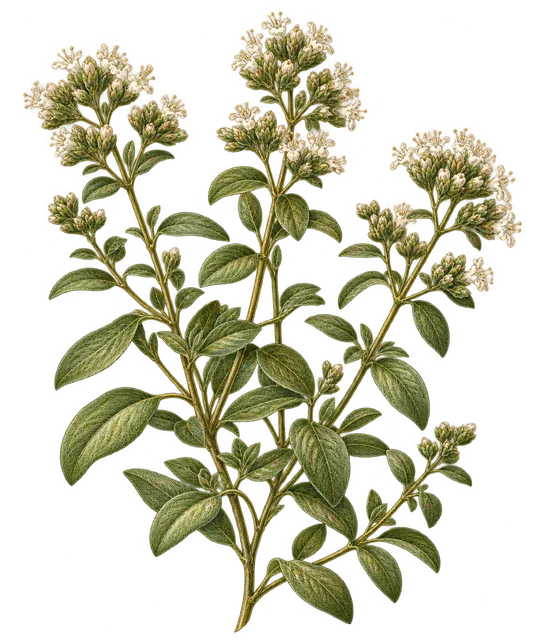
Origanum majorana L. is sweet marjoram, a Lamiaceae herb. Its leaves and flowering shoots are used; EMA’s medicinal herb is the flowering shoot material. O. vulgare, often called oregano or wild marjoram, is a separate species. Common-name overlap is not a reason to substitute one extract for another.
Kew Plants of the World Online: Origanum majorana L. · Kew Plants of the World Online: Origanum vulgare L. · EMA: Sweet-marjoram herb, traditional oral and skin uses
Attributed traditional uses and current assessment
EMA’s European traditional-use assessment covers oral digestive tea for mild indigestion, gas and bloating, and a specific ointment for irritated skin around the nostrils. The support is longstanding use rather than adequate efficacy trials. Its 2023 review found no evidence requiring revision of those indications; it did not add a hormone or infection indication.
EMA: Sweet-marjoram herb, traditional oral and skin uses · EMA: Marjoram assessment addendum (2023), no revision required
Similar names at the herb stall
Pot marjoram, Origanum onites, is also sold as marjoram and has a stronger flavor. RHS distinguishes it from sweet marjoram and from oregano. Check the botanical name when choosing a medicinal preparation rather than treating this overlap in kitchen names as proof of interchangeability.
Knotted marjoram in the kitchen and herbal
Sweet marjoram’s compact flower clusters gave it the older name “knotted marjoram,” a small botanical detail preserved in nineteenth-century pharmacy. Jonathan Pereira’s materia medica described a warm, aromatic kitchen herb whose principal employment was with the cook. Alongside that ordinary use, he recorded marjoram tea as a popular remedy for nervous complaints. The account offers a gentler historical picture than the grand cure-all lists sometimes attached to Mediterranean herbs.
Jonathan Pereira: Sweet Knotted Marjoram, historical materia medica · EMA: Sweet-marjoram herb, traditional oral and skin uses · EMA: Marjoram assessment, including Polish ointment tradition · EMA: Final assessment report on Origanum majorana herb, historical-use section · Royal Horticultural Society: How to grow marjoram
From digestive tea to pharmacy ointment
Digestive and external uses continued in European herbal practice. EMA records sweet-marjoram preparations for mild bloating and flatulence, and a separate ointment tradition for irritated skin around the nostrils; its assessment includes Polish preparations. These traditions show how one scented garden plant moved among seasoning, tea and salve. They also explain why the preparation matters to the story. Sweet marjoram is Origanum majorana, while oregano, Origanum vulgare, is often called wild marjoram: the shared common name can otherwise make two related histories appear to be one.
Jonathan Pereira: Sweet Knotted Marjoram, historical materia medica · EMA: Sweet-marjoram herb, traditional oral and skin uses · EMA: Marjoram assessment, including Polish ointment tradition · EMA: Final assessment report on Origanum majorana herb, historical-use section · Royal Horticultural Society: How to grow marjoram
Bloating and digestive cramps
European herbal books used sweet-marjoram flowering aerial parts as infusions, powders and tinctures for difficult digestion, abdominal cramps and flatulence. EMA documents this recurring digestive tradition.
EMA: Final assessment report on Origanum majorana herb, historical-use section
Nasal-rhinitis salves
Polish pharmacy preserved an ointment made from sweet-marjoram herb for irritated skin associated with rhinitis. EMA traces the preparation through a 1949 regulation and later Polish pharmacopoeias.
EMA: Final assessment report on Origanum majorana herb, historical-use section
Tea for nervous complaints
Jonathan Pereira’s nineteenth-century materia medica records marjoram-herb tea as a popular remedy for nervous complaints. The warm, aromatic aerial herb supplied the tea.
Jonathan Pereira: Sweet Knotted Marjoram, historical materia medica
Colds, coughs and catarrh
European textbooks reviewed by EMA describe flowering-herb infusions and tinctures for colds, cough and catarrh. Those accounts preserve an expectorant tradition separate from the ointment used around a sore nose.
EMA: Final assessment report on Origanum majorana herb, historical-use section
Rheumatic and neuralgic discomfort
EMA’s historical review records an infusion of sweet-marjoram flowering shoot tips used externally for neuralgic and rheumatic pain. Flowering tips supplied the aromatic water preparation for local use.
EMA: Final assessment report on Origanum majorana herb, historical-use section
Greek and Italian food seasoning
The RHS records marjoram leaves in Greek and Italian cuisine and distinguishes sweet marjoram, Origanum majorana, from oregano and other plants sold under similar names. Its delicate leaves supply a culinary seasoning distinct from medicinal flowering-herb preparations.
An older nasal powder, not the modern ointment
Pereira also records powdered marjoram used alone or mixed with other powders as an errhine, a substance intended to provoke nasal discharge or sneezing. This nineteenth-century practice is a different route from a formulated ointment applied to surrounding skin.
Jonathan Pereira: Sweet Knotted Marjoram, historical materia medica · EMA: Sweet-marjoram herb, traditional oral and skin uses
Fresh leaves and a tender garden plant
RHS notes that sweet marjoram is often used fresh and is less hardy than oregano in British gardens. It is commonly grown there as an annual or overwintered indoors. Fresh leaves are usually added near the end of cooking to preserve their delicate flavor.
Regional reading paths
These sourced notes describe cultivation, trade, food traditions or material history. A regional connection does not claim exclusive origin.
Europe
Cultivated and traditional processing: European cookery and UK seasonal herb cultivation.
Fresh or dried leaves season vegetables, soups and sauces.
Identity & detailed reference
Identity
Origanum majorana L.; leaves and flowering shoots. It is distinct from oregano (Origanum vulgare), which is also sometimes called wild marjoram.
Ingredient details, preparation and research
Source plant or material
Origanum majorana L.; leaves and flowering aerial shoots.
Plant family / material: Lamiaceae (mint family).
Forms and route
Fresh or dried culinary herb, herb tea, and prepared topical marjoram ointments. Tinctures and other extracts are product-specific; distilled sweet-marjoram essential oil is a separate preparation.
Vitamins and minerals
USDA dried marjoram: 1 teaspoon (0.6 g) supplies about 2 kcal, 0.24 g fiber, 12 mg calcium, 0.50 mg iron and 3.7 micrograms vitamin K (about 3% Daily Value). These modest values apply to the dried herb eaten; fresh leaves, strained tea, ointment and essential oil are different materials.
Absorption and preparation
No well-characterized human pharmacokinetic profile for ordinary marjoram tea is established here. Water, solvent extracts and distilled oil contain different fractions, and extraction yield is not bioavailability. Ointments are intended for local skin action. A food pairing or extra oil has no established medicinal absorption benefit.
Practical preparation
Use identified sweet-marjoram leaves for food and a labeled herb product for an infusion. Keep the finished topical ointment to the external area named on its label and wash hands afterward. Do not prepare a nose remedy from food leaves, homemade tincture or oil.
Combination notes
Marjoram pairs with tomato dishes, vegetables, eggs and soups, and can accompany thyme in food. A small marjoram–cinnamon trial cannot separate the herbs’ effects or establish medicinal synergy; it is not a home PCOS-treatment recipe.
Traditional and reported uses
- Sweet aromatic seasoning for soups, vegetables, tomato dishes, eggs and other savory foods.
- EMA traditional European oral use: specific herb-tea preparations for mild indigestion including bloating and flatulence.
- EMA traditional external use: specified semisolid preparations for irritated skin around the nostrils.
- Small human tea trials have examined PCOS hormone/metabolic markers. They do not establish hormone normalization, fertility benefit or a treatment substitute.
Contraindications and cautions
- Avoid marjoram medicines with hypersensitivity to marjoram or other Lamiaceae plants. Stop for local irritation or an allergic reaction.
- Medicinal safety in pregnancy and breastfeeding is not established; EMA does not recommend medicinal use in these settings. Ordinary culinary seasoning is a different exposure.
- EMA oral digestive use is for adults. Its specific ointment has separate pediatric labeling, which does not authorize essential-oil use in children.
- Seek assessment for digestive symptoms persisting beyond two weeks, skin symptoms beyond one week, worsening symptoms or signs of skin infection.
- Use only a preparation labeled for skin around the nostrils, keep it out of the eyes, and do not insert it deep in the nose. Do not swallow aromatherapy oil or apply undiluted essential oil.
- No interactions were reported in the EMA monograph, but medication-interaction and long-term safety data remain limited. Do not change PCOS or glucose-lowering treatment based on pilot tea studies.
Similar items and how they compare
- Oregano
Both belong to Origanum and are aromatic culinary herbs containing phenolics and chemically variable volatile oils.
Sweet marjoram is Origanum majorana; oregano is usually Origanum vulgare and may be more carvacrol- or thymol-dominant.
- Thyme
Both are mint-family seasoning herbs with separate teas, extracts and essential oils, including some linalool-containing types.
Marjoram has traditional digestive and specified topical uses; thyme has a traditional cough indication for particular preparations.
Human tea research: small and exploratory
In a 25-person, one-month PCOS pilot, marjoram tea affected selected adrenal-androgen and insulin-resistance measures. The insulin change itself was not statistically significant versus placebo. A 2025 marjoram–cinnamon pilot randomized 60 participants but only 36 completed. Biomarker changes, substantial attrition and a mixed formulation do not establish fertility outcomes, menstrual normalization or benefit from marjoram alone.
Laboratory findings are not parasite treatment
An aqueous-marjoram study exposed isolated Blastocystis cysts to extract in the laboratory. A concentration that affects a parasite outside the body does not show a safe, effective human dose or clinical cure. This cannot justify a parasite-cleansing protocol with tea or oil.
Route, age and safety
EMA oral digestive use is for adults. Its specified topical ointment has different labeling, including children from age one, but that is not an essential-oil recommendation. Avoid with relevant mint-family allergy. Pregnancy/lactation medicinal safety is unestablished. Apply only around the nostrils as labeled, avoid eyes, and wash hands after use; do not substitute a raw extract or intranasal oil.
When to seek assessment and interaction limits
Obtain advice for digestive symptoms lasting beyond two weeks, skin symptoms beyond one week, worsening symptoms or skin infection. EMA reports no known interactions for the assessed preparations; absent reports are not proof that every extract is interaction-free. Pilot PCOS findings do not authorize changing prescribed treatment.
Preparation and culinary partners
Use the leaf with vegetables, soups, tomatoes or eggs. Culinary pairing with thyme or oregano is reasonable for flavor; medicinal extracts and teas remain distinct. A mixed marjoram–cinnamon trial cannot show which ingredient caused a result or that combining them is synergistic.
Entry sources
- Kew Plants of the World Online: Origanum majorana L.
- Kew Plants of the World Online: Origanum vulgare L.
- EMA: Sweet-marjoram herb, traditional oral and skin uses
- Baâtour et al. (2012): Growing conditions and sweet-marjoram essential-oil composition
- Origanum majorana extracts (2025): Comparative phytochemical profiles of valuable fraction and by-product
- EMA: Marjoram assessment addendum (2023), no revision required
- Haj-Husein et al. (2016): Marjoram tea in a 25-person PCOS pilot trial
- Majeed et al. (2025): Marjoram–cinnamon tea PCOS pilot, substantial attrition
- Méabed et al. (2018): Marjoram aqueous extract against Blastocystis cysts in vitro
- EMA: Origanum majorana herb monograph (2016)
- National Capital Poison Center: Essential oils, poisonous when misused
- USDA FoodData Central: SR Legacy downloadable food and portion data
- FDA: Daily Value on the Nutrition and Supplement Facts labels
- University of Minnesota Extension: Herbs, preparation and culinary pairings
- Royal Horticultural Society: How to grow marjoram
Reference entry 98 · Recorded content review: 2026-10-05 · Review scope and dates