


Key cautions
- Do not treat a modern resin or oil sold as stacte as an authenticated biblical ingredient.
- No oral dose, skin remedy or reconstructed holy-incense recipe is established by this entry.
What’s inside
No established constituent profile for biblical stacte. Modern myrrh, storax, benzoin and balsam products require separate identification and cannot donate their chemistry to this name.
Uses in brief

- A named component of the sacred incense in Exodus.
- Classical writers used a related name for prized myrrh-associated aromatic material; identity with biblical stacte is not proved.
In the King James Bible
In the King James Bible
Uncertain botanical connection
The KJV explicitly names stacte in the incense passage. Its precise identity is uncertain; Greek and Roman descriptions of a myrrh-related material help explain a traditional reading but do not resolve the Hebrew name. The surrounding text reserves the composition for sacred use.
And the LORD said unto Moses, Take unto thee sweet spices, stacte, and onycha, and galbanum; these sweet spices with pure frankincense: of each shall there be a like weight:
Exodus 30:34 (KJV)
And as for the perfume which thou shalt make, ye shall not make to yourselves according to the composition thereof: it shall be unto thee holy for the LORD.
Exodus 30:37 (KJV)
Scripture and identification sources
- King James Bible: Exodus 30:34
- King James Bible: Exodus 30:37
- Project Gutenberg: The King James Version of the Bible, ebook 10
- S. R. Driver, Cambridge Bible for Schools and Colleges: Exodus 30:34 commentary (1911)
- Pliny, Natural History, Book XII, chapters 19 and 35, Bostock and Riley translation; Perseus Digital Library
Words & their stories
WORDS & THEIR STORIES
The name behind the KJV
Biblical Hebrew · Exodus 30:34 (KJV)
נָטָףnāṭāp
The aromatic gum rendered “stacte.”
Dictionary form: נָטָף · nāṭāp
The material-name is associated with drops or dripping; its precise source is uncertain.
What the language reveals
A descriptive name with disputed identity
BDB records interpretations including a kind of myrrh and storax. The idea of drops does not identify one species or imply modern steam distillation.
The ingredient and the sacred blend
Verse 34 names nāṭāp as an ingredient. Verse 37 refers to the finished incense, qəṭōret, whose composition was reserved for sacred use.
Stacte remains an uncertain aromatic material. It cannot securely identify a modern Styrax species, myrrh product or essential oil.
Language and identification bibliography
History, folklore and reported uses
History, folklore and traditional uses
Stacte survives in scripture as a named fragrance rather than a described plant. It stands at the beginning of the aromatic list in Exodus 30:34, within instructions for incense set apart as holy. The passage identifies its place in worship but leaves later readers without leaves, flowers, a growing region or an independently recognizable raw material. The uncertainty invites close attention to the words, to ancient perfume trades and to how translators understood a fragrant material whose original source was already difficult to recover.
The name’s history nevertheless offers clues. Greek and Roman stacte was linked with myrrh, and Pliny describes a particularly valued exudate of the myrrh tree. Older biblical scholarship also considered storax and balsam interpretations, noting that a word associated with dripping may indicate a kind of material rather than one plant species. The comparison makes a myrrh-related reading plausible while leaving the identification open. Stacte thus preserves a fragment of the ancient fragrance trade: a prized aromatic known by name and religious function, with competing explanations of its original source.
Traditional, historical and reported uses
- Sacred incense
Historical recordWhy this label?
Specific Exodus passage documents sacred incense.
Exodus 30:34 places stacte in the holy incense. The surrounding passage separates that composition from personal perfume, so this record does not supply a home recipe.
- Classical luxury aromatic, with an identity caveat
Historical recordWhy this label?
Pliny's identified classical text records aromatic commerce with an identity caveat.
Pliny’s stacte is a highly valued myrrh-associated exudate in his discussion of aromatic commerce. That classical material helps explain the translation tradition but is not proof of the biblical ingredient’s identity.
Two supported historical contexts are supplied; the original material remains uncertain.
Identity & detailed reference
Identity
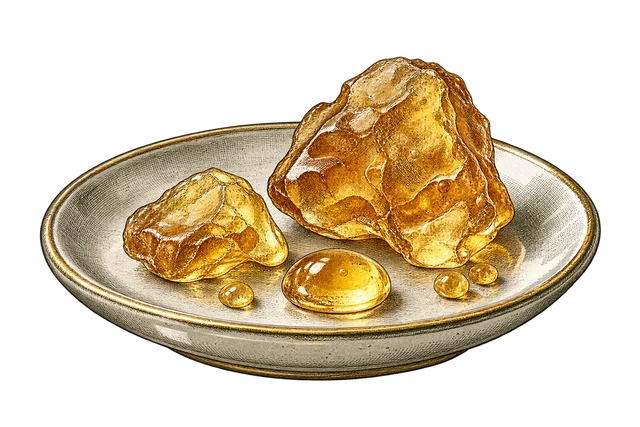
An unresolved aromatic ingredient named in Exodus, generally interpreted as a fragrant exudate or resin. Myrrh-derived material is a longstanding proposal, but storax or balsam interpretations also occur.
Ingredient details, preparation and research
Also known as: Nataph / nataf (transliterations); Stakte (Greek related name)
Source plant or material
Unknown aromatic exudate; the language of dripping underlies traditional explanations, but it is not a botanical identification.
Plant family / material: Unresolved for the biblical material.
Forms and route
Ancient incense material; possibly a naturally exuded resin or fragrant myrrh-related liquid. The name does not establish a modern essential oil, tincture or a preparation method.
Vitamins and minerals
This is a historical-material entry, not a dietary recommendation. The biblical name supplies no dependable modern food identity, serving size or vitamin/mineral values.
Absorption and preparation
No absorption guidance or medicinal dose is assigned to this uncertain ancient material. A modern product would require its own verified identity, preparation and safety assessment.
Traditional and reported uses
- A named component of the sacred incense in Exodus.
- Classical writers used a related name for prized myrrh-associated aromatic material; identity with biblical stacte is not proved.
Contraindications and cautions
- Do not treat a modern resin or oil sold as stacte as an authenticated biblical ingredient.
- No oral dose, skin remedy or reconstructed holy-incense recipe is established by this entry.
Similar items and how they compare
- Myrrh
Classical descriptions connect stacte with myrrh.
This is an interpretive clue, not proof that ordinary myrrh resin or its essential oil is biblical stacte.
- Onycha
Both names occur in the sacred-incense passage.
Both are uncertain, but the competing identifications involve different materials.
Why a Latin species is not supplied
The Hebrew and translated names have been connected with dripping or exudation. The Cambridge commentary discusses myrrh, storax and balsam proposals while explicitly leaving the material uncertain.
Ancient descriptions are not a modern product standard
Pliny’s account is evidence about a classical aromatic. It does not establish that a commercial myrrh oil, benzoin resin or storax product reproduces the substance in Exodus.
Evidence and practical limits
The documented biblical role is incense, not food or medicine. No nutrient contribution, absorption advice or therapeutic dose can be inferred from the verse.
Evidence limits
- Ancient names do not provide a verified modern species or product specification.
- Historical practice is recorded as history and does not establish present-day medical benefit or safety.
Entry sources
- S. R. Driver, Cambridge Bible for Schools and Colleges: Exodus 30:34 commentary (1911)
- Pliny, Natural History, Book XII, chapters 19 and 35, Bostock and Riley translation; Perseus Digital Library
- King James Bible: Exodus 30:34
- King James Bible: Exodus 30:37
- Project Gutenberg: The King James Version of the Bible, ebook 10
- King James Bible: Exodus 30:34-38
Reference entry 136 · Recorded content review: 2026-10-06 · Review scope and dates