


Key cautions
- Choose food-grade pods or extract.
- Alcohol-based extract is not a beverage; keep it away from children.
- Check ingredients rather than relying on “vanilla flavored.”
What’s inside
Vanillin is a characteristic aroma constituent within a more complex cured-pod flavor. An extract’s alcohol, water and any added sweeteners depend on the labeled preparation.
Uses in brief

- Custards and infused desserts
- Baking and confectionery
- Cacao-drink food heritage
History, folklore and reported uses
History, folklore and traditional uses
Vanilla’s food history begins in the Americas. Smithsonian Gardens describes vanilla in pre-Columbian Aztec and Maya cacao drinks, while Kew explains the curing that turns harvested pods into the familiar culinary flavor.
A specifically identifiable written record survives in the Florentine Codex. The University of Oregon Nahuatl Dictionary reproduces a Book 8 passage listing sellers of chocolate, aromatic plants and tlilxochitl, translated as vanilla. It documents a sixteenth-century market ingredient without establishing a modern cultivar.
Traditional, historical and reported uses
- Custards and infused desserts
Food or household practiceWhy this label?
Records a specific culinary preparation of the named material; this is a food-practice category, not evidence of a medical benefit.
Kew describes cured pods used whole, or split with their tiny seeds scraped out, to flavor cream and custard sauces. Curing matters: a green fruit or orchid flower is not the same ready-to-use ingredient.
- Baking and confectionery
Food or household practiceWhy this label?
Records a specific culinary preparation of the named material; this is a food-practice category, not evidence of a medical benefit.
The Spices Board records vanilla in bakery goods, candies, ice cream and beverages. Bean-derived extract is a convenient food preparation, while pastes and other products need their own ingredient check.
- Cacao-drink food heritage
Traditional accountWhy this label?
An explicitly attributed botanical-museum account documents a regional food tradition; it is not presented as a directly analyzed ancient recipe or as medical evidence.
Smithsonian Gardens identifies vanilla as one of several flavorings used in Aztec and Maya cacao drinks. This preserves an attributed Indigenous food history without treating every present-day hot-chocolate recipe as an unchanged ancient formula.
- Perfumery ingredient
Food or household practiceWhy this label?
A government spice-industry profile explicitly records a nonfood perfume application; the claim does not infer a particular extraction process, therapeutic effect or food safety for fragrance products.
India’s Spices Board records vanilla as a component of perfumes. This is a fragrance application distinct from food-grade pod extract; a product described as vanilla-scented does not by itself identify its ingredients or make it edible.
- Vanilla-pod jewelry in Veracruz
Food or household practiceWhy this label?
An original local-enterprise study identifies the species, pod material, makers and jewelry types; an original producer survey independently documents regional pod crafts. Neither is treated as proof that proposed exports occurred.
A 2013 Universidad Veracruzana study documents women artisans in Tihuatlán, Veracruz, making bracelets, necklaces and other jewelry from Vanilla planifolia pods. A later Totonacapan producer survey also records pod handicrafts for regional festivities. Finished craft objects should not be reused as food ingredients.
- García-Rodríguez et al. (2013), Universidad Veracruzana: Comercialización de artesanías de vainilla de la región del Totonacapan al mercado Francés, pp. 11–21
- Santillán-Fernández et al. (2019): Potencial productivo de Vanilla planifolia Jacks en el Totonacapan, México, mediante técnicas geográficas; producer survey and regional crafts
5 distinct supported uses are featured. Culinary, material and attributed historical practices are distinguished from medicinal efficacy; no fixed seven-use quota is imposed.
Historical-use additions reviewed 2026-10-09
Story sources
- Kew POWO species profile: Vanilla planifolia, cured pods and culinary use
- Smithsonian Gardens collection: Vanilla planifolia and Mexican cacao-drink history
- University of Oregon Nahuatl Dictionary: tlilxochitl, with Florentine Codex Book 8 market attestation
- Spices Board India: Vanilla, food flavoring and perfumery uses
- García-Rodríguez et al. (2013), Universidad Veracruzana: Comercialización de artesanías de vainilla de la región del Totonacapan al mercado Francés, pp. 11–21
- Santillán-Fernández et al. (2019): Potencial productivo de Vanilla planifolia Jacks en el Totonacapan, México, mediante técnicas geográficas; producer survey and regional crafts
Regional reading paths
These sourced notes describe cultivation, trade, food traditions or material history. A regional connection does not claim exclusive origin.
Africa
Introduced/cultivated: Madagascar and neighboring Indian Ocean islands.
Cured pods provide culinary vanilla flavor.
North America
Native/cultivated: Mexico and Mesoamerica.
Cured pods flavor sweets and drinks.
Australia & Oceania
introduced/traded and cultivated; Tonga, Papua New Guinea and French Polynesia
Cured pod flavouring.
Identity & detailed reference
Identity
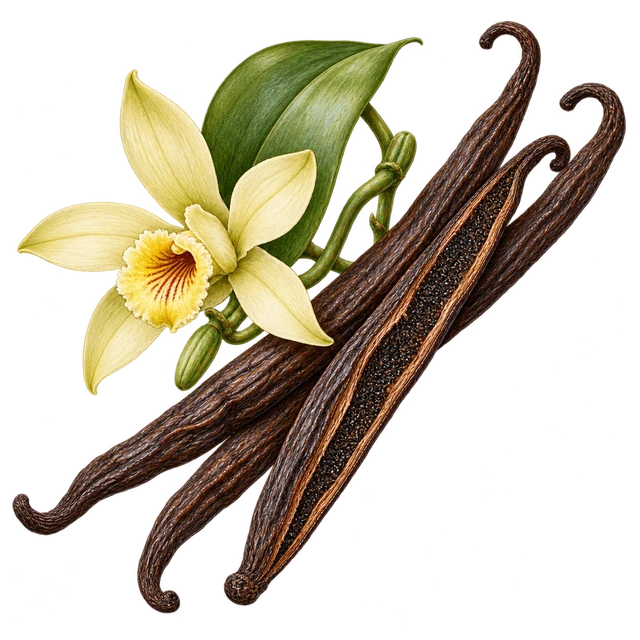
The cured fruit capsules, commonly called beans or pods, of vanilla orchids, principally Vanilla planifolia. Genuine commercial vanilla also includes V. pompona and V. × tahitensis; this card is centered on cured pods and food-grade bean-derived extract, not every vanilla-scented flavoring.
Ingredient details, preparation and research
Also known as: Vanilla bean; Vanilla pod; Vanilla planifolia; Vainilla; Bean-derived vanilla extract
Source plant or material
Vanilla planifolia Andrews (principal commercial species)
Plant family / material: Orchidaceae
Forms and route
Cured whole pods, their tiny seeds used in food, and food-grade vanilla-bean extract. Pastes and sweetened products vary by ingredients. Artificial vanillin flavoring and nonfood fragrance products are separate materials.
Vitamins and minerals
Vanilla is used primarily for aroma in small recipe quantities. No serving-specific nutrient advantage is claimed for cured pods or extract. Sugar in a paste or syrup and alcohol in an extract belong to the particular product, not to every vanilla preparation.
Absorption and preparation
No nutrient-absorption benefit is established for ordinary vanilla flavoring. Research on isolated vanillin cannot be used to assign health effects to a custard or a teaspoon of a particular extract.
Practical preparation
Use a food-grade cured pod or the labeled extract specified by the recipe. For an infusion, split the cured pod and scrape the seeds if desired; remove the tough pod afterward. Measure concentrated extract rather than drinking it.
Combination context
No medicinal pairing or enhanced-absorption claim is established.
Combination notes
Vanilla can complement cacao and dairy-based or other dessert recipes. Added sugar and the rest of the recipe determine much of the finished food’s nutritional profile.
Traditional and reported uses
- Custards and infused desserts
- Baking and confectionery
- Cacao-drink food heritage
- Perfumery ingredient
- Vanilla-pod jewelry in Veracruz
Contraindications and cautions
- Use products labeled for food. Vanilla fragrance oil, perfume and arbitrary vanilla-scented products are not substitutes for an edible pod or food-grade extract.
- Alcohol-based vanilla extract is a concentrated cooking ingredient, not a drink. Swallowing a large quantity can cause alcohol poisoning; keep it out of children’s reach.
- Check the actual ingredient list and concentration, particularly when a product is a paste, syrup, blend or multi-fold extract. “Vanilla flavored” alone does not establish that the flavor came from vanilla beans.
Similar items and how they compare
- Other genuine vanilla orchids
V. pompona and V. × tahitensis are also commercially grown for aromatic pods.
They are real vanilla materials but are not botanically identical to the principal V. planifolia used for this card’s illustration.
- Artificial vanillin flavoring
May reproduce part of vanilla’s familiar aroma.
It is not cured vanilla fruit or necessarily bean-derived extract. Different origin does not by itself prove that a correctly labeled food flavoring is unsafe.
- Vanilla paste, syrup and extract
All may be food flavorings.
Their bean content, concentration, sweeteners and alcohol vary. The product label and recipe determine use.
Genuine vanilla is broader than one species
Kew identifies V. planifolia, V. pompona and V. × tahitensis among commercial vanilla orchids. The common flavor name therefore needs a product and species boundary, even when the material really comes from vanilla pods.
What U.S. vanilla extract means
The U.S. standard defines vanilla extract as bean-derived flavor constituents in aqueous ethyl alcohol and specifies at least 35% alcohol by volume. That is a U.S. product standard, not a claim about every product sold worldwide as essence or flavoring.
A concentrated flavoring still needs safe storage
Poison Control warns that alcohol-based flavoring extracts can be harmful when swallowed in large amounts. Keep the bottle secure and use the recipe quantity; the normal role is flavoring a dish.
A historical name is not a modern taxonomic specimen
The Nahuatl dictionary links tlilxochitl to both Molina’s 1571 dictionary and a translated Florentine Codex market passage. These written sources support historical naming and trade; exact modern species identification requires separate botanical evidence.
Pods also have a documented craft role
The 2013 Tihuatlán study describes an existing craft enterprise while assessing a proposed French market. Its evidence supports the described jewelry, not a claim that the export plan succeeded. The 2019 study reports fieldwork with 175 producers and records regional handicrafts as a cultural use.
- García-Rodríguez et al. (2013), Universidad Veracruzana: Comercialización de artesanías de vainilla de la región del Totonacapan al mercado Francés, pp. 11–21
- Santillán-Fernández et al. (2019): Potencial productivo de Vanilla planifolia Jacks en el Totonacapan, México, mediante técnicas geográficas; producer survey and regional crafts
Evidence limits
The principal food material is cured V. planifolia fruit or bean-derived extract. Historical flavor use, isolated vanillin studies and synthetic flavorings are not collapsed into one medical or nutritional claim. No medicinal dose or health outcome is established. Perfumery and pod jewelry are separately documented nonfood uses; they do not make scented products or finished crafts edible.
Entry sources
- Kew POWO species profile: Vanilla planifolia, cured pods and culinary use
- Royal Botanic Gardens, Kew: From pods to puddings, commercially grown vanilla species
- Spices Board India: Vanilla, food flavoring and perfumery uses
- Smithsonian Gardens collection: Vanilla planifolia and Mexican cacao-drink history
- University of Oregon Nahuatl Dictionary: tlilxochitl, with Florentine Codex Book 8 market attestation
- U.S. eCFR, 21 CFR 169.175: Vanilla extract standard of identity
- National Capital Poison Center: Kitchen surprises and cautions, nutmeg and alcohol-based extracts
- García-Rodríguez et al. (2013), Universidad Veracruzana: Comercialización de artesanías de vainilla de la región del Totonacapan al mercado Francés, pp. 11–21
- Santillán-Fernández et al. (2019): Potencial productivo de Vanilla planifolia Jacks en el Totonacapan, México, mediante técnicas geográficas; producer survey and regional crafts
Reference entry 275 · Recorded content review: 2026-10-09 · Review scope and dates