


Key cautions
- Keep fruit separate from leaf or bark remedies.
- Diarrhea needs hydration and appropriate care.
- Juice, paste and pastries have different compositions.
What’s inside
Raw fruit provides vitamin C, fiber and potassium; pectin contributes to its usefulness in preserves. Cultivar and processing change composition.
Uses in brief

- Fresh fruit
- Juices and frozen desserts
- Jellies and fruit paste
- Cuban-American guava-and-cheese pastries
- Reported guava-leaf remedy history
History, folklore and reported uses
History, folklore and traditional uses
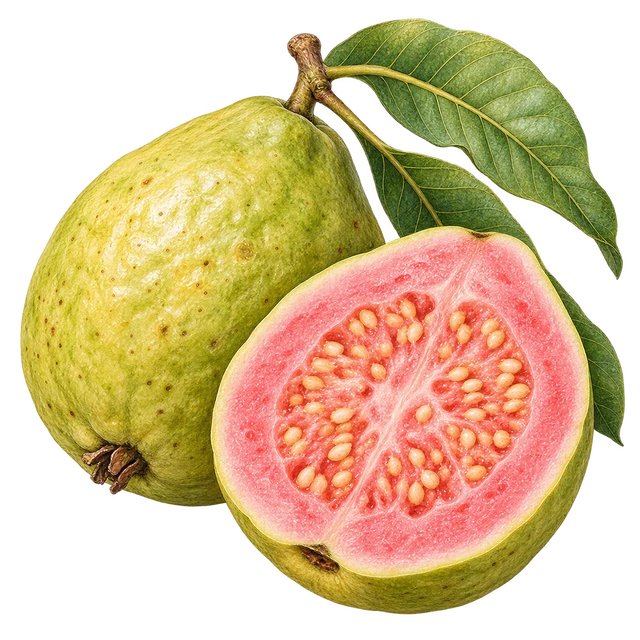
Guava has a tropical-American history and now grows widely across the tropics. Kew treats it as a cultigen from Peru while older flora accounts note uncertainty about its original wild range; a precise single origin should not be presented as settled.
Its food story extends through fresh-fruit markets, preserves and migration. In an interview with the Natural History Museums of Los Angeles County, Beatriz Porto describes guava-and-cheese pastries as part of her family’s Cuban-American experience.
A closer look at its history
An American fruit with many textures and destinations
Guava is native to the American tropics and became cultivated and naturalized widely beyond them. UF/IFAS records commercial growing in Puerto Rico, Hawaii and Florida, and uses ranging from fresh fruit to pastes and pastries. White-fleshed crunchy selections and soft ripe pink fruit reflect different eating traditions, not a single universal ripeness preference.
Additional history reviewed 2026-10-10
Traditional, historical and reported uses
- Fresh guava fruit
Food or household practiceWhy this label?
Describes how cultivars of the edible fruit are eaten.
UF/IFAS describes eating guava fresh and distinguishes cultivars commonly eaten firm from pink or red guavas usually allowed to soften. Ripeness preference is culinary and cultivar-dependent.
- Juices and frozen desserts
Food or household practiceWhy this label?
Describes fruit-processing and dessert uses, with composition boundaries.
NParks records fruit juice and sherbet; UF/IFAS also lists ice cream and popsicles. The fruit supplies flavor, while straining, dilution and added ingredients change the finished food.
- Jellies and fruit paste
Food or household practiceWhy this label?
Records culinary preservation using guava fruit.
NParks notes guava’s pectin and its use in jams, jellies and candies. A preserve is a culinary product, not a concentrated version of all the fresh fruit’s nutrients.
- Cuban-American guava-and-cheese pastries
Traditional accountWhy this label?
A first-person museum interview connects a named family’s food to Cuban-American experience; it is not an efficacy claim.
In a museum interview, Beatriz Porto recounts the family’s guava and guava-cheese pastries and the Los Angeles refugiado. The account links a particular bakery food to migration and cultural continuity; it is not a claim that one family invented every guava pastry.
- Reported Mexican guava-leaf use for diarrhea
Traditional accountWhy this label?
The claim is the authors’ account of Mexican popular leaf-remedy use, separate from their clinical trial results.
Lozoya and colleagues describe Mexican popular use of a guava-leaf water preparation for diarrhea and abdominal complaints. This records a traditional intended use of leaves, not proof that eating guava fruit treats diarrhea.
Featured uses are distinct documented practices, not a quota. Cultural and medicinal accounts preserve their named place and material; they do not establish clinical benefit.
Historical-use additions reviewed 2026-10-09
Story sources
- Kew POWO: Psidium guajava, accepted name, origin and flora accounts
- Natural History Museums of Los Angeles County: The Cuban Pastry that Built a Legacy in L.A., interview with Beatriz Porto
- UF/IFAS: Guava Growing in the Florida Home Landscape, including Table 4
- Singapore NParks: Psidium guajava, fruit uses
- Lozoya and colleagues (2002): Intestinal anti-spasmodic effect of a Psidium guajava leaf phytodrug
Growing notes
Psidium guajava only; excludes strawberry guava and pineapple guava.
- Suitability before planting
- Check local invasive-plant guidance first. UF/IFAS does not recommend planting guava in south Florida; central Florida plantings require escape prevention. This guide is not a blanket planting recommendation. [1]
- Site and water
- Where appropriate, use full sun and well-drained soil. Protect young trees from cold; supply water during establishment and fruit development without waterlogging. [1]
- Pollination and canopy
- Self-pollination is possible; insect cross-pollination can increase yield. Selective pruning keeps the tree reachable and improves light and airflow. [1]
- Harvest and pests
- Pink types are often picked as green turns yellow; crunchy white types may be picked full-sized but green. Bag developing fruit to reduce fruit-fly damage. Watch for anthracnose and root-knot problems. [1]
Growing sources and regional guidance
Growing notes reviewed 2026-10-10
Regional reading paths
These sourced notes describe cultivation, trade, food traditions or material history. A regional connection does not claim exclusive origin.
North America
Cultivated/traditional food: Caribbean, including Trinidad and Tobago.
Ripe fruit eaten fresh and processed.
South America
cultivated; Brazil
Fruit and guava paste.
Identity & detailed reference
Identity
The edible fruit of common guava, Psidium guajava, including white-, pink- and red-fleshed cultivars. Guava leaves, bark and medicinal extracts are different materials from the fruit serving.
Ingredient details, preparation and research
Also known as: Common guava; Guayaba; Goyave; Jambu batu; Jambu biji; Apple guava
Source plant or material
Psidium guajava L.
Plant family / material: Myrtaceae
Forms and route
Fresh fruit, pulp, juice, paste, jelly and desserts. Leaf decoctions and standardized leaf capsules are discussed only as separate traditional or research preparations.
Vitamins and minerals
UF/IFAS Table 4, citing the USDA legacy reference for raw guava, lists approximately 228 mg vitamin C, 5.4 g fiber and 417 mg potassium per 100 g (about 3.5 oz) of fruit. These are reference values for that raw-food form, not a guarantee for every cultivar, jelly, juice or pastry. No copper value is added.
Absorption and preparation
Vitamin C helps the body absorb nonheme iron in a meal. Heating and storage can reduce vitamin C; this nutritional role does not turn guava or leaf tea into treatment for anemia.
Practical preparation
Rinse fruit before cutting. Eat at the ripeness appropriate to the cultivar and preference; strain seeds from puree if desired. Refrigerate cut fruit. Use tested preservation guidance rather than improvising shelf-stable canning.
Combination context
A vitamin-C-containing fruit can accompany beans or other nonheme-iron foods; this supports ordinary nutrition and does not treat iron deficiency.
Combination notes
Guava can accompany ordinary foods, including cheese or a pastry filling, as a culinary choice. Those combinations add their own sugar, fat, sodium or allergens.
Traditional and reported uses
- Fresh fruit
- Juices and frozen desserts
- Jellies and fruit paste
- Cuban-American guava-and-cheese pastries
- Reported guava-leaf remedy history
Contraindications and cautions
- Fruit-food use does not establish safety or dosing for leaf tea, bark or concentrated extracts, including during pregnancy or breastfeeding.
- Do not use guava leaf preparations to replace rehydration or medical care for diarrhea. Seek care for significant dehydration, bloody stools, severe symptoms or persistent illness.
- Choose pasteurized or otherwise treated juice when foodborne-illness risk is a concern. Fruit drinks, paste and pastries may contain added sugar and do not share a raw-fruit nutrient panel.
Similar items and how they compare
- Guavaberry / rumberry
A related fruit with a similar English name.
Myrciaria floribunda is a separate species with much smaller fruit and its own traditions.
- Strawberry guava and pineapple guava
Other fruits also carry guava in their common names.
They are different plants; common-guava measurements and leaf trials do not automatically apply.
- Guava leaf decoction or capsules
These may come from Psidium guajava.
They use a different plant part and preparation; fruit nutrition does not establish their medicinal effect.
A small leaf trial does not test the fruit
A 2020 open-label randomized study enrolled 109 adults with uncomplicated acute diarrhea and tested standardized daily preparations from one Indian guava variety. It reported better stool outcomes for one group. The brief duration, lack of blinding and mid-study protocol change limit confidence; it does not establish a home recipe, long-term safety or efficacy of guava fruit.
Rehydration remains essential
The trial advised oral rehydration solution for participants with dehydration. Standard diarrhea care addresses fluid and electrolyte loss and the cause of illness; a plant remedy should not delay that care.
A raw-food reference has a narrow scope
The numerical panel is for 100 g raw fruit, from the legacy USDA table reproduced by UF/IFAS. It is not a comparison of white versus pink cultivars or a measurement of juice, jam or leaf tea.
Evidence limits
Food traditions, a reported leaf practice and limited preparation-specific human research are distinguished. This is not a comprehensive clinical review or medicinal dosing guide.
Entry sources
- Kew POWO: Psidium guajava, accepted name, origin and flora accounts
- Natural History Museums of Los Angeles County: The Cuban Pastry that Built a Legacy in L.A., interview with Beatriz Porto
- UF/IFAS: Guava Growing in the Florida Home Landscape, including Table 4
- Singapore NParks: Psidium guajava, fruit uses
- Lozoya and colleagues (2002): Intestinal anti-spasmodic effect of a Psidium guajava leaf phytodrug
- Birdi and colleagues (2020): Randomized open-label trial of guava leaf decoction in adults with acute diarrhoea
- NIH NIDDK: Treatment of Diarrhea
- NIH ODS: Vitamin C, food reference servings and absorption
- FDA: Selecting and Serving Produce Safely
- FDA: What You Need to Know About Juice Safety
- Kew POWO: Myrciaria floribunda, accepted name and native range
Reference entry 272 · Recorded content review: 2026-10-09 · Review scope and dates