


Key cautions
- Guavaberry is not common guava or camu-camu.
- Rum preparations contain alcohol.
- Leaf and bark remedies are separate from food.
What’s inside
Fruit sugars, organic acids and phenolic compounds have been measured in Brazilian accessions. Those analyses do not establish a standard Caribbean serving or a treatment benefit.
Uses in brief

- Fruit and preserves
- St. Martin Christmas guavaberry rum
- Guavaberry tarts
History, folklore and reported uses
History, folklore and traditional uses
Kew accepts Myrciaria floribunda and places its native range from southern Mexico through tropical America, including many Caribbean islands.
On St. Martin, guavaberry is part of seasonal hospitality. Les Fruits de Mer describes Christmas serenaders receiving guavaberry rum and food at households, with fruit tarts also central to the celebration.
Traditional, historical and reported uses
- Ripe fruit and preserves
Food or household practiceWhy this label?
Describes ripe fruit and processed fruit-food uses; it does not label chemical assays as human benefit.
A Brazilian germplasm study describes the fruit eaten fresh and made into juices, jellies and other fruit foods. These are culinary uses; the composition of a sweetened preserve is different from that of fresh pulp.
- St. Martin Christmas guavaberry rum
Traditional accountWhy this label?
A St. Martin heritage organization records a specific Christmas hospitality and serenading practice.
Les Fruits de Mer documents guavaberry rum served during Christmas house-to-house serenading. This is a specific island tradition of food, music and hospitality, not a medicinal claim.
- St. Martin guavaberry tarts
Traditional accountWhy this label?
A local cultural account records the named island’s holiday pastry tradition.
The same local heritage account identifies guavaberry tarts as a characteristic holiday food. Baking the fruit into a tart is a separate culinary preparation from the alcoholic drink.
Featured uses are distinct documented practices, not a quota. Cultural and medicinal accounts preserve their named place and material; they do not establish clinical benefit.
Historical-use additions reviewed 2026-10-09
Regional reading paths
These sourced notes describe cultivation, trade, food traditions or material history. A regional connection does not claim exclusive origin.
North America
Native in the Caribbean; St. Martin has a specifically documented Christmas guavaberry tradition.
Ripe fruit is used in tarts and preserves; guavaberry rum is a historical and cultural beverage reference.
Identity & detailed reference
Identity
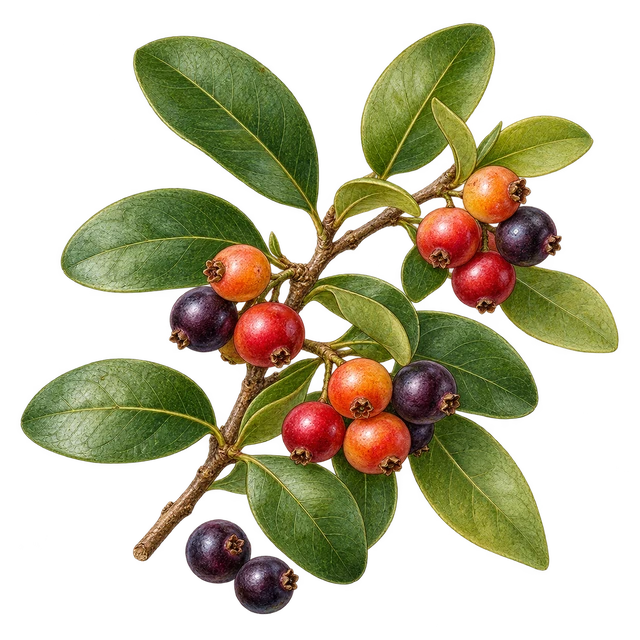
The small edible fruit of Myrciaria floribunda, known as guavaberry or rumberry in the Caribbean. It is a different species from common guava, Psidium guajava, and from camu-camu, Myrciaria dubia.
Ingredient details, preparation and research
Also known as: Rumberry; Rum berry; Guava berry; Myrciaria floribunda
Source plant or material
Myrciaria floribunda (H.West ex Willd.) O.Berg
Plant family / material: Myrtaceae
Forms and route
Ripe fruit pulp, fruit preserves and pastry filling; also fruit-flavored alcoholic drinks. Leaves and bark used in reported remedies are separate materials.
Vitamins and minerals
No verified standard-serving nutrient panel was located for this exact fruit. A laboratory study of Brazilian germplasm measured acidity, sugars and phenolics, but it is not a USDA serving table. Guava or camu-camu vitamin C values must not be borrowed for guavaberry; tarts, preserves and liqueurs also have recipe-dependent sugar and alcohol.
Absorption and preparation
Chemical detection and laboratory antioxidant assays do not show how much a person absorbs or whether eating the fruit improves a medical outcome.
Practical preparation
Wash food fruit under running water. Separate hard seeds when preparing pulp or filling. Use a tested recipe for any shelf-stable preserve; the card is not a canning or alcohol-production guide.
Combination context
No therapeutic herb pairing is established here.
Combination notes
Use in an ordinary fruit recipe according to taste. Added sugar, pastry and alcohol determine much of a finished dish’s composition.
Traditional and reported uses
- Fruit and preserves
- St. Martin Christmas guavaberry rum
- Guavaberry tarts
Contraindications and cautions
- Use correctly identified food fruit. A common name or decorative illustration is not a safe wild-plant identification guide.
- Guavaberry rum contains alcohol; fruit flavor does not make an alcoholic drink a health remedy. Choose a nonalcoholic preparation if avoiding alcohol.
- Food use does not establish safety or a dose for leaf, bark or concentrated medicinal preparations. Reliable clinical safety data for those forms were not established in this review.
Similar items and how they compare
- Guava, Psidium guajava
Both are edible fruits in the myrtle family.
Common guava is usually much larger and has its own nutrient and leaf-research literature.
- Camu-camu, Myrciaria dubia
The genus and some loose trade names overlap.
It is a different species; camu-camu nutrient and supplement claims do not describe guavaberry.
An accepted name, not a guava synonym
Kew lists Myrciaria floribunda as accepted; Eugenia floribunda is an older synonym. The common English name does not make this plant Psidium guajava.
Composition research is not a clinical trial
The Brazilian study analyzed fruit accessions and reported variation between them. Its chemical profiling and antioxidant work cannot establish disease prevention, an effective dose or a typical nutrient serving.
Leaf and bark history remains separate
The St. Martin publication also mentions Caribbean use of bark and leaves in plant medicine, without specifying a condition or standardized preparation. No disease-treatment use is inferred or featured from that nonspecific account.
Evidence limits
This bounded review supports a fruit-food card and specific St. Martin cultural uses. It does not establish a medicinal dose, clinical efficacy, comprehensive interaction list or standard nutrient serving.
Entry sources
- Kew POWO: Myrciaria floribunda, accepted name and native range
- Les Fruits de Mer: Trees for Me and My Island, guavaberry, pages 26–27
- Kew POWO: Myrciaria floribunda, flora descriptions
- García and colleagues (2021): Physicochemical characterization of Myrciaria floribunda accessions
- Kew POWO: Psidium guajava, accepted name, origin and flora accounts
- FDA: Selecting and Serving Produce Safely
Reference entry 271 · Recorded content review: 2026-10-09 · Review scope and dates