


Key cautions
- Verify the species; discard the hard stone.
- Refrigerate prepared fruit.
What’s inside
Organic acids contribute to its tartness. Food-chemistry studies examine acidity and ripening; extract research also measures phenolic compounds and antioxidant activity, which are not clinical benefits.
Uses in brief

- Caribbean sweet gooseberry stew
- Sour fruit and preserves
- Trinidad culinary heritage
History, folklore and reported uses
History, folklore and traditional uses
Kew currently places the native range in Pará, northern Brazil, and records introduction across Caribbean islands including Jamaica and Trinidad and Tobago. Names such as Otaheite and Malay gooseberry do not by themselves establish botanical origin.
The regional story is firmly culinary: Taymer Mason describes gooseberries bought in Guadeloupe, Barbadian preserves and her own spiced syrup preparation. Trinidadian cook Felix recalls family harvests and sour-cherry jam. These firsthand accounts document particular households and places, rather than a single recipe shared by every island.
Traditional, historical and reported uses
- Caribbean gooseberry stew in spiced syrup
Food or household practiceWhy this label?
This documents an identified culinary practice or food-processing preparation, not a treatment effect; preparation and safety limits remain attached.
Taymer Mason records stewing West Indian gooseberries with sugar and warm spices, including cinnamon, after a Guadeloupe market visit. The cooked fruit can turn reddish. This sweet stew or syrupy preserve reflects a Caribbean kitchen tradition; recipes vary by household.
- Trinidad sour-cherry jam
Food or household practiceWhy this label?
This documents an identified culinary practice or food-processing preparation, not a treatment effect; preparation and safety limits remain attached.
Simply Trini Cooking documents West India gooseberries cooked into a syrupy reddish-brown jam, including a bay-leaf version and family preferences for pepper. The author directs refrigerator storage; the account is not a tested canning process.
- Fresh tart fruit
Food or household practiceWhy this label?
This documents an identified culinary practice or food-processing preparation, not a treatment effect; preparation and safety limits remain attached.
NParks records the fruit eaten raw with sugar as well as cooked. The edible flesh is very sour; its sharpness is a flavor characteristic, not proof of detoxifying or medicinal action.
- Trinidad seasoned sour cherry
Food or household practiceWhy this label?
This documents an identified culinary practice or food-processing preparation, not a treatment effect; preparation and safety limits remain attached.
Felix records gooseberries seasoned with garlic, hot pepper, chadon beni and salt. This is an attributed savory food practice. The original page includes a sun-soaking method that this card does not endorse as a food-safety protocol; obtain validated preservation guidance before attempting storage.
Distinct documented food practices are featured without filling a quota. Place-specific accounts preserve culinary heritage; none is evidence of a cure.
Historical-use additions reviewed 2026-10-09
Story sources
- Kew POWO: Phyllanthus acidus, accepted name, synonyms and distribution
- Singapore NParks: Cicca acida (syn. Phyllanthus acidus)
- Taymer Mason: West Indian Gooseberry Syrup and Candy (2009)
- Felix, Simply Trini Cooking: Soaked Sour Cherry (Gooseberries) (2013)
- Felix, Simply Trini Cooking: Sour Cherry Jam, a Tasty Trini Favourite (2013)
- Mokhtar and Abd Aziz (2015): Physicochemical characteristics and organic acids during ripening of five tropical fruits
- Antioxidant, alpha-glucosidase and nitric oxide inhibitory activities of Phyllanthus acidus (2018)
- FDA: Selecting and Serving Produce Safely
Identity & detailed reference
Identity
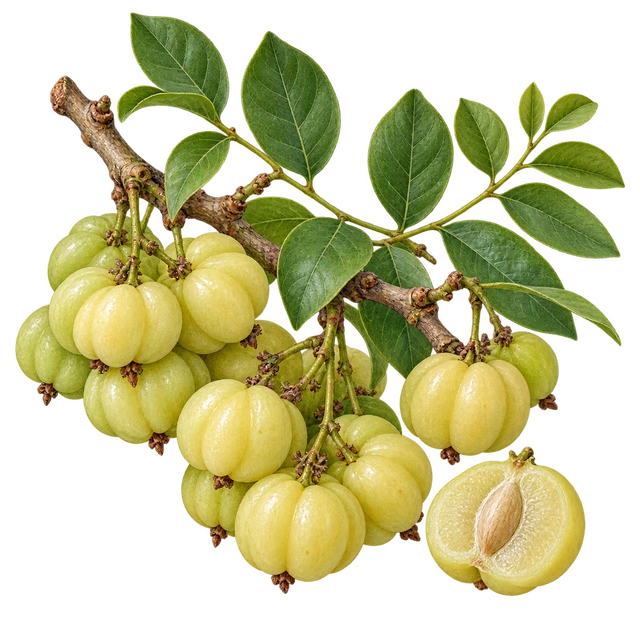
The small, round, distinctly ribbed or lobed, very sour tree fruit known as star or West Indian gooseberry. This card follows Phyllanthus acidus; Cicca acida is an alternative taxonomic treatment of the same plant. It does not cover amla, Ribes gooseberries or Cape gooseberry.
Ingredient details, preparation and research
Also known as: Star gooseberry; West Indian gooseberry; West India gooseberry; Otaheite gooseberry; Malay gooseberry; Chermai; Sour cherry (Trinidad); Phyllanthus acidus; Cicca acida; Averrhoa acida; Gooseberry stew
Source plant or material
Phyllanthus acidus (L.) Skeels; also treated as Cicca acida (L.) Merr.
Plant family / material: Phyllanthaceae
Forms and route
Fresh edible fruit flesh, sweet cooked gooseberry stew, jam or preserves, and regionally seasoned fruit. The hard central stone, roots, bark, leaves and medicinal extracts are outside this fruit-food scope.
Vitamins and minerals
No serving-specific vitamin, mineral or copper amount is assigned in this card. A sour taste does not measure vitamin C. Sweetened stew, drained fruit and syrup differ from raw fruit and from laboratory extracts.
Absorption and preparation
No special nutrient-absorption advantage is established for this food. Laboratory extract results are not measurements of absorption from a fruit serving.
Practical preparation
Rinse sound fruit under running water. Keep the hard stone out of purees and servings. For the Caribbean sweet preparation, documented cooks simmer the fruit in spiced sugar syrup; this is culinary context, not a standardized preservation recipe. Refrigerate the finished preparation.
Combination context
No medicinal combination or required nutrient-absorption pairing is established.
Combination notes
Combine with ordinary foods to taste. Sweeteners, salt, pastry and other ingredients change the finished food; no medicinal pairing is implied.
Traditional and reported uses
- Caribbean sweet gooseberry stew
- Sour fruit and preserves
- Trinidad culinary heritage
Contraindications and cautions
- Confirm the species before eating: the common name gooseberry is shared by unrelated fruits. This description is not a foraging identification guide.
- Do not chew or grind the hard central stone. Remove it before pureeing, or keep it out of the portion eaten.
- Wash fruit before preparing and refrigerate prepared fruit. Traditional recipe accounts are not validated shelf-stable canning or fermentation instructions.
- Use fruit as food, not as a diabetes, asthma or other disease treatment. Root, bark, leaf and concentrated extract preparations require separate safety evaluation.
- Stews and preserves may contain substantial added sugar; salty seasoned preparations have their own sodium content.
Similar items and how they compare
- Amla / Indian gooseberry
Another sour fruit sometimes called gooseberry.
Phyllanthus emblica is a different species; its supplement research and nutrient claims do not transfer here.
- Ribes gooseberry / Cape gooseberry
Share an English common name.
Ribes fruits and Physalis peruviana are unrelated culinary materials, not this Caribbean tree fruit.
One fruit, two botanical name treatments
Kew accepts Phyllanthus acidus and lists Cicca acida and Averrhoa acida as synonyms. NParks instead heads its record Cicca acida, citing a revised classification. These records describe the same ribbed sour fruit, not two culinary species.
Acidity changes are food chemistry
A Malaysian study examined Phyllanthus acidus among five fruits at different maturity stages. Such measurements concern the sampled fruit and ripeness; they do not establish a universal nutrient serving or the composition of a Caribbean sugar-syrup preparation.
Extract assays are not treatment evidence
A 2018 study tested leaf and fruit extracts made with different water/ethanol mixtures for antioxidant, alpha-glucosidase and nitric-oxide-related activity. These laboratory assays do not show that eating the fruit treats diabetes or inflammation, and do not establish a medicinal dose.
Evidence limits
This is a bounded botanical and food-history review, not an exhaustive clinical review. Origin is attributed to the current named botanical authority. Firsthand recipes establish practice, not shelf-stability or therapeutic efficacy. No medicinal regimen is proposed.
Entry sources
- Kew POWO: Phyllanthus acidus, accepted name, synonyms and distribution
- Singapore NParks: Cicca acida (syn. Phyllanthus acidus)
- Taymer Mason: West Indian Gooseberry Syrup and Candy (2009)
- Felix, Simply Trini Cooking: Soaked Sour Cherry (Gooseberries) (2013)
- Felix, Simply Trini Cooking: Sour Cherry Jam, a Tasty Trini Favourite (2013)
- Mokhtar and Abd Aziz (2015): Physicochemical characteristics and organic acids during ripening of five tropical fruits
- Antioxidant, alpha-glucosidase and nitric oxide inhibitory activities of Phyllanthus acidus (2018)
- FDA: Selecting and Serving Produce Safely
Reference entry 260 · Recorded content review: 2026-10-09 · Review scope and dates