


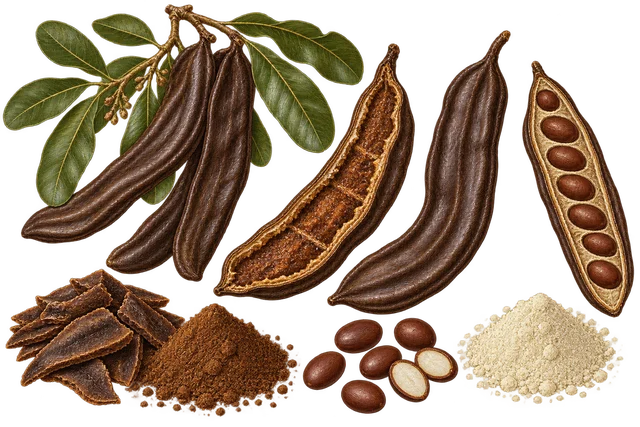
Key cautions
- Do not chew or swallow the very hard seeds in whole pods. Use properly processed food-grade powder or remove seeds from pod foods.
- Carob syrup and confectionery are concentrated sweet foods; powder values do not describe syrup, sweetened chips or drinks.
What’s inside
Pod pulp contains sugars, substantial fiber and tannins/polyphenols with some calcium and potassium. Plain carob powder has little fat. Seed endosperm supplies galactomannan gum, a different carbohydrate material from the sugar-rich pulp.
Uses in brief

- Use food-grade carob powder for a naturally sweet, roasted flavor in porridge, baking or a drink.
- Use carob syrup sparingly as a sweetener; commercially processed locust bean gum serves a separate thickening and stabilizing role.
In the King James Bible
Carob (KJV husks candidate) in the KJV
Probable botanical identification
The KJV says husks in Luke 15:16. These are generally identified as carob pods, Ceratonia siliqua, making this a conventional/probable botanical identification. The verse describes pig fodder and the prodigal son’s hunger, not a health recommendation. The later nickname St John’s bread is not evidence that John the Baptist’s locusts were carob pods.
And he would fain have filled his belly with the husks that the swine did eat: and no man gave unto him.
Luke 15:16 (KJV)
Scripture and identification sources
Words & their stories
WORDS & THEIR STORIES
The name behind the KJV
Koine Greek · Luke 15:16 (KJV)
κερατίωνkeratíōn
The pods translated “husks,” eaten by the pigs.
Dictionary form: κεράτιον · kerátion
A genitive plural after the preposition in the passage. Checked in Scrivener’s 1894 Textus Receptus, a later reconstruction of the KJV’s Greek textual basis.
What the language reveals
A pod rather than cereal chaff
The lexicon identifies kerátion as the carob pod. KJV “husks” should not automatically be pictured as the outer covering removed from grain.
A small-horn name
The noun is a diminutive of kéras, “horn,” a naming connection to the pod’s shape.
Carob pods are the conventional identification of these “husks.” The narrative describes hunger and pig fodder, not a health recommendation or evidence that John the Baptist ate carob instead of locusts.
Language and identification bibliography
History, folklore and reported uses
History, folklore and traditional uses
Carob belongs to a Mediterranean landscape of long-lived trees, dry summers and several harvests from the same farm. World Agroforestry describes it among mixed systems with olives, figs and other crops. Its leathery pods hold a sweet pulp around remarkably hard seeds. The conventional reading of Luke’s husks as these pods connects the plant with both human hunger and animal feeding, while leaving the KJV wording intact.
In Cyprus, the pod became a rural livelihood as well as food. The national heritage inventory records traditional cultivation and processing, and the Cyprus Food Museum preserves accounts of village mills and families making carob syrup and pastellin. The sweet was sold at fairs and demanded practiced handling rather than a simple spoonful of syrup. Such records give carob a social history of skilled work, seasonal production and trade.
Carob also shows why the part of a plant matters. Farmers used pods as fodder; wood supplied fuel and useful objects. The seed’s endosperm yields locust bean gum, valued by food makers for texture, while pulp belongs to a separate history of sweeteners and digestive preparations. A jar of syrup, a bag of flour and a tiny quantity of gum can therefore share a tree without sharing a nutritional profile.
Traditional, historical and reported uses
- Pod foods, syrup and village confectionery
Food or household practiceWhy this label?
Pod processing into syrup and confectionery.
Cypriot teratsomelo and pastellin turn sweet pods into syrup and a worked confection, documented as food craft and rural trade.
- Livestock fodder
Food or household practiceWhy this label?
Pods used as livestock fodder.
World Agroforestry records carob pods as feed for several livestock types. Luke’s husks are conventionally understood in this fodder context.
- Seed gum for texture
Food or household practiceWhy this label?
Processed seed gum used for food texture, without a nutrient-data claim.
Processed seed endosperm supplies locust bean gum for thickening and stabilizing foods; this is a distinct functional ingredient, not pulp powder.
- Digestive household tradition
Mixed/contextual sourcesWhy this label?
Combines household digestive tradition with a defined hospital-study preparation.
Carob pulp has been used in digestive preparations. The later tannin-rich hospital study used a defined powder alongside rehydration, not ordinary syrup as sole treatment.
- Wood, fuel and household objects
Food or household practiceWhy this label?
Wood used for fuel, charcoal and utensils.
Carob wood has supplied firewood, charcoal and utensils, uses of the tree’s structure rather than variations on eating the pod.
Five distinct documented uses are presented with the plant part or product specified; historical practices are not preparation instructions.
Story sources
- World Agroforestry: Ceratonia siliqua, products and cultivation
- Cyprus National Commission for UNESCO: Cypriot Carob, Traditional Cultivation, Harvesting and Processing Techniques
- Cyprus Food Museum: Pastellin, historical sources and recorded village practice
- Loeb et al.: Tannin-rich carob pod for acute-onset diarrhea
Regional reading paths
These sourced notes describe cultivation, trade, food traditions or material history. A regional connection does not claim exclusive origin.
Africa
Cultivated: Mediterranean North Africa, including Morocco.
Sweet pod pulp used in flour and other foods.
Identity & detailed reference
Identity
Carob is a Mediterranean legume-family tree with sweet brown pods. The usual culinary powder is milled pod pulp after removal of the hard seeds. Locust bean gum comes from seed endosperm and is a different ingredient. The KJV husks in Luke 15:16 are conventionally identified as carob pods.
Ingredient details, preparation and research
Also known as: Carob; Locust bean; St John’s bread, later common name; KJV husks, conventional identification
Source plant or material
Ceratonia siliqua L.; ripe pod pulp for food powder or syrup, separate seed endosperm for commercial locust bean gum.
Plant family / material: Fabaceae, the legume family; this is not a tree nut despite its placement beside biblical nuts.
Forms and route
Food-grade carob powder/flour, pod pieces, syrup or molasses, confectionery and beverages. Locust bean gum (E410) is a purified thickening ingredient from seed endosperm; carob chips may contain added fat and sugar.
Food sources
The reference food is plain carob flour made from the pod. Commercial labels should specify whether the product is pulp powder, seed gum or a sweetened mixture. The name locust bean does not mean the edible insect and does not identify the plant in every food called algarroba.
Vitamins and minerals
For 12 g plain carob flour, 2 tablespoons using USDA’s 6 g tablespoon: about 27 kcal, 10.7 g carbohydrate, 5.9 g sugars, 4.8 g fiber, 0.55 g protein, 0.08 g fat, 42 mg calcium, 99 mg potassium, 6.5 mg magnesium and 0.35 mg iron. Calculated from USDA SR28 food 16055. These values describe pod flour, not syrup, carob confectionery or purified locust bean gum.
Absorption and preparation
Carob powder’s sugars and fiber travel together in a food matrix; syrup usually removes much of the insoluble material, while purified seed gum is a separate fiber ingredient. Its minerals are measured content, not a guarantee that all are absorbed. No special timing, oil pairing or blanket medicine-spacing rule is established for an ordinary culinary serving.
Practical preparation
Whisk food-grade powder into liquid or combine with other dry ingredients for even mixing. Carob is sweeter and compositionally different from cocoa, so adjust a recipe rather than assuming every substitution is identical. Keep powder dry and follow a syrup’s storage label. No home seed-gum extraction is suggested.
Combination context
Carob can flavor oats, yogurt or baked foods. If used in place of cocoa, consider its sweetness and different fat content. Sesame paste and carob syrup are a culinary combination, not an established nutrient-absorption treatment.
Traditional and reported uses
- Use food-grade carob powder for a naturally sweet, roasted flavor in porridge, baking or a drink.
- Use carob syrup sparingly as a sweetener; commercially processed locust bean gum serves a separate thickening and stabilizing role.
- Traditional records include livestock fodder, rural syrup-making, timber/fuel and digestive preparations. Material and processing determine the use.
Contraindications and cautions
- Do not chew or swallow the very hard seeds in whole pods. Use properly processed food-grade powder or remove seeds from pod foods.
- Carob syrup and confectionery are concentrated sweet foods; powder values do not describe syrup, sweetened chips or drinks.
- Introduce larger fiber portions gradually if they cause bloating or altered stools. An ordinary baking amount is different from a concentrated fiber product.
- Do not use a home carob preparation instead of rehydration or medical care for diarrhea, particularly in a child. Historic and hospital uses do not supply a household infant dose.
- Carob can still cause individual allergy even though it is a legume rather than a tree nut. Check ingredients and shared-equipment statements on substitutes and confectionery.
Preparation-specific cautions
- Use properly processed food material and avoid biting or swallowing the very hard seeds.
- Check sugar content; pulp powder and syrup have different food composition.
- Do not replace rehydration or medical assessment with a home carob preparation. The cited infant trial was inpatient and adjunctive.
- Check all ingredients and allergen information when using carob substitutes.
Similar items and how they compare
- Cocoa powder
Both can give a dark, roasted flavor to foods.
Carob is a sweet legume-pod ingredient with a different fat, sugar and stimulant profile; it is not cocoa.
- Locust bean gum
Comes from the same carob tree.
Purified seed-endosperm thickener, not the sweet pod-pulp flour and not an interchangeable nutrient serving.
- Honey
Both sweeten foods; carob syrup is sometimes called carob honey.
Carob syrup is plant-derived, while bee honey is made by bees; the biblical evidence must be read passage by passage.
Husks as a botanical identification
Luke’s KJV wording remains husks. Carob pods are the conventional identification of this pig fodder in the prodigal-son story. The passage describes hunger and deprivation; it neither names a medicinal preparation nor calls John the Baptist’s locusts carob.
Three ingredients from one pod-bearing tree
Pod flour, concentrated syrup and seed-endosperm gum serve different purposes. Flour retains pulp solids; syrup provides extracted sweet material; gum thickens or stabilizes formulated foods. USDA’s flour serving must not be reused for the other two.
A documented digestive preparation
A small 1989 randomized inpatient study gave a specified tannin-rich pod powder alongside oral rehydration to infants with acute diarrhea, with faster improvement than placebo. This was a controlled hospital preparation and adjunctive treatment; it is not a recipe or dose for treating a child at home.
A living rural food tradition
Cyprus’s heritage inventory records carob cultivation, harvest and processing, including teratsomelo syrup and pastelli. Museum accounts describe the specialist work and village trade behind these foods. This is stronger historical grounding than treating all carob products as simply a modern chocolate substitute.
Parts and materials used
Sweet pod pulp; commercially processed seed endosperm for gum. Whole hard seeds and wood are not the food-powder portion.
Food forms and ingredient distinctions
The reference food is plain carob flour made from the pod. Commercial labels should specify whether the product is pulp powder, seed gum or a sweetened mixture. The name locust bean does not mean the edible insect and does not identify the plant in every food called algarroba.
Practical preparation
Whisk food-grade powder into liquid or combine with other dry ingredients for even mixing. Carob is sweeter and compositionally different from cocoa, so adjust a recipe rather than assuming every substitution is identical. Keep powder dry and follow a syrup’s storage label. No home seed-gum extraction is suggested.
Meal ideas and combinations
Carob can flavor oats, yogurt or baked foods. If used in place of cocoa, consider its sweetness and different fat content. Sesame paste and carob syrup are a culinary combination, not an established nutrient-absorption treatment.
Food reference portions
- Carob flour
2 tablespoons (6 g each) (12 g): about 26.64 kcal Energy. Calculated from the specified edible-portion reference; shells, oil and other forms excluded. Data: USDA SR28.
- Carob flour
2 tablespoons (6 g each) (12 g): about 0.554 g Protein. Calculated from the specified edible-portion reference; shells, oil and other forms excluded. Data: USDA SR28.
- Carob flour
2 tablespoons (6 g each) (12 g): about 0.078 g Total fat. Calculated from the specified edible-portion reference; shells, oil and other forms excluded. Data: USDA SR28.
Food composition reference
Carob flour · 2 tablespoons (6 g each) (12 g). Approximate values, rounded to about three significant digits.
| Nutrient | Per 100 g | Per stated serving |
|---|---|---|
| Energy | 222 kcal | 26.6 kcal |
| Protein | 4.62 g | 0.554 g |
| Total fat | 0.65 g | 0.078 g |
| Carbohydrate | 88.9 g | 10.7 g |
| Fiber | 39.8 g | 4.78 g |
| Sugars | 49.1 g | 5.89 g |
| Calcium | 348 mg | 41.8 mg |
| Magnesium | 54 mg | 6.48 mg |
| Potassium | 827 mg | 99.2 mg |
| Iron | 2.94 mg | 0.353 mg |
USDA SR28 reference data, currently accessible; not newly collected 2026 measurements; USDA NDB 16055
per-100-g value × edible serving grams / 100; displayed prose rounded
Evidence limits
- Carob is the conventional/probable identification of KJV husks, not an explicit English plant name in the verse.
- Pod powder, syrup, tannin-enriched preparations and seed gum cannot share one composition or dose.
- The later common name St John’s bread does not establish that John the Baptist ate carob rather than locust insects.
Entry sources
- World Agroforestry: Ceratonia siliqua, products and cultivation
- Lytton John Musselman, Old Dominion University: Carob
- USDA SR28: Carob flour, food 16055
- Cyprus National Commission for UNESCO: Cypriot Carob, Traditional Cultivation, Harvesting and Processing Techniques
- Cyprus Food Museum: Pastellin, historical sources and recorded village practice
- Laaraj et al.: Carob Seed Constituents, composition and applications
- Loeb et al.: Tannin-rich carob pod for acute-onset diarrhea
- FDA: Food Allergies, What You Need to Know
- Luke 15:16 (KJV)
Reference entry 158 · Recorded content review: 2026-10-06 · Review scope and dates