


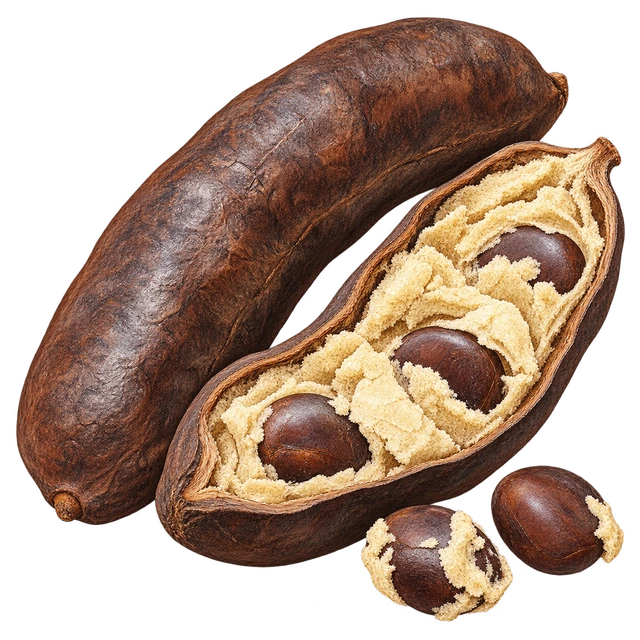
Key cautions
- Eat only the separated pulp.
- Hard seeds and shell fragments must be removed.
- Common names do not establish species identity.
What’s inside
Dry pulp contains carbohydrate and fiber, with minerals and some protein reported in studies. Composition varies by material and source; crude-fiber measurements are not automatically equivalent to modern dietary-fiber values.
Uses in brief

- Sweet pod pulp
- Pulp drinks and baked foods
- Seed-craft and copal heritage
History, folklore and reported uses
History, folklore and traditional uses
Hymenaea courbaril is a tropical American tree recorded across the Caribbean as well as the mainland. Its regional names follow several languages: stinking toe in the English-speaking Caribbean, guapinol or copinol in Central America, and jatobá in Brazil.
The dry pulp, rather than a juicy fruit flesh, is central to its food character. Accounts from Jamaica, El Salvador and Bolivia describe that edible material, while craftspeople value entirely different parts of the same tree.
Traditional, historical and reported uses
- Sweet dry pulp as a snack
Food or household practiceWhy this label?
This records an identified food preparation or material practice, without claiming a medical outcome.
The pulp inside a ripe pod is eaten after the seeds and shell are separated. Jamaican accounts emphasize its sweet, mealy character despite the pungent smell.
- Pulp-based refreshments
Food or household practiceWhy this label?
This records an identified food preparation or material practice, without claiming a medical outcome.
The El Salvador tree account records a sweet drink made from the pulp. Bolivian researchers also prepared a pulp-and-water refreshment, documenting this as a food use rather than a treatment for illness.
- Pulp flour in baking
Food or household practiceWhy this label?
This records an identified food preparation or material practice, without claiming a medical outcome.
A Bolivian food study prepared cookies using Hymenaea courbaril pulp flour with wheat flour. It is a documented food-development example, not evidence that the cookies prevent or treat disease.
- Seed jewelry and miniature paintings
Food or household practiceWhy this label?
This records an identified food preparation or material practice, without claiming a medical outcome.
Researchers working in El Salvador describe artisans turning the hard seeds into ornaments and tiny painted pieces. This is a craft use of the seeds, separate from the edible pulp.
- Copal for varnish and incense
Food or household practiceWhy this label?
This records an identified food preparation or material practice, without claiming a medical outcome.
Trunk and root resin has been used as copal for varnishes and incense. This historical material use does not make resin a food or a safe home remedy.
- Durable wood for everyday objects
Food or household practiceWhy this label?
This records an identified food preparation or material practice, without claiming a medical outcome.
The tree account records El Salvador uses for oxcart wheels, weaving equipment and construction, alongside furniture and flooring elsewhere. These woodworking uses help explain the tree’s broader local importance.
Distinct documented practices are featured without filling a quota. Food, material use and traditional remedy accounts retain separate evidence labels; none is a cure claim.
Historical-use additions reviewed 2026-10-09
Story sources
- USDA GRIN: Hymenaea courbaril L.
- USDA Forest Service, Francis (1990): Hymenaea courbaril, Algarrobo, locust
- Embrapa and collaborators: Hymenaea courbaril, fruit and seed morphology
- Navarrete-Tindall and Orellana Núñez: Hymenaea courbaril, the flour tree
- Revista Boliviana de Química (2011): Estudio del fruto comestible de la especie vegetal Hymenaea courbaril L.
- Jamaica Information Service: Jamaican food and fruit traditions
- Jamaica Forestry Department: Food and fruit tree inventory
- FDA: Selecting and Serving Produce Safely
Regional reading paths
These sourced notes describe cultivation, trade, food traditions or material history. A regional connection does not claim exclusive origin.
North America
Native across tropical America, including the Greater and Lesser Antilles; documented in Jamaican fruit traditions.
The ripe pod contains sweet, dry, flour-like edible pulp; bark, resin, hard seeds and shell are different materials.
South America
Native to tropical South America; Brazilian Amazon research documents fruit material collected in Moju, Pará.
Ripe pods supply dry, sweet, farinaceous pulp; retain the food card’s separation of pulp from seeds, shell, bark and resin.
Identity & detailed reference
Identity
The dry, sweet, flour-like pulp inside ripe Hymenaea courbaril pods. The hard seeds, woody pod shell, bark and resin are separate materials. “Locust,” “algarrobo” and “jatobá” are regional names that can also refer to other trees.
Ingredient details, preparation and research
Also known as: stinking toe; Stinktoe; Tinking Toe; West Indian locust; Courbaril; Guapinol; Copinol; Jatobá; Jatoba; Algarrobo (regional name); Paquio
Source plant or material
Hymenaea courbaril L.
Plant family / material: Fabaceae
Forms and route
Pulp removed from the woody pod and separated from seeds; food-grade pulp flour used in drinks or baking. Seed flour, resin and bark extracts are not covered as edible forms.
Vitamins and minerals
Research describes a carbohydrate- and fiber-containing dry pulp. Published values differ by location, maturity, drying and analytical method. No general copper serving, “high in” threshold or mineral dose is assigned; seed, shell and sap analyses are not relabeled as pulp nutrition.
Absorption and preparation
No distinctive absorption advantage is established for this pulp. A mineral measurement does not show how much a person absorbs, and drying changes the weight basis.
Practical preparation
Obtain verified food-grade ripe pods or separated pulp. Open the shell carefully, remove the hard seeds and shell pieces, and use the clean dry pulp. Use a food recipe for drinks or baking; never mill the whole pod.
Combination context
No medicinal combination or required nutrient-absorption pairing is established for this food.
Combination notes
The naturally floury pulp can be mixed into ordinary food preparations. Wheat, egg, milk, sugar and other recipe additions retain their own nutritional and allergy implications.
Traditional and reported uses
- Sweet pod pulp
- Pulp drinks and baked foods
- Seed-craft and copal heritage
Contraindications and cautions
- Confirm Hymenaea courbaril identity through a reliable food supplier. A common name alone is not an edibility test.
- Separate edible pulp from the hard seeds and every shell fragment. Do not grind whole pods or substitute seed powder.
- Do not eat bark or copal resin, or use their traditional remedies on the basis of this food card. Food and material uses involve different parts.
- Use sound, food-grade pods or pulp and discard moldy, damp-spoiled or insect-damaged material. A species’ naturally strong odor cannot by itself establish freshness.
- Prepared drinks and baked dishes need ordinary food-safe handling. No storage life or medicinal dose is established here.
Similar items and how they compare
- Jatobá-do-cerrado
A similar name and floury fruit are used for other Hymenaea species.
Hymenaea stigonocarpa is distinct; its composition or studies are not automatically Hymenaea courbaril data.
- Carob / other locust trees
Algarrobo and locust are shared regional names.
They can name unrelated or different trees, with different edible parts and safety.
Keep the species in the nutrition claim
The name jatobá is used for several Hymenaea species. Only explicitly identified H. courbaril material is used for this card; studies of H. stigonocarpa are not silently pooled with it.
Food analysis is not a treatment trial
The Bolivian study measured pulp and tested foods prepared from it. Its analyses do not establish clinical benefits. Dry-matter values and unusually large mineral figures are not converted here into a serving recommendation.
Evidence limits
The food literature is smaller than for common supermarket fruit and often uses dried-material analyses or regional samples. A validated household seed-processing method, medicinal dose and universal pulp nutrient profile were not established.
Entry sources
- USDA GRIN: Hymenaea courbaril L.
- USDA Forest Service, Francis (1990): Hymenaea courbaril, Algarrobo, locust
- Embrapa and collaborators: Hymenaea courbaril, fruit and seed morphology
- Navarrete-Tindall and Orellana Núñez: Hymenaea courbaril, the flour tree
- Revista Boliviana de Química (2011): Estudio del fruto comestible de la especie vegetal Hymenaea courbaril L.
- Jamaica Information Service: Jamaican food and fruit traditions
- Jamaica Forestry Department: Food and fruit tree inventory
- FDA: Selecting and Serving Produce Safely
Reference entry 256 · Recorded content review: 2026-10-09 · Review scope and dates