


Key cautions
- Onion fructans can trigger symptoms in some people with irritable bowel syndrome. Personal tolerance matters; removing onion pieces from a soup does not remove fructans already dissolved in it.
- Wash before preparing, remove the dry outer skin and refrigerate cut onion in a covered container.
- For pickling, follow a tested recipe and its storage directions. Do not assume that adding vinegar makes a homemade jar shelf-stable.
What’s inside
Water, carbohydrate and fiber, with small amounts of vitamins and minerals. Red onions contain anthocyanin pigments and flavonols such as quercetin; concentrations vary among samples and cultivars.
Uses in brief

- Fresh salads, sandwiches and salsa
- Grilled vegetable dishes
- Pickled onion condiment
- Tropea storage-onion braids
History, folklore and reported uses
History, folklore and traditional uses
A red onion can tell a local story as well as adding color to a plate. In Calabria, the Tropea onion developed from garden production into a substantial regional crop. The European product specification cites travelers who described red onions there between 1700 and 1800, and a 1901 account of elongated red Calabrian bulbs.
That record also preserves a practical food tradition: fresh onions are sold in bunches, while dried storage onions may be braided with their tops left attached. Tropea is a geographically defined product with particular local types, not a name for every purple onion. Elsewhere, red onions appear in fresh salads and salsa, on the grill and in pickled condiments.
Traditional, historical and reported uses
- Fresh salads, sandwiches and salsa
Food or household practiceWhy this label?
The claim describes documented culinary preparation, with preservation safeguards where relevant; it does not assert clinical efficacy.
Thin slices or chopped red onion give salads, sandwiches and salsa a crisp texture, onion flavor and purple accents. These are everyday food uses of the peeled bulb.
- Grilled vegetable dishes
Food or household practiceWhy this label?
The claim describes documented culinary preparation, with preservation safeguards where relevant; it does not assert clinical efficacy.
Red-onion wedges can be grilled, including on vegetable or mixed kebabs. Cooking softens the bulb; some purple color can spread into the other ingredients.
- Pickled onion condiment
Food or household practiceWhy this label?
The claim describes documented culinary preparation, with preservation safeguards where relevant; it does not assert clinical efficacy.
Red onion is also used as a pickled condiment. Safe preservation depends on the recipe: use a tested method for the particular product and follow its acid proportions, processing and storage instructions.
- Tropea storage-onion braids
Food or household practiceWhy this label?
The specification records a traditional food-storage and presentation practice for a named regional onion; it is not a health-outcome claim.
In Calabria, dried storage onions of the named Tropea product are traditionally assembled into braids with their tops intact. The published specification records this local handling and presentation practice.
Uses follow the reviewed food and cultural sources, without a fixed quota. Tropea history is attributed to that regional crop; no ancient or biblical onion reference is assigned a modern purple cultivar.
Historical-use additions reviewed 2026-10-09
Identity & detailed reference
Identity
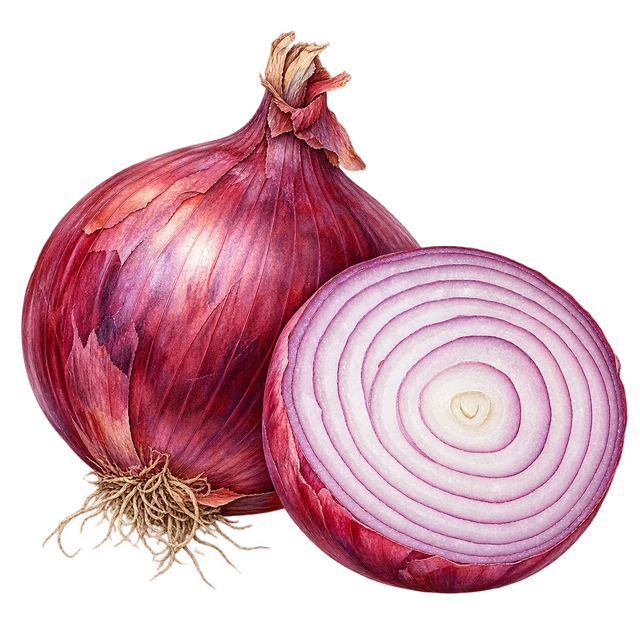
Red or purple-skinned cultivars of the cultivated bulb onion, Allium cepa. Their fleshy layers are white with purple-red coloring. This color group includes many cultivars; it is not a separate species or a synonym for every shallot.
Ingredient details, preparation and research
Also known as: Purple onion; Purple onions; Red onion; Red onions; Red bulb onion; Purple bulb onion
Source plant or material
Allium cepa L.; red/purple bulb cultivars
Plant family / material: Amaryllidaceae (amaryllis family)
Forms and route
Fresh peeled bulb eaten raw; grilled or otherwise cooked bulb; pickled onion prepared with a suitable recipe. Dried onion powders and concentrated extracts are different products.
Food sources
Peeled fresh bulb in salads, sandwiches and salsa; cooked or grilled onion; appropriately prepared pickled onion.
Vitamins and minerals
Red onion contributes fiber and modest amounts of nutrients as part of an ordinary meal. General onion references include vitamin C and potassium, but a generic onion serving is not presented here as a measured purple-cultivar profile. Pigment or quercetin content varies; purple color does not establish a higher copper content.
Absorption and preparation
Use as a vegetable or seasoning in a varied meal. This card assigns no special food pairing, extract dose or absorption-enhancing regimen to its pigments or quercetin.
Practical preparation
Rinse, peel away the dry skin and slice or chop for the dish. Refrigerate cut portions covered. Follow the complete tested method for any pickled or canned product.
Combination context
No special herbal pairing is required.
Combination notes
Combine with other ingredients for flavor and texture; a culinary pairing is not a therapeutic prescription.
Traditional and reported uses
- Fresh salads, sandwiches and salsa
- Grilled vegetable dishes
- Pickled onion condiment
- Tropea storage-onion braids
Contraindications and cautions
- Onion fructans can trigger symptoms in some people with irritable bowel syndrome. Personal tolerance matters; removing onion pieces from a soup does not remove fructans already dissolved in it.
- Wash before preparing, remove the dry outer skin and refrigerate cut onion in a covered container.
- For pickling, follow a tested recipe and its storage directions. Do not assume that adding vinegar makes a homemade jar shelf-stable.
Similar items and how they compare
- Onion
The same cultivated species, Allium cepa, covered more broadly.
This card focuses on red/purple bulbs and their food uses. General onion history and nutrient figures should not be presented as evidence for a particular red cultivar.
- Leek
Another culinary allium used for savory flavor.
Leeks are a different cultivated allium with long leaf sheaths rather than this round, layered bulb.
A color group within the cultivated onion
Kew accepts Allium cepa in Amaryllidaceae. Red onions have purple skin and purple-lined fleshy layers; their flavor and shape vary. A source that names only onion does not establish which modern color or cultivar was used.
Color and composition
USDA’s flavonoid database lists raw red onion separately from generic raw onion and reports anthocyanidins and quercetin across multiple samples. These composition measurements describe compounds in food. They do not establish a treatment benefit from eating the bulb or taking an extract.
Nutrient values belong to the food form
A few raw slices, a cooked onion dish and a sweetened or salted pickle supply different amounts. The University of Minnesota’s general onion reference is useful context, but this card does not copy its serving figures into a red-cultivar nutrient table.
Fructans and individual tolerance
Monash explains that onion fructans dissolve in water. Taking onion pieces out of soup or stock therefore does not make the liquid free of those carbohydrates. People managing IBS may need a serving or ingredient adjustment based on their own tolerance.
Preparation, storage and pickling
Rinse the onion, remove its papery outer layer and use clean cutting tools. Keep intact dry bulbs cool, dark and ventilated; refrigerate cut pieces covered. For preserved onions, use a tested recipe rather than improvising acid levels or a canning process.
Evidence limits
This food card covers cultivated red/purple Allium cepa bulbs. Its regional heritage example is Tropea-specific. No particular cultivar’s copper amount, medicinal efficacy or biblical identification is inferred from color or from general onion history.
Entry sources
- Kew Plants of the World Online: Allium cepa L.
- University of Illinois Extension: The ultimate onion guide
- University of Maine Cooperative Extension: 7 Types of Onions and the Best Ways to Use Them
- University of Minnesota Extension, Real Life Good Food: Onions
- USDA Agricultural Research Service: Database for the Flavonoid Content of Selected Foods, release 3.1, raw red onions (NDB 99055), printed page 70
- European Commission: Cipolla Rossa di Tropea Calabria PGI, product specification and historical context, Regulation 264/2013, Annex II
- Monash University FODMAP Team: Cooking with onion and garlic, myths and facts
- Oregon State University Extension: Pickling vegetables, safety checklist
Reference entry 252 · Recorded content review: 2026-10-09 · Review scope and dates