


Key cautions
- Onion fructans can trigger bloating, pain or other symptoms in people with IBS/FODMAP sensitivity; response is individual and portion-dependent.
- Avoid onion if you have a diagnosed allergy. Raw onion juice can irritate skin, eyes and mucous membranes.
What’s inside
Water, carbohydrates, fructans and fiber; sulfur-containing flavor precursors and their breakdown products; flavonoids including quercetin glycosides. Red onions also contain anthocyanin pigments. Composition varies by cultivar, layer, storage and processing.
Uses in brief

- Flavor raw salads and cooked dishes, from soups and stews to roasted vegetables.
- Contribute modest fiber and micronutrients as part of a varied vegetable intake.
- Historical topical and digestive uses are recorded separately from modern research on onion flavonoids.
In the King James Bible
In the King James Bible
Named material
Onions appear beside leeks and garlic among the foods the Israelites remember from Egypt. Allium cepa is the customary botanical identification; the verse preserves a familiar food memory without specifying a modern cultivar.
We remember the fish, which we did eat in Egypt freely; the cucumbers, and the melons, and the leeks, and the onions, and the garlick:
Numbers 11:5 (KJV)
Scripture and identification sources
Words & their stories
WORDS & THEIR STORIES
The name behind the KJV
Biblical Hebrew · Numbers 11:5 (KJV)
הַבְּצָלִיםhabbəṣālīm
The onions, among the foods remembered from Egypt.
Dictionary form: בָּצָל · bāṣāl
Ha- is “the”; bəṣālīm is plural. The dictionary form is singular.
What the language reveals
An everyday food in a wilderness complaint
Onions occur with fish and vegetables in the speakers’ recollection of Egypt. The passage records remembered food rather than a preparation instruction.
Onion is the conventional identification. The verse does not specify a bulb color, cultivar, raw or cooked form, or onion extract.
Language and identification bibliography
History, folklore and reported uses
History, folklore and traditional uses
Onion appears in Numbers as a food remembered with longing, but its history also reaches into tombs, markets and kitchens. Its round bulb and concentric layers lent themselves to Egyptian symbolism, and onions were placed with the dead as well as served to the living. The KJV’s plain word onions needs no exotic reinterpretation: this was a recognizable food with a place in ordinary meals.
Classical accounts then reveal a much wider set of expectations. Greek athletes ate onions and rubbed them on their bodies; Pliny collected remedies for the mouth, skin and digestion, sometimes noting disagreement among medical writers. In medieval Europe the durable bulb could even function as rent or a wedding gift. Its most dependable continuity is culinary: a stored crop capable of lending flavor to a pot of food, in many forms and across many communities.
Traditional, historical and reported uses
- Everyday food and stored provision
Historical recordWhy this label?
Specific biblical food record and historical meal accounts.
Numbers 11:5 remembers onions as food, and later Roman and medieval accounts describe their continuing role in everyday meals.
- Egyptian funerary symbolism
Traditional accountWhy this label?
Secondary historical account records Egyptian funerary practice and symbolism.
Onions were placed in tombs and with mummies. The bulb’s concentric layers were associated with eternity in the historical account preserved by NMSU.
- Athletic preparation
Traditional accountWhy this label?
Secondary historical account records Greek athletic customary practice.
The NMSU history records Greek athletes eating onions, drinking their juice and rubbing them on the body before competition.
- Mouth and tooth remedies
Historical recordWhy this label?
Specific Pliny chapter records mouth and tooth remedies.
Pliny’s Book XX, chapter 20, records onions in remedies for mouth sores and toothache, alongside other household medicinal uses.
- Rent payments and wedding gifts
Mixed/contextual sourcesWhy this label?
Historical economic and gift-exchange context without an identified archival record.
Medieval European use extended beyond the meal: onions are recorded as a form of rent payment and as wedding gifts.
- Colour from discarded onion skins
Food or household practiceWhy this label?
Practical textile and paper dyeing from discarded skins.
Onion skins supply natural dyes for cloth and paper. The US National Park Service documents the textile use, while Georgia Tech’s papermaking museum identifies Allium cepa skins as a source of paper colours. These related craft applications form one use.
Historical-use additions reviewed 2026-10-08
Story sources
- King James Bible, public-domain complete text, Project Gutenberg eBook 10
- New Mexico State University, Onion Breeding Program: History
- Pliny the Elder: Natural History, Book XX; Bostock and Riley translation (1856), public-domain primary historical text
- National Park Service: Botanical dyes, onion skins
- Robert C. Williams Museum of Papermaking: Onion
Identity & detailed reference
Identity
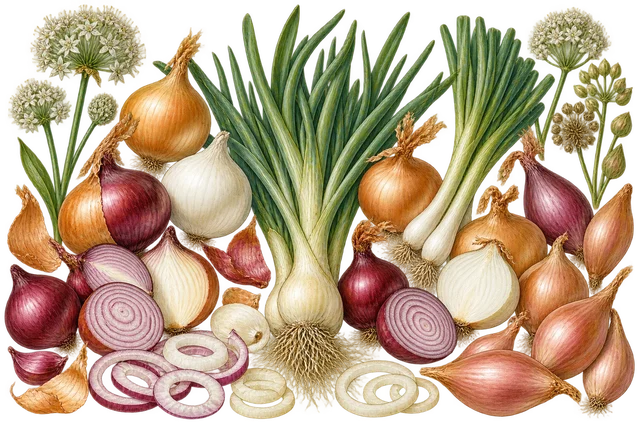
Allium cepa L., the cultivated bulb onion, with many modern colors and cultivars. KJV onions in Numbers 11:5 conventionally refers to this familiar culinary allium without specifying a modern variety.
Ingredient details, preparation and research
Also known as: Bulb onion; Garden onion
Source plant or material
Allium cepa L., the cultivated bulb onion, with many modern colors and cultivars. KJV onions in Numbers 11:5 conventionally refers to this familiar culinary allium without specifying a modern variety. Parts used: Fleshy bulb scales and, for suitable young plants, green leaves. Dry outer skins are normally removed; standardized onion-skin extracts are separate products.
Plant family / material: Amaryllidaceae (amaryllis family), subfamily Allioideae
Forms and route
Raw, cooked, pickled, dried flakes or powder as food. Onion juice, topical extracts and quercetin supplements are different preparations and should not be treated as a food serving.
Vitamins and minerals
USDA raw chopped onion: 1/2 cup (80 g, 2.8 oz; half the 160 g cup measure) provides about 32 kcal, 0.9 g protein, 1.4 g fiber, 5.9 mg vitamin C and 15 micrograms folate. These are modest contributions, not an exceptionally vitamin-rich serving. Cooking with oil adds energy; pickled onion may add sodium or sugar. Onion powder is much more concentrated by weight than fresh onion.
Absorption and preparation
Human studies show that onion quercetin glycosides are absorbed and metabolized, with behavior differing from isolated quercetin and other plant forms. A small red-onion soup study does not establish a universal food-to-supplement conversion or a therapeutic effect. Onion fructans reach the colon and may be fermented; no added herb reliably cancels that FODMAP exposure.
Practical preparation
Remove damaged tissue and dry outer skin; use clean utensils and refrigerate cut onion. Raw, gently cooked and deeply browned onion have different textures and flavors. Use a tested recipe for pickling; an old antimicrobial claim is not a preservation method.
Combination notes
Onion forms a flavor base with many vegetables, grains and legumes. If fructans cause symptoms, a dietitian can help assess portions and alternatives. Taking the solids out of an onion-containing broth does not necessarily remove water-soluble fructans.
Traditional and reported uses
- Flavor raw salads and cooked dishes, from soups and stews to roasted vegetables.
- Contribute modest fiber and micronutrients as part of a varied vegetable intake.
- Historical topical and digestive uses are recorded separately from modern research on onion flavonoids.
Contraindications and cautions
- Onion fructans can trigger bloating, pain or other symptoms in people with IBS/FODMAP sensitivity; response is individual and portion-dependent.
- Avoid onion if you have a diagnosed allergy. Raw onion juice can irritate skin, eyes and mucous membranes.
- Do not use onion poultices or juice for bites, burns, eye disease or infected wounds as described in historical texts.
- Whole onion, onion-skin extract and isolated quercetin are not equivalent. Review concentrated supplements with a clinician when taking regular medicines.
Similar items and how they compare
- Leek
A related culinary allium named in the same KJV verse.
Leek is eaten mainly for its layered shank and leaves rather than a rounded storage bulb.
- Garlic
Another allium that adds strong flavor and has a long medicinal history.
Garlic uses cloves and has different sulfur chemistry; garlic extract trials cannot be assigned to onion.
- Quercetin supplement or onion-skin extract
Related to a studied onion flavonoid.
An isolated compound or concentrated skin product is not a normal onion portion and has its own absorption and safety questions.
Food plant and biblical setting
Allium cepa is the cultivated onion. Numbers 11:5 remembers onions with fish, cucumbers, melons, leeks and garlick in Egypt. The verse establishes a culinary and cultural connection; it does not identify a particular onion color, modern extract or disease remedy.
Historical reach
New Mexico State University’s onion history records food, funerary and ceremonial roles in Egypt, athletic customs in Greece and medieval rent or gift uses. Pliny’s primary text also documents mouth, skin and digestive remedies, sometimes alongside disagreements among ancient medical writers.
Composition and absorption research
Quercetin in onion occurs mainly as glycosides rather than as one uniform isolated ingredient. Human studies show preparation- and sugar-linkage-dependent absorption and subsequent metabolism. These pharmacokinetic findings show exposure to metabolites, not that eating onion treats a disease.
A food study is not a supplement prescription
A crossover study in six men compared red-onion soup with a quercetin supplement using urinary excretion as an endpoint. Its small sample and very different doses limit generalization. It does not support a precise equivalence for all onions or a claim of clinical benefit.
Nutrition, FODMAPs and preparation
A half-cup chopped raw portion weighs 80 g using the USDA measure. It supplies modest fiber and vitamin C. Onion fructans are water-soluble and can move into a broth; removing pieces does not reliably make the broth low-FODMAP. Choose portions around personal tolerance.
Evidence limits
- The small quercetin pharmacokinetic study does not establish a food-to-supplement equivalence for all onions.
- Allium-extract and isolated-quercetin findings are separate from normal bulb portions.
Entry sources
- Kew Plants of the World Online: Allium cepa L.
- New Mexico State University, Onion Breeding Program: History
- Pliny the Elder: Natural History, Book XX; Bostock and Riley translation (1856), public-domain primary historical text
- Graefe et al. Pharmacokinetics and bioavailability of quercetin glycosides in humans (2001)
- Lee and Mitchell. Pharmacokinetics of quercetin absorption from apples and onions in healthy humans (2012)
- Shi and Williamson. Quercetin glycosides from red onion versus supplement: randomized crossover study (2015)
- USDA FoodData Central, SR Legacy: Onions, raw (FDC 170000)
- Monash University: Onion, garlic and infused oils on the low FODMAP diet
- Lytton John Musselman, Old Dominion University: Plants of the Bible: plant index
- King James Bible, public-domain complete text, Project Gutenberg eBook 10
- King James Bible: Numbers 11:5
- National Park Service: Botanical dyes, onion skins
- Robert C. Williams Museum of Papermaking: Onion
Reference entry 131 · Recorded content review: 2026-10-06 · Review scope and dates