


Key cautions
- Deadly lookalikes: never use smell-only identification.
- Cooking does not detoxify autumn crocus; suspected ingestion needs urgent advice.
- Refrigerate pesto and herb oils; use within four days or freeze.
What’s inside
Leaf analyses identify vitamin C, phenolic compounds and plant pigments. Concentrations vary with growing location and growth stage; laboratory antioxidant measurements are not health outcomes.
Uses in brief

- Spring salads and herb sauces
- Cooked soups and dumpling fillings
- Documented regional food traditions
History, folklore and reported uses
History, folklore and traditional uses
Kew places Allium ursinum’s native range from western and central Europe to the Caucasus. Its food story is especially associated with the brief spring season, when fresh leaves are used for flavor.
Food heritage changes over time. A Slovenian field-and-literature study found wild garlic much more prominent in present-day responses than in older written food records. Its current popularity should not be described as one unchanged ancient tradition everywhere.
Traditional, historical and reported uses
- Spring salads and herb seasoning
Food or household practiceWhy this label?
The claim records a culinary preparation or way of eating the named food, with its species or cultivar-group boundary retained.
A Slovenian field study records the aerial parts in salads, soups, spreads and egg dishes. These are documented food practices; the researchers also caution that recent popularity exceeds its prominence in older local records.
- Pesto and herb quark
Food or household practiceWhy this label?
The claim records a culinary preparation or way of eating the named food, with its species or cultivar-group boundary retained.
Germany’s Federal Centre for Nutrition describes fresh leaves in pesto, herb quark and sauces. These are seasonal kitchen uses. Homemade oil-rich mixtures need cold storage rather than an assumed shelf life in a sealed jar.
- Dagestani milk soup
Food or household practiceWhy this label?
The named culinary practice is documented in Dagestan fieldwork; the claim is food use rather than a clinical outcome or validated preservation protocol.
Aliev and colleagues’ 2022–2023 fieldwork in Dagestan records early-spring ramson shoots cooked in milk with ghee and seasonings. This is an attributed regional food account, not a recommendation to dig unidentified wild plants.
- Savory dumpling filling
Food or household practiceWhy this label?
The named culinary practice is documented in Dagestan fieldwork; the claim is food use rather than a clinical outcome or validated preservation protocol.
The same Dagestan study documents ramson in kurze dumplings and other cooked dishes, including fillings with onion, egg and sometimes cheese. It records culinary practice without implying one recipe represents every community.
- Pickled appetizer and kefir pairing
Food or household practiceWhy this label?
The named culinary practice is documented in Dagestan fieldwork; the claim is food use rather than a clinical outcome or validated preservation protocol.
Dagestani accounts describe marinated ramson shoots, leaves and stems served as appetizers or added to kefir for a drink called kambar. This is food-history documentation, not a validated home-fermentation or shelf-stable preservation method.
Five distinct culinary practices are featured. Regional accounts are attributed; no ancient universal tradition, treatment efficacy or biblical identification is inferred.
Historical-use additions reviewed 2026-10-09
Story sources
- Kew Plants of the World Online: Allium ursinum L.
- Traditional Use of Wild Edible Plants in Slovenia: A Field Study and an Ethnobotanical Literature Review (2024)
- German Federal Centre for Nutrition: Bärlauch selber sammeln (German)
- Aliev et al. (2023): Ethnobotany of Dagestan, Allium ursinum account, pp. 13–15
- Aliev et al. (2023): Ethnobotany of Dagestan, author-shared full text
- Oregon State University Extension: Herbs and vegetables in oil
Regional reading paths
These sourced notes describe cultivation, trade, food traditions or material history. A regional connection does not claim exclusive origin.
Europe
Native and culinary: western and central Europe toward the Caucasus; Germany’s BfR documents spring use in soups, sauces and salads.
Spring culinary leaves from controlled cultivation or another reliably identified food supply. Poisonous lookalikes can be fatal; smell alone is insufficient.
Identity & detailed reference
Identity
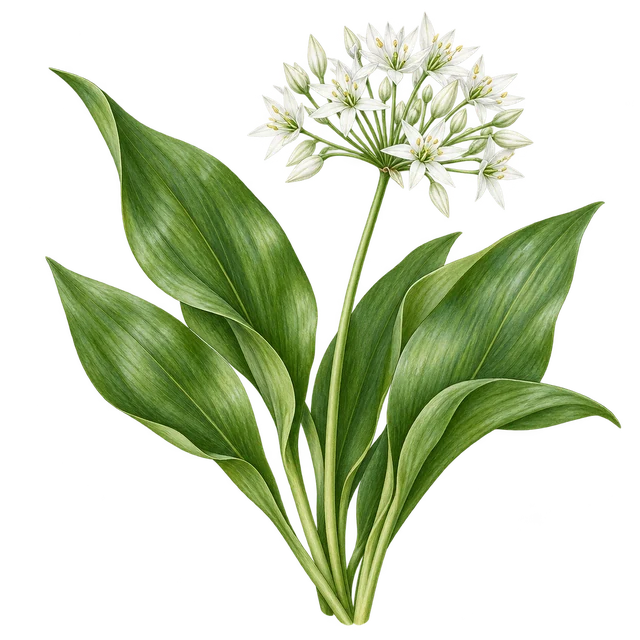
The spring leaves and tender shoots of European wild garlic, Allium ursinum. North American ramps are different plants; a common name or garlic smell cannot establish safe identification.
Ingredient details, preparation and research
Also known as: Ramsons; European wild garlic; Bear’s garlic; Wood garlic; Bärlauch; Allium ursinum
Source plant or material
Allium ursinum L.
Plant family / material: Amaryllidaceae
Forms and route
Correctly identified food-grade leaves and tender shoots, fresh or cooked. Pesto, dried seasoning and concentrated extracts are different preparations.
Vitamins and minerals
Studies of identified fresh Allium ursinum leaves measured vitamin C and plant pigments, with substantial variation by site and growth stage. No universal serving value, “high in” claim or copper figure is assigned. A small seasoning portion is different from a plate of greens.
Absorption and preparation
A chemical measurement in a leaf or extract does not show how much a person absorbs or whether a health benefit follows. No special absorption advantage or therapeutic food pairing is established for ramson here.
Practical preparation
Start with reliably identified food-grade leaves or tender shoots. Rinse under running water, use clean utensils and prepare as a fresh herb or cooked green. Keep fresh leaves chilled. Follow tested food-safety guidance for any preservation; discard uncertain plant material.
Combination context
No medicinal combination is established. Cooking safety and correct identity take priority over proposed nutrient or herb synergies.
Combination notes
Use for garlic-like flavor in ordinary meals. Recipe ingredients such as milk, cheese, eggs and nuts bring their own allergy and storage considerations.
Traditional and reported uses
- Spring salads and herb sauces
- Milk soup and savory dumpling fillings
- Documented pickled-food traditions
Contraindications and cautions
- Never identify this plant by smell alone, a photograph or this card. Lily of the valley (Convallaria majalis) and autumn crocus (Colchicum autumnale) can be mistaken for it. Scent left on fingers can make a later smell test misleading; do not eat uncertain plants.
- Cooking or freezing does not make autumn crocus safe. If a possibly misidentified plant was eaten, contact a poison centre or urgent medical service immediately, even before symptoms develop.
- Use a reputable food supplier. Keep leaves refrigerated, rinse under running water and prevent cross-contamination. Washing cannot correct a mistaken plant identity.
- Fresh herb-and-oil mixtures and homemade pesto need prompt refrigeration and use within four days, or freezing for longer storage. Oil does not make leaves shelf-stable; do not improvise canning.
- This food card establishes no medicinal dose or treatment benefit. Concentrated wild-garlic products should not be substituted for prescribed care.
Similar items and how they compare
- North American ramps
Broad-leaved spring Allium plants with overlapping common names.
Allium tricoccum and Allium burdickii are distinct from A. ursinum. North American ramp food traditions and conservation guidance should retain their own species context.
- Cultivated garlic
A related culinary Allium with a garlic-like flavor.
Garlic bulbs and their supplement studies are not evidence for an A. ursinum leaf serving.
- Lily of the valley and autumn crocus
Their spring foliage can be confused with ramson.
They are poisonous, not substitutes. This comparison is a warning, not an identification key.
Identification is the main safety issue
BfR documents severe poisoning from confusion with toxic plants and warns that odor remaining on hands can produce a false smell test. Obtain known food-grade material; a short text, illustration or single distinguishing feature is inadequate for foraging decisions.
Cooking cannot repair a wrong identification
ANSES poison-centre surveillance includes serious and fatal cases after meals thought to contain wild garlic, including a cooked quiche. Its reference table identifies autumn-crocus colchicine as resistant to cooking and freezing.
Ramson and ramps have different identities
USDA describes A. tricoccum as a spring forest plant of eastern North America. Penn State separately recognizes wide-leaf A. tricoccum and narrow-leaf A. burdickii. Neither is the European A. ursinum covered by this card.
Composition does not establish a treatment
A 2022 study compared wild-garlic leaves from different sites and growth stages, measuring vitamin C, phenolic compounds, pigments and laboratory antioxidant capacity. It studied plant samples, not prevention or treatment of disease in people.
Heritage preservation needs a modern safety boundary
Documented pickling and dairy-food traditions are not laboratory-validated preservation instructions. Oregon State advises refrigerating homemade pesto and herb-oil mixtures for no more than four days, or freezing; it reports no researched safe canning times for pesto.
Evidence limits
Educational food and heritage overview. It is not a foraging key, preservation recipe or treatment guide. Plant-sample composition and regional reports do not prove clinical benefit; no cultivar-independent nutrient serving or medicinal dose is established.
Entry sources
- Kew Plants of the World Online: Allium ursinum L.
- German Federal Institute for Risk Assessment: Wild garlic, confusion often leads to poisoning
- ANSES: Confusion between autumn crocus and wild garlic, poison-centre cases 2020–2022
- German Federal Centre for Nutrition: Bärlauch selber sammeln (German)
- Traditional Use of Wild Edible Plants in Slovenia: A Field Study and an Ethnobotanical Literature Review (2024)
- Aliev et al. (2023): Ethnobotany of Dagestan, Allium ursinum account, pp. 13–15
- Aliev et al. (2023): Ethnobotany of Dagestan, author-shared full text
- Neglected Potential of Wild Garlic: Metabolites, location and growth-stage study (2022)
- Penn State Extension: Ramps, Allium tricoccum and Allium burdickii
- USDA Forest Service: Forest Farming Ramps (2014)
- Oregon State University Extension: Herbs and vegetables in oil
- FDA: Selecting and Serving Produce Safely
Reference entry 251 · Recorded content review: 2026-10-09 · Review scope and dates