


Key cautions
- Avoid with salicylate allergy, bleeding/ulcer problems and the other contraindications below; check blood thinners and pain medicines first.
- Adult-only. Avoid during pregnancy/breastfeeding; do not use for a child’s viral fever.
What’s inside
Salicin and related phenolic glycosides, together with flavonoids and tannins. Species, harvest and extraction change the profile. Stated total-salicin content is a chemical standardization marker, not a guarantee of equal clinical action across products.
Uses in brief

- Documented traditional use for minor joint discomfort, headache and fever accompanying a cold.
- Certain standardized dry extracts have human evidence for short-term low-back pain; arthritis findings are inconsistent.
In the King James Bible
Possible source-tree connection: willows
Uncertain botanical connection
Isaiah pictures willows beside water as flourishing growth. Several Salix species, including S. alba, grow in the Middle East, but the verse does not identify a species or mention bark preparations.
And they shall spring up as among the grass, as willows by the water courses.
Isaiah 44:4 (KJV)
Scripture and identification sources
Words & their stories
WORDS & THEIR STORIES
The name behind the KJV
Biblical Hebrew · Isaiah 44:4 (KJV)
כַּעֲרָבִיםkaʿărābīm
“Like willows,” in the KJV image of growth beside flowing water.
Dictionary form: עֲרָבָה · ʿărābāh
The prefixed k- expresses comparison, and the noun is plural. Brown–Driver–Briggs supplies the reconstructed singular ʿărābāh and favors poplar.
What the language reveals
The water matters
The image concerns flourishing offspring, following the promise of water, spirit and blessing in verse 3.
A disputed tree name
Musselman discusses true willows here, while Brown–Driver–Briggs favors Euphrates poplar. The Hebrew word alone cannot settle a modern species.
Treat this as an uncertain tree-name connection. It does not securely specify Salix alba or identify bark as a remedy.
History, folklore and reported uses
History, folklore and traditional uses
Willow’s story moves from a bitter piece of bark to one of medicine’s most familiar family trees. A particularly well-documented episode comes from Chipping Norton in Oxfordshire: in April 1763, the Reverend Edward Stone sent the Royal Society his observations on powdered white-willow bark for recurring fevers, then called agues. The surviving letter names the local tree rather than a mysterious imported ingredient. It offers a vivid glimpse of a period when a clergyman’s observations of ordinary plants could enter the scientific record.
Later European herbal practice kept willow bark among its remedies for fever, headache and aching joints. The EMA’s historical assessment carries those uses into the modern herbal-medicine record, alongside more recent work on specified extracts. The connection with aspirin is real but needs careful wording: willow contains salicin-related compounds, while aspirin is acetylsalicylic acid, a different substance. Bark, isolated salicin and aspirin belong to a connected history of investigation, not an interchangeable set of medicines.
Traditional, historical and reported uses
- Agues and fever
Mixed/contextual sourcesWhy this label?
Combines the 1898 dispensatory account with continuing European tradition.
Nineteenth-century American pharmacy used powdered white-willow bark and decoctions for recurring fevers known as intermittents. European herbal practice also retained bark preparations for fever accompanying colds.
- Aching joints and headache
Traditional accountWhy this label?
EMA documents traditional bark-remedy practice.
European herbal medicine used dried willow bark and bark extracts for minor joint pain and headache. Teas, powders and later manufactured extracts carried these uses into household and pharmacy practice.
- Astringent bowel remedies
Historical recordWhy this label?
Explicitly cites the 1898 dispensatory’s bowel-remedy account.
King’s American Dispensatory (1898) described white-willow bark powder and decoction for chronic diarrhoea and dysentery, valuing the bark’s combination of bitterness and astringency.
- Bitter tonic in convalescence
Historical recordWhy this label?
Explicitly cites the same dispensatory’s tonic-use account.
The same American dispensatory recorded bark preparations for weak digestion and recovery after acute illness. This older tonic use concerned appetite and depleted strength, beyond willow’s better-known fever reputation.
- External washes for sores
Historical recordWhy this label?
Uses the 1898 dispensatory’s record of external washes.
Late-nineteenth-century American pharmacy also used a white-willow bark decoction as a local wash for longstanding, poorly healing sores and ulcers. This is a separate external branch of the bark’s astringent tradition.
Regional reading paths
These sourced notes describe cultivation, trade, food traditions or material history. A regional connection does not claim exclusive origin.
Europe
Historical: the Royal Society preserves Edward Stone’s 1763 letter reporting white-willow-bark observations from Chipping Norton, Oxfordshire.
Pharmacy-history reference and identified bark preparations. Willow bark, isolated salicin and aspirin are not interchangeable medicines.
Identity & detailed reference
Identity
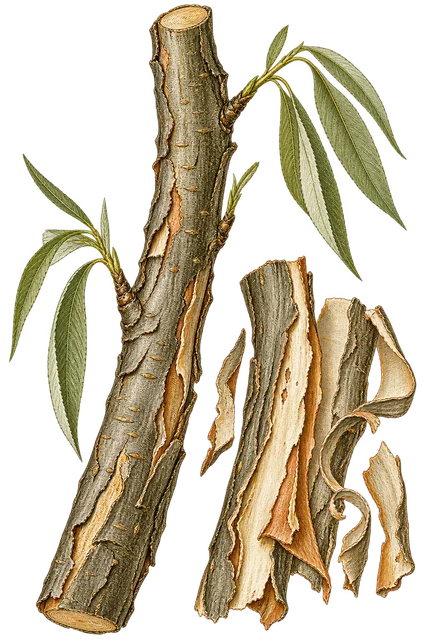
White willow is Salix alba L., family Salicaceae; the medicinal material is bark, often from young branches. Commercial willow-bark medicines may instead contain other identified Salix species. Salicin is not aspirin, and bark or salicin milligrams are not aspirin-equivalent milligrams.
Ingredient details, preparation and research
Source plant or material
Salix alba L., bark or young-branch bark. Other medicinal willow sources include S. purpurea, S. daphnoides and S. × fragilis; check the actual species on the product.
Plant family / material: Salicaceae (willow family).
Forms and route
Dried cut bark for decoctions/infusions; bark powder; oral capsules/tablets; tinctures, liquid extracts and dry extracts. A characterized medicinal extract differs from home-brewed bark tea, and oral evidence does not establish the effects of a topical willow cosmetic.
Food sources
Not an ordinary food or useful micronutrient serving. A bark infusion or decoction is an herbal preparation, not a dietary serving of willow.
Vitamins and minerals
Willow bark and its salicin-standardized extracts are not established vitamin/mineral sources. Salicin is a phytochemical, not an essential micronutrient. No nutritional household serving is assigned.
Absorption and preparation
A small human pharmacokinetic study found salicylic acid and related metabolites after a characterized oral extract. The exposure was lower than after usual analgesic aspirin amounts. This does not establish an aspirin conversion factor, an antiplatelet substitute, a tea dose or a food pairing that improves clinical benefit.
Traditional and reported uses
- Documented traditional use for minor joint discomfort, headache and fever accompanying a cold.
- Certain standardized dry extracts have human evidence for short-term low-back pain; arthritis findings are inconsistent.
Contraindications and cautions
- Avoid with salicylate/aspirin or relevant NSAID allergy, salicylate-sensitive asthma, active peptic ulcer, a bleeding disorder, severe kidney/liver dysfunction or G6PD deficiency.
- Adult-only medicinal use. Do not give to children or adolescents, especially during viral fever; avoid in pregnancy and breastfeeding.
- Ask a pharmacist or clinician before combining with anticoagulants, aspirin, other NSAIDs or another pain supplement. Any history of asthma or ulcers also needs review.
- Stomach upset and allergic reactions can occur. A hot, swollen joint, worsening pain or persistent fever needs assessment.
Similar items and how they compare
- Turmeric
Both are used in herbal practice for joint or other discomfort and sold as teas, powders or concentrated extracts.
Willow has salicylate-related restrictions; turmeric uses rhizomes containing curcuminoids and turmerones.
- Stinging nettle leaf
Both have traditional use for minor joint discomfort, offering a shared-use comparison rather than evidence of interchangeable effects.
Nettle uses aerial herb with urinary traditions; willow uses salicylate-precursor-containing bark.
Plant, bark and product identity
Salix alba L. is the accepted white-willow species in the willow family, Salicaceae. Health Canada also recognizes bark from S. purpurea, S. daphnoides and S. × fragilis. EMA’s willow monograph covers various Salix species, not only S. alba. A product called “white willow” should identify the plant actually used; evidence for a named mixed-species extract cannot automatically be transferred to every white-willow tea.
Constituents and standardization
Salicin-related glycosides are accompanied by flavonoids and tannins. The chemical profile depends on species and extraction. A label stating total salicin helps characterize an extract, but salicin is not acetylsalicylic acid (aspirin), and equal milligram amounts do not mean equal pain relief, bleeding effects or safety. Bark weight, extract weight and salicin content are three different quantities.
Traditional use and the EMA distinction
EMA separates a well-established short-term low-back-pain use for a specified dry extract from traditional uses for minor joint pain, cold-associated fever and headache. “Traditional” records a history of use and plausibility; it is not the same as convincing modern trials for each complaint. EMA’s current page still lists the adopted 2017 monograph, with a later review call for data.
Human studies: back pain versus arthritis
A four-week randomized trial enrolled 210 adults with worsening chronic low-back pain and found more people pain-free without rescue tramadol during the final week in the studied extract groups than with placebo. In contrast, a six-week trial involving 127 people with hip/knee osteoarthritis found no statistically significant benefit of its willow extract over placebo; a separate 26-person rheumatoid-arthritis trial was also negative. These results support product- and condition-specific caution, not a general arthritis cure.
Absorption and the aspirin comparison
In ten healthy volunteers, a standardized extract produced circulating salicylic acid, salicyluric acid and gentisic acid. The investigators concluded that salicylate exposure alone was too low to explain all proposed pain effects. A separate small platelet study found a much smaller effect with willow than with aspirin. Neither study validates using willow to replace prescribed aspirin or provides a practical aspirin-equivalent dose.
Allergy, asthma, ulcers and bleeding
The EMA contraindications include salicylate/NSAID hypersensitivity, salicylate-sensitive asthma, active peptic ulcer, coagulation disorders, severe liver/kidney dysfunction and G6PD deficiency. Health Canada advises a pre-use review for asthma or peptic-ulcer history. Gastrointestinal upset can occur, and allergic reactions can be serious. These restrictions are not cancelled by willow’s smaller measured platelet effect compared with aspirin.
Age, pregnancy and breastfeeding
EMA contraindicates medicinal willow in under-18s as a salicylate-related precaution concerning Reye syndrome; a child’s febrile viral illness is a particular reason not to use it. Health Canada advises against use throughout pregnancy and breastfeeding. EMA specifically contraindicates the third trimester and does not recommend use earlier in pregnancy or during lactation. Do not turn an adult extract study into a child or pregnancy dose.
Medicines and combinations
EMA warns that willow may increase anticoagulant effects and recommends medical advice before concurrent salicylates or other NSAIDs. Review the full product list, including prescribed aspirin, warfarin, nonprescription ibuprofen/naproxen and combination joint products. Combining willow with turmeric or MSM is not an established “joint stack”; one ingredient does not protect against another ingredient’s adverse effects.
Preparation, nutrients and when to seek care
Decoctions, powders, tinctures and standardized extracts have different concentrations; a spoon of bark or dropper of tincture cannot be assigned a generic medicinal dose. Willow is not a dependable micronutrient food and needs no absorption-enhancing oil or pepper recipe. Follow the actual authorized product’s instructions. Acute joint inflammation, worsening symptoms, or fever with severe headache needs clinical assessment rather than repeated home dosing.
Entry sources
- EMA: Salicis cortex, current monograph status and public summary
- Health Canada: Willow bark monograph (2024)
- EMA: European Union herbal monograph on Salix species, cortex (2017)
- Kew Plants of the World Online: Salix alba L.
- EMA: Assessment report on Salix species, cortex (2017)
- Chrubasik et al.: Placebo-controlled willow-bark trial for low-back-pain exacerbations (2000)
- Biegert et al.: Willow-bark extract trials in osteoarthritis and rheumatoid arthritis (2004)
- Schmid et al.: Pharmacokinetics of salicin after a standardized willow-bark extract (2001)
- Krivoy et al.: Effect of Salicis cortex extract on human platelet aggregation (2001)
- Medsafe: Turmeric/curcumin products and warfarin interaction (2018)
- NCCIH: DMSO and MSM for osteoarthritis
Reference entry 51 · Recorded content review: 2026-10-05 · Review scope and dates