


Key cautions
- Reference only: no foraging, dietary or medicinal recommendation can be made from an unresolved name.
- The historical name alone does not identify either Oxalis stricta or Oxalis acetosella.
What’s inside
Not established for the historical specimen or preparation. A presumed Oxalis identification cannot justify importing oxalate or nutrient measurements from another species.
Uses in brief

- Documented ingredient in seventeenth-century apothecary preparations.
- Material-culture evidence from a dated medicine-storage jar.
- Historical plague-prescription ingredient, with botanical identity unresolved.
History, folklore and reported uses
History, folklore and traditional uses
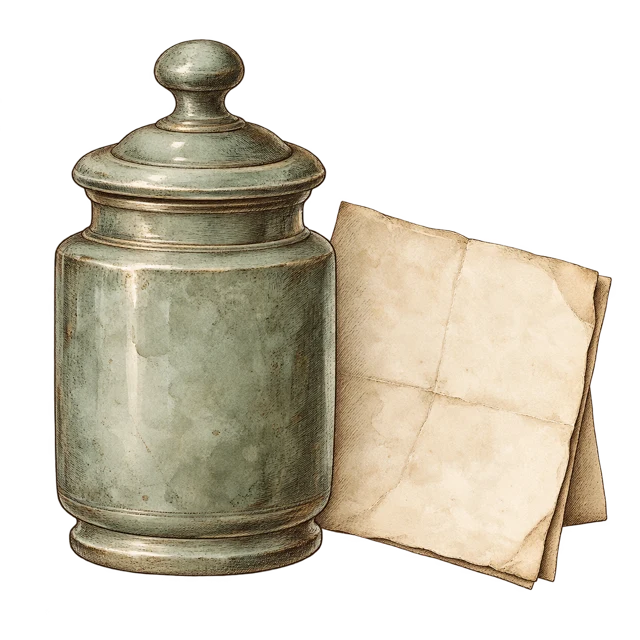
An apothecary jar can preserve a preparation name more securely than a plant identity. RCP illustrates an English jar dated 1655 for wood-sorrel conserve and reproduces a 1665 prescription naming wood-sorrel conserve and syrup. Together they show that the named materials belonged to pharmacy practice.
Their surviving names do not settle the botanical question. The reviewed passage does not establish the yellow wood sorrel already in this collection, and a plausible European Oxalis identification remains a lead rather than a conclusion. Broader culinary or medicinal claims have therefore been withheld instead of borrowed from another plant.
Traditional, historical and reported uses
- Conserve and syrup in pharmacy
Historical recordWhy this label?
An RCP transcription records preparation names and ingredient use while leaving species unresolved, an explicit historical written-record claim.
The RCP transcription names two wood-sorrel preparations. It establishes their historical names and use as ingredients, while leaving their species unresolved.
- Plague-prescription ingredient, 1665
Historical recordWhy this label?
A dated 1665 prescription and digitized primary source document compound use, without proving effectiveness or safety.
Wood-sorrel material appears in a compound intended for plague. This documents a prescription, not its effectiveness, frequency of use or safety.
- Medicine storage and display
Historical recordWhy this label?
A dated conserve jar and museum collection interpretation document seventeenth-century pharmacy storage/display.
The dated conserve jar anchors the material in seventeenth-century pharmacy. RCP’s wider jar collection explains how such vessels stored and displayed preparations.
The historical material’s botanical identity is unresolved. These documentary records are not food, foraging or preparation instructions.
Historical-use additions reviewed 2026-10-08
Identity & detailed reference
Identity
The wood-sorrel material named in a seventeenth-century English apothecary record. The source does not establish a species. This is not a second identified wood-sorrel herb or a foraging entry.
Ingredient details, preparation and research
Also known as: Wood-sorrel conserve (historical material); Wood-sorrel syrup (historical material)
Source plant or material
Unresolved from the reviewed text. Oxalis acetosella is a research lead only; the existing Oxalis stricta card must remain distinct.
Plant family / material: Unresolved historical botanical material; family not assigned
Forms and route
Conserve and syrup as named historical apothecary materials; a surviving 1655 jar and a 1665 printed prescription provide documentation. No reconstruction or consumption method is supplied.
Absorption and preparation
Neither composition nor species is sufficiently resolved to assess absorption. The record documents a historical preparation name, not a testable modern product specification.
Traditional and reported uses
- Documented ingredient in seventeenth-century apothecary preparations.
- Material-culture evidence from a dated medicine-storage jar.
- Historical plague-prescription ingredient, with botanical identity unresolved.
Contraindications and cautions
- Reference only: no foraging, dietary or medicinal recommendation can be made from an unresolved name.
- The historical name alone does not identify either Oxalis stricta or Oxalis acetosella.
- The historical prescription’s intended audience does not establish safety for pregnancy or children.
Identification remains open
The 1665 common name alone cannot establish Oxalis stricta, O. acetosella or a chemically equivalent modern product. The scientific-name and constituent fields therefore remain unresolved rather than borrowing a nearby entry’s data.
Why the wider uses stop here
Without a secure identity, adding species-specific food, nutrient, craft or medicinal uses would create false equivalence. The rounded account for this material consists of its preparation, documentary and apothecary contexts.
Historical plague claims and present care
No historical plant or material here is established to prevent or cure plague. Suspected plague requires urgent medical assessment and prompt antibiotics.
Entry sources
- RCP Museum: For the cure of the plague
- College of Physicians: Certain necessary directions (1665), Wellcome digitized copy
- RCP Museum: Apothecary jars, storage and display
- CDC: Clinical Care of Plague
Reference entry 238 · Recorded content review: 2026-10-08 · Review scope and dates