


Key cautions
- Review with clinicians when using anticoagulants or glucose-lowering medicines; a bleeding case has been reported.
- Do not self-treat kidney disease or alter transplant medicines.
What’s inside
Analyses report polysaccharides, proteins, mannitol and adenosine, with differences between wild and cultivated samples. A generic “cordyceps” label does not establish composition.
Uses in brief

- Restorative fatigue tonic
- Sexual-vitality medicine
- Cough remedies
History, folklore and reported uses
History, folklore and traditional uses
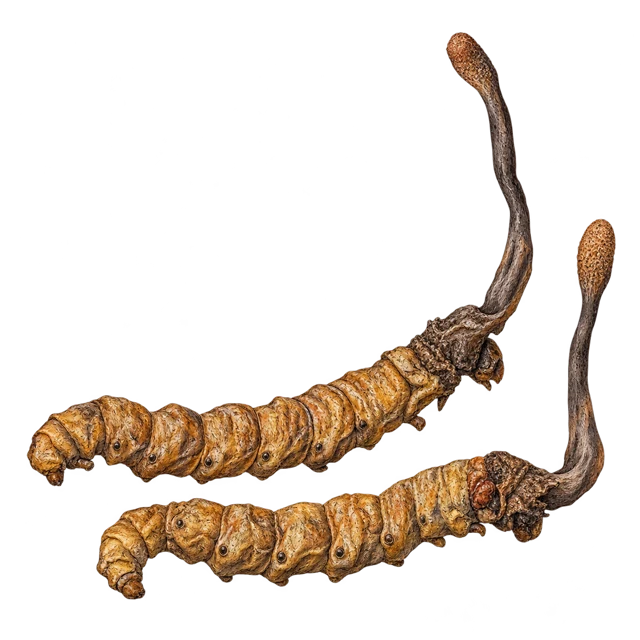
The dried material called dong chong xia cao or yartsa gunbu joins an insect body and the fungus growing from it. Historical research places Tibetan medicinal use no later than the fifteenth century and its entry into Chinese materia medica in the eighteenth. Its later circulation to Europe and other parts of Asia is part of a documented international trade history.
Tonic traditions encompass stamina, sexual vitality and cough complaints. For communities in its mountain range, collecting and selling the fungus can also be economically important. This connection makes questions of harvesting pressure and conservation inseparable from the supplement story. Cultured mycelium and orange Cordyceps militaris products have their own production histories and should not silently replace the traditional insect–fungus complex.
A closer look at its history
Two organisms, one traded medicine
The insect–fungus complex became a traded medicinal material rather than an ordinary cap-and-stem food. Historical scholarship tracks its circulation beyond Tibet and China; that circulation helps explain why several unlike products now share the commercial word cordyceps.
A resource tied to mountain livelihoods
Primary conservation work connects O. sinensis with alpine habitats, specialised hosts and heavy collecting pressure. This makes provenance an ecological and livelihood question as well as a product-authentication question. Do not convert dated price or production figures into claims about today’s market.
Additional history reviewed 2026-10-09
Traditional, historical and reported uses
- Restorative fatigue tonic
Traditional accountWhy this label?
The claim describes a Tibetan/Chinese restorative tradition and its later supplement use, not a tested fatigue outcome.
Used in Tibetan/Chinese medical traditions and later supplements for fatigue and stamina.
- Sexual-vitality medicine
Traditional accountWhy this label?
Sexual vitality is recorded as a traditional medical indication rather than a demonstrated clinical effect.
Sexual dysfunction is among the documented traditional indications.
- Cough remedies
Traditional accountWhy this label?
The source records a traditional cough indication rather than a clinical result.
Cough is another recorded Chinese medical indication.
- Kidney-related adjunct research
Human researchWhy this label?
The claim concerns investigations in people with kidney disease or transplantation and explicitly states that reviews find insufficient evidence.
Modern products have been investigated in kidney disease and transplantation, but reviews find evidence insufficient for reliable clinical recommendations.
- Exercise supplements
Human researchWhy this label?
The exact claim concerns exercise-performance studies in healthy people, with mixed findings.
Studied in healthy people for exercise performance, with mixed results.
- Household income and medicinal trade
Mixed/contextual sourcesWhy this label?
This is resource, trade, conservation, and livelihood context; it is neither a clinical effect nor a food-composition measurement.
Harvest and trade contribute to livelihoods on the Tibetan Plateau and adjacent Himalayan regions. Heavy collection pressure connects this economic role with questions of resource management and conservation.
Features and lookalikes to study
Ophiocordyceps sinensis (Berk.) G.H. Sung et al.; formerly Cordyceps sinensis. The traditional material is the fungus–caterpillar complex.
Dong chong xia cao and yartsa gunbu refer to a culturally specific insect–fungus material; “cordyceps” on a capsule may instead refer to cultured mycelium or another species.
Morphology described in sources
- The traditional material combines a colonised ghost-moth larva and its fungal stroma. A fungus-shaped product without that host complex is a different material even if sold under a broad cordyceps name.
- Habitat and substrate
- See the source-linked morphology and comparison notes below; a separate habitat summary has not been verified for this card.
- Geographic scope
- A complete regional range is not established here. Broad common names and commercial labels can span different species.
- Season in the cited region
- No region-specific fruiting season has been verified for this card. Do not infer a local season from trade availability.
Cordyceps militaris and products sold as “Cordyceps gunnii”
These are documented substitutes or adulterants in O. sinensis authentication research. A clearly labelled cultivated C. militaris product is a separate species rather than automatically fraudulent.
The gunnii name has itself been misapplied in Asia. Gross shape is insufficient, especially after milling; laboratory microscopy and validated molecular tests are relevant.
Other insect-associated fungal complexes
O. nutans and materials traded as C. cicadae or C. liangshanensis are among the taxa targeted in authentication research.
An insect with a fungal projection does not establish O. sinensis, nor does correct species identity exclude contamination or establish a medicinal effect.
Limits and regional differences
- Whole material requires expert host/fungus assessment. Processed powders and capsules need traceable sourcing and validated analytical authentication; photos cannot confirm their species or purity.
- Educational comparison only. Neither this card, an illustration, a photograph, a spore-print colour nor a checklist establishes that a wild collection is safe to eat. A qualified local mycologist must assess uncertain material; do not taste an unknown fungus. Cooking does not reliably eliminate mushroom toxins.
Identity & detailed reference
Identity
Ophiocordyceps sinensis (Berk.) G.H. Sung et al.; formerly Cordyceps sinensis. The traditional material is the fungus–caterpillar complex.
Ingredient details, preparation and research
Also known as: dong chong xia cao; yartsa gunbu; yarsha gumba
Source plant or material
Ophiocordyceps sinensis (Berk.) G.H. Sung et al.; The traditional dried caterpillar–fungus complex, including the fungal stroma and colonized insect body. Cultured fungal products are separate materials.
Fungal family: Ophiocordycipitaceae
Forms and route
Traditional dried insect–fungus complex; preparations in tonic foods and medicine. Cultured mycelial products and orange Cordyceps militaris fruiting bodies are not identical substitutes.
Vitamins and minerals
This medicinally traded material is not treated as an ordinary nutrient serving. Chemical assays do not establish a practical vitamin/mineral contribution from an unspecified product.
Absorption and preparation
Traditional material is used in tonic foods and medicinal preparations. Wild insect–fungus complexes, fermentation products and Cordyceps militaris are not interchangeable; human findings need the exact preparation.
Traditional and reported uses
- Used in Tibetan/Chinese medical traditions and later supplements for fatigue and stamina.
- Sexual dysfunction is among the documented traditional indications.
- Cough is another recorded Chinese medical indication.
- Modern products have been investigated in kidney disease and transplantation, but reviews find evidence insufficient for reliable clinical recommendations.
- Studied in healthy people for exercise performance, with mixed results.
- Harvest and trade contribute to livelihoods on the Tibetan Plateau and adjacent Himalayan regions. Heavy collection pressure connects this economic role with questions of resource management and conservation.
Contraindications and cautions
- Review with clinicians when using anticoagulants or glucose-lowering medicines; a bleeding case has been reported.
- Do not self-treat kidney disease or alter transplant medicines.
- Wild harvesting has conservation and livelihood consequences; provenance and adulteration matter.
- This card is not a foraging identification guide. Unknown wild mushrooms should not be eaten.
Identity, fungal material and preparation
Ophiocordyceps sinensis (Berk.) G.H. Sung et al.; formerly Cordyceps sinensis. The traditional material is the fungus–caterpillar complex. The traditional dried caterpillar–fungus complex, including the fungal stroma and colonized insect body. Cultured fungal products are separate materials. Traditional material is used in tonic foods and medicinal preparations. Wild insect–fungus complexes, fermentation products and Cordyceps militaris are not interchangeable; human findings need the exact preparation.
Constituents and food context
Analyses report polysaccharides, proteins, mannitol and adenosine, with differences between wild and cultivated samples. A generic “cordyceps” label does not establish composition. This medicinally traded material is not treated as an ordinary nutrient serving. Chemical assays do not establish a practical vitamin/mineral contribution from an unspecified product.
Traditional uses and evidence boundaries
“Cordyceps” is a broad commercial label. Findings for a fermentation product cannot automatically be assigned to wild O. sinensis or C. militaris; kidney and exercise studies remain limited or mixed.
Safety and product distinctions
Review with clinicians when using anticoagulants or glucose-lowering medicines; a bleeding case has been reported. Do not self-treat kidney disease or alter transplant medicines. Wild harvesting has conservation and livelihood consequences; provenance and adulteration matter.
Entry sources
- Di Lu: The Global Circulation of Chinese Materia Medica, 1700–1949 (2023)
- MSK: Cordyceps
- Primary resource and conservation investigation, Ophiocordyceps sinensis
- NCBI/PubChem taxonomy: Ophiocordyceps sinensis
- Primary study: composition of wild and cultivated O. sinensis, 2025
Reference entry 209 · Recorded content review: 2026-10-08 · Review scope and dates