


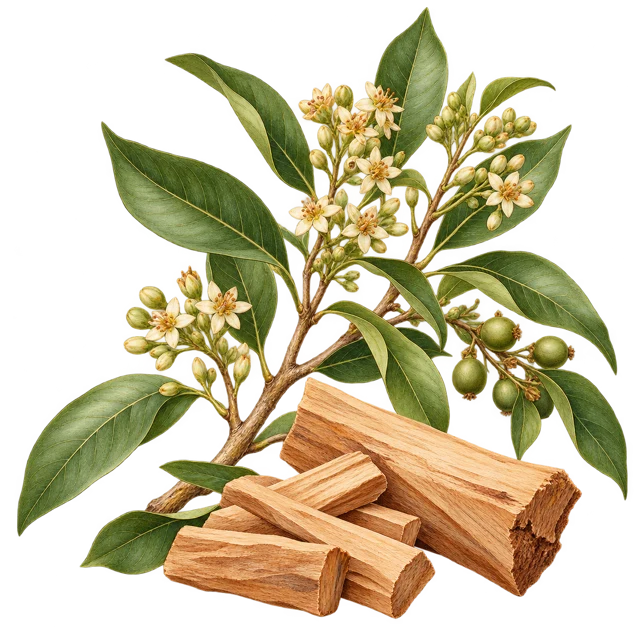
Key cautions
- Verify the species and wood part; red sandalwood, other sandalwoods and synthetic fragrances are not equivalent materials.
- This is not an oral remedy or an essential-oil use guide. Do not recreate historical medicinal preparations.
What’s inside
The heartwood contains a volatile-oil fraction characterized by alpha- and beta-santalol and related sesquiterpenes. Oil percentages describe the separated fraction, not the percentage composition of whole wood.
Uses in brief

- Fragrant wood for carving and decorative objects.
- Source heartwood for perfumery and cosmetic fragrance ingredients.
- Documented household scent and ceremonial histories; traditional body-use records are not efficacy claims.
History, folklore and reported uses
History, folklore and traditional uses
Sandalwood’s value rests as much in material culture as in medicine. Kew documents fragrant heartwood used for fine carving and as a source of perfume and cosmetic fragrance. An object made from that wood and a bottle of its extracted oil therefore share a source without becoming the same preparation.
PROSEA records scenting stored clothes and ceremonial associations in several Asian traditions. A separate conference abstract connects sandalwood with Ibn Sīnā and Hajī Pasha in epidemic medical theory. That historical lead remains provisional: the underlying texts and exact sandalwood material have not been independently resolved.
Traditional, historical and reported uses
- Carved objects
Food or household practiceWhy this label?
The claim documents carved objects as a culinary, craft, gardening, or practical material use; it reports neither a treatment outcome nor measured nutrient content.
Kew describes sandalwood as a prized carving material. This use depends on the wood itself rather than a distilled derivative.
- Perfumery source material
Food or household practiceWhy this label?
The claim documents perfumery source material as a culinary, craft, gardening, or practical material use; it reports neither a treatment outcome nor measured nutrient content.
Fragrant heartwood supplies the essence used in perfumes and cosmetics. Perfumery use does not establish a therapeutic action of wood or oil.
- Household and ceremonial scent
Food or household practiceWhy this label?
The claim documents household and ceremonial scent as a culinary, craft, gardening, or practical material use; it reports neither a treatment outcome nor measured nutrient content.
PROSEA records aromatic sachets for stored clothing and ceremonial use. These are cultural uses, with no fumigation or burning directions supplied.
- Traditional body-cooling practice
Traditional accountWhy this label?
PROSEA records an Indonesian perceived cooling practice using ground wood, an ethnobotanical account rather than a demonstrated treatment.
PROSEA records Indonesian external body use of ground wood for a perceived cooling effect. This is ethnobotanical history, not a validated treatment for fever or skin disease.
- Apothecary material
Historical recordWhy this label?
Named Ayurvedic and Unani pharmacopoeial listings document dried heartwood as an apothecary material; the listing supports a written-record claim only.
Kew’s medicinal-name service records dried S. album heartwood in Ayurvedic and Unani pharmacopoeial sources. A listing documents the material, not clinical efficacy for an unspecified complaint.
- Epidemic aromatics: provisional historical lead
Not yet classifiedWhy this label?
Only a conference-abstract lead is provided and both primary passages and botanical identity are expressly unverified; classification remains pending.
A scholarly conference abstract attributes sandalwood to Ibn Sīnā’s and Hajī Pasha’s epidemic responses. Exact botanical identity and the primary passages remain unverified, so this is not a species-proven plague use.
Historical-use additions reviewed 2026-10-08
Regional reading paths
These sourced notes describe cultivation, trade, food traditions or material history. A regional connection does not claim exclusive origin.
Asia
Native and cultural source wood: Kew places the native range from Java toward northern Australia; long cultivation and aromatic-wood traditions connect the material with South and Southeast Asia.
Fragrant heartwood for carving and perfumery-source history. This is wood, not bottled essential oil or red sandalwood.
Australia & Oceania
Cultivated in northern Australia, including documented Western Australian plantation trials and later commercial production.
Identified fragrant heartwood for scent and craft reference; do not ingest wood or treat incense smoke as medicine.
Identity & detailed reference
Identity
White or Indian sandalwood: identified Santalum album heartwood. This is source wood, not bottled essential oil, red sandalwood (Pterocarpus santalinus), or every product sold under a sandalwood fragrance name.
Ingredient details, preparation and research
Also known as: White sandalwood; Indian sandalwood; East Indian sandalwood; Chandan (context-dependent common name)
Source plant or material
Santalum album; fragrant heartwood of trunk, branches and roots. Sapwood and extracted essential oil are separate materials.
Plant family / material: Santalaceae (sandalwood family)
Forms and route
Identified heartwood pieces, carvings, shavings and powder; wood as raw material for fragrance manufacture. Distilled essential oil and formulated cosmetics require separate product-level assessment.
Absorption and preparation
Wood used as a carving or scent material has no nutritional absorption role. Skin contact with a formulated product and exposure to concentrated essential oil are different from handling intact wood.
Traditional and reported uses
- Fragrant wood for carving and decorative objects.
- Source heartwood for perfumery and cosmetic fragrance ingredients.
- Documented household scent and ceremonial histories; traditional body-use records are not efficacy claims.
Contraindications and cautions
- Verify the species and wood part; red sandalwood, other sandalwoods and synthetic fragrances are not equivalent materials.
- This is not an oral remedy or an essential-oil use guide. Do not recreate historical medicinal preparations.
- Stop a skin product if irritation occurs; ornamental wood or powder is not automatically cosmetic grade.
- Prefer traceable sourcing; aromatic wood demand has contributed to pressure on wild trees.
Scope and chemistry
This entry is for S. album heartwood. Santalols characterize its aromatic fraction; distilled oil concentrates selected constituents and needs separate safety assessment.
Source-plant context
Other parts of a sandalwood tree have their own reported uses. Fruit, seed oil and leaves are deliberately not listed as uses of source wood.
Evidence and sourcing boundaries
Species identity matters both culturally and commercially. Kew lists an IUCN Vulnerable assessment; traceable material avoids assuming that any fragrant wood is authentic or responsibly sourced.
Historical plague claims and present care
No historical plant or material here is established to prevent or cure plague. Suspected plague requires urgent medical assessment and prompt antibiotics.
Entry sources
- Kew: Santalum album, identity and wood uses
- PROSEA: Santalum album, wood, scent and cultural uses
- Kew Medicinal Plant Names Services: sandal wood and dried heartwood
- Osman Süreyya Kocabaş: Scent Use in the Epidemic Treatment of Early Modern Ottoman Medicine
- CDC: Clinical Care of Plague
Reference entry 236 · Recorded content review: 2026-10-08 · Review scope and dates