


Key cautions
- Avoid raw butterbur and homemade preparations: PAs can injure liver and lungs and may cause cancer.
- Even purported PA-free products have been associated with liver injury; discuss any proposed product with a clinician.
What’s inside
Pyrrolizidine alkaloids (PAs) are the central safety concern. Extracts also contain sesquiterpene esters such as petasin; removing PAs and measuring petasin are different quality questions.
Uses in brief

- Historical large-leaf use for wrapping butter and improvised rain covering.
- Separate root-extract migraine and leaf-extract hay-fever research, limited by safety concerns.
- Medieval and early-modern plague beliefs, recorded as history only.
History, folklore and reported uses
History, folklore and traditional uses
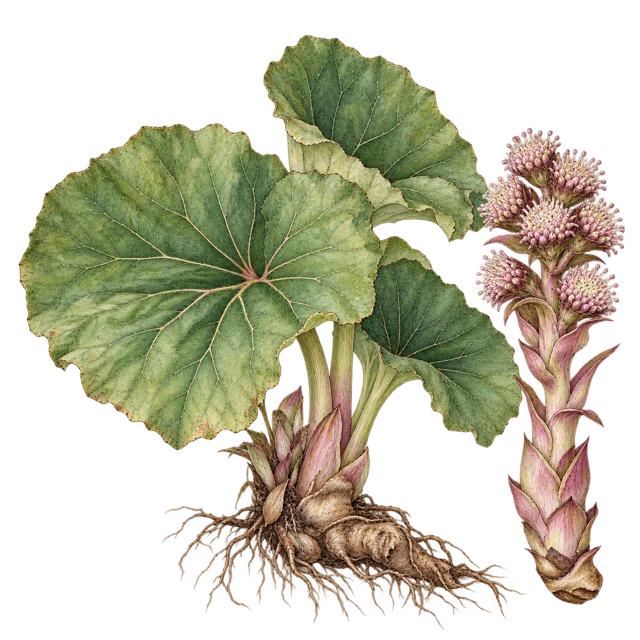
Butterbur’s great leaves gave it a practical household reputation before its modern supplement market. NCCIH traces its English name to wrapping butter in warm weather and records names evoking a rain hat. These are accounts of past use, not a recommendation to place a toxic plant in contact with food.
Its darker name, pestilence-wort, reflects a medical reputation. Medieval people credited its smell and smoke with opposing plague, and RCP places butterbur in seventeenth-century plague literature. Contemporary research shifted to selected extracts and different complaints, but toxicity remains central to judging those products.
Traditional, historical and reported uses
- Butter-wrapping and rain-hat history
Food or household practiceWhy this label?
The claim documents butter-wrapping and rain-hat history as a culinary, craft, gardening, or practical material use; it reports neither a treatment outcome nor measured nutrient content.
Large leaves supplied historical butter wrappers and rain coverings. The name preserves these material uses; it does not establish present-day food-contact safety.
- Migraine prevention research
Human researchWhy this label?
The exact claim concerns root-extract migraine trials and a withdrawn clinical recommendation; classification does not imply present endorsement.
Some root-extract trials suggested fewer migraines. The American Academy of Neurology withdrew its recommendation in 2015 because of safety concerns; this is not an endorsement of raw roots or supplements generally.
- Hay-fever research
Human researchWhy this label?
The claim concerns studies of specified oral leaf extracts in allergic rhinitis, with no transfer to other butterbur materials.
Studies of specific oral leaf extracts suggest possible relief of allergic-rhinitis symptoms. Findings cannot be transferred to leaf tea, root products or home extraction.
- Pestilence-wort
Historical recordWhy this label?
RCP and NCCIH historical accounts document butterbur plague associations; the claim does not establish successful prevention or treatment.
Butterbur’s plague association belongs to a history of attempted protection and treatment. No evidence here establishes that it prevented or cured plague.
Historical beliefs and research on specific extracts are distinct. Raw plant material is not a substitute for a characterized product.
Historical-use additions reviewed 2026-10-08
Identity & detailed reference
Identity
Petasites hybridus, European butterbur. A toxic botanical retained for historical and research reference; raw plant, root extract and leaf extract are not equivalent.
Ingredient details, preparation and research
Also known as: Purple butterbur; Pestilence-wort; Petasites officinalis (synonym)
Source plant or material
Petasites hybridus; large leaves in historical household use, root and leaf preparations in distinct research traditions.
Plant family / material: Asteraceae (daisy family)
Forms and route
Historical large leaves and roots; manufactured root or leaf extracts, some labeled PA-free. No raw-herb, tea, topical poultice or homemade extract is recommended here.
Absorption and preparation
PAs can enter through damaged skin as well as oral exposure. Extraction and PA-removal claims determine product risk; they are not evidence that a preparation is safe or better absorbed.
Traditional and reported uses
- Historical large-leaf use for wrapping butter and improvised rain covering.
- Separate root-extract migraine and leaf-extract hay-fever research, limited by safety concerns.
- Medieval and early-modern plague beliefs, recorded as history only.
Contraindications and cautions
- Avoid raw butterbur and homemade preparations: PAs can injure liver and lungs and may cause cancer.
- Even purported PA-free products have been associated with liver injury; discuss any proposed product with a clinician.
- Avoid in pregnancy or breastfeeding; PA-free pregnancy safety is also uncertain.
- Ragweed-family allergy may predict reactions; medicines need an interaction review.
Identity and chemistry
P. hybridus belongs to Asteraceae. Petasin has been studied in laboratory models, but pharmacological activity does not cancel the hazard from pyrrolizidine alkaloids.
Why PA-free is not a blanket guarantee
NCCIH describes short-term studies of processed products, yet also rare liver injury with products said to be PA-free. Raw plant material is not an acceptable substitute; neither heating nor home processing is established here as a detoxification method.
Route and vulnerable groups
PA-containing material may be unsafe on broken skin. Pregnancy, breastfeeding, related-plant allergies and concurrent medication require particular caution; long-term safety is not established.
Historical plague claims and present care
No historical plant or material here is established to prevent or cure plague. Suspected plague requires urgent medical assessment and prompt antibiotics.
Entry sources
- NCCIH: Butterbur
- ITIS: Petasites hybridus
- Thomet et al.: Role of petasin in a Petasites hybridus extract (2001)
- Royal College of Physicians: Plague remedies from the garden
- CDC: Clinical Care of Plague
Reference entry 233 · Recorded content review: 2026-10-08 · Review scope and dates