


Key cautions
- Use cultivated food-grade mushrooms and normal food hygiene; this card cannot establish the identity of a wild Agaricus.
- UV-treated vitamin D products need their own labels; ordinary mushrooms are not a standardized supplement.
What’s inside
Protein, carbohydrates, fatty acids, phenolic compounds and ergosterol are documented. Ultraviolet exposure can increase vitamin D2; untreated and UV-treated products differ.
Uses in brief

- Culinary food traditions
- A cultivated commercial crop
- Horticultural reuse of spent substrate
- Vitamin-D-enriched food production
History, folklore and reported uses
History, folklore and traditional uses
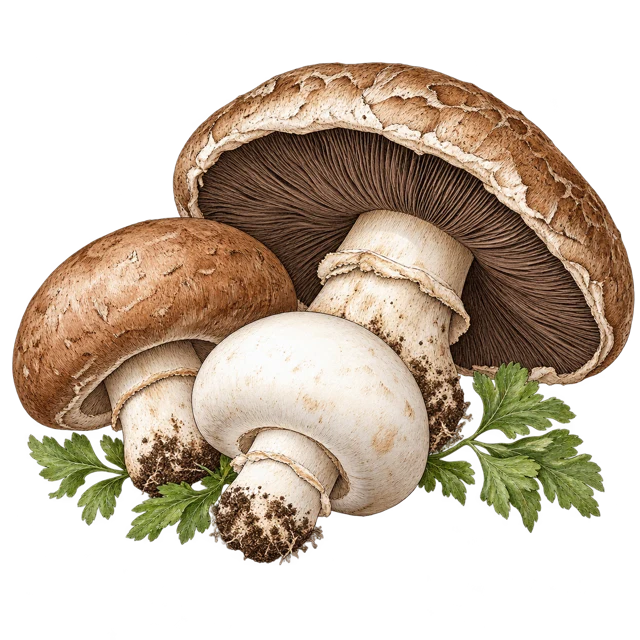
Agaricus bisporus makes an important point about food names: one species can acquire several identities in the kitchen. White button mushrooms come from white lines; brown cremini mature into the large caps sold as portobello. White mushrooms do not simply become brown cremini with age.
Genetic research connects the crop’s domestication with early-eighteenth-century France and its later industrial expansion. Selection, cultivation and harvest timing helped a mushroom become a year-round staple, while giving cooks several textures and formats from the same species.
A closer look at its history
Three market names, one cultivated species
The button–cremini–portobello progression illustrates how marketing and harvest age create apparent diversity without requiring different species. Genetic research on global strains traces domestication and breeding, offering a more precise history than calling each supermarket form a separate mushroom.
Additional history reviewed 2026-10-09
Traditional, historical and reported uses
- Culinary food traditions
Food or household practiceWhy this label?
The claim documents culinary food traditions as a culinary, craft, gardening, or practical material use; it reports neither a treatment outcome nor measured nutrient content.
White and brown mushrooms are sautéed or roasted for everyday dishes. Whole caps offer a format for stuffed or grilled dishes; large mature portobello caps are a distinct culinary market form of the same species. Pizza toppings and chopped mixed dishes make use of the mushroom’s versatile flavour and texture.
- A cultivated commercial crop
Food or household practiceWhy this label?
The claim documents a cultivated commercial crop as a culinary, craft, gardening, or practical material use; it reports neither a treatment outcome nor measured nutrient content.
Controlled cultivation and strain selection underpin a major global food industry rooted in French cultivation history.
- Horticultural reuse of spent substrate
Food or household practiceWhy this label?
The claim documents horticultural reuse of spent substrate as a culinary, craft, gardening, or practical material use; it reports neither a treatment outcome nor measured nutrient content.
After an Agaricus crop is harvested, the remaining growing substrate can be reused as a soil amendment, including in turf management. This is a use of the cultivation residue, not the mushroom caps. Fresh material can be too salty for sensitive plants, so substrate condition and the intended planting matter.
- Vitamin-D-enriched food production
Mixed/contextual sourcesWhy this label?
The claim combines UV-B food-processing experiments with historical commercial-production reporting; no actual finished-product nutrient measurement is given.
Commercial food processing uses controlled ultraviolet exposure to raise vitamin D2 in A. bisporus. USDA research examined post-harvest UV-B treatment and storage, and its 2008 report documented a commercial line of treated white, brown and portobello mushrooms. This is a food-manufacturing application; the finished product’s label determines its nutrient content.
Four distinct roles are documented: culinary food, commercial cultivation, horticultural reuse of spent growing substrate and vitamin-D-enriched food production. Different dishes and market forms remain examples within the culinary use.
Story sources
- Global strain study of Agaricus bisporus domestication
- Wageningen: Genetic basis of white and brown cap colour
- Mushroom Council: white button culinary applications
- Wellcome Sanger Institute: Agaricus bisporus taxonomy
- Primary analysis: Bioactive Compounds and Volatile Profiles of Five Transylvanian Wild Edible Mushrooms
- USDA ARS: Vitamin D and sterol composition of ten types of mushrooms
- Penn State Extension: Basic Procedures for Agaricus Mushroom Growing
- Penn State Extension: Spent Mushroom Substrate as a Soil Amendment in Turf
- USDA ARS: Vitamin D2 Formation from Post-Harvest UV-B Treatment of Mushrooms (Agaricus bisporus) and Retention during Storage
- USDA ARS: Vitamin D-Rich Mushrooms, A Research Success (2008 historical report)
Features and lookalikes to study
Agaricus bisporus. White and brown cultivars are one species; cremini and mature portobello are brown-market forms.
Common names vary between regions and suppliers; the scientific scope above governs this card.
Morphology described in sources
- White button, brown cremini and mature brown portobello are cultivated forms or stages of Agaricus bisporus. A commercial food label is not a method for identifying a white or brown garden mushroom.
- Habitat and substrate
- See the source-linked morphology and comparison notes below; a separate habitat summary has not been verified for this card.
- Geographic scope
- A complete regional range is not established here. Broad common names and commercial labels can span different species.
- Season in the cited region
- No region-specific fruiting season has been verified for this card. Do not infer a local season from trade availability.
Agaricus xanthodermus and related yellow-stainers (poisonous)
Yellow-stainers can resemble cultivated Agaricus. Bright yellow staining at the stem base and a phenolic odour may be informative warning features.
Staining changes with time and may be weak; people differ in odour perception. Other Agaricus also yellow, so neither presence nor absence of one reaction determines safety.
Amanita phalloides and destroying-angel Amanita (potentially lethal)
Amanita can have a volva and pale mature gills, whereas Agaricus mature gills become brown.
Immature gills are concealed; a volva can be buried, damaged or left behind. White caps or dark gills are not a complete identification rule.
Limits and regional differences
- Agaricus species-level identification is difficult and may require microscopic characters and expert assessment. Buy known cultivated material instead of identifying garden mushrooms by resemblance to grocery produce.
- Educational comparison only. Neither this card, an illustration, a photograph, a spore-print colour nor a checklist establishes that a wild collection is safe to eat. A qualified local mycologist must assess uncertain material; do not taste an unknown fungus. Cooking does not reliably eliminate mushroom toxins.
Regional reading paths
These sourced notes describe cultivation, trade, food traditions or material history. A regional connection does not claim exclusive origin.
Europe
Cultivated: Ireland, UK and continental European mushroom industries.
Different maturity/colour forms of one cultivated food species.
North America
Cultivated: United States, especially Pennsylvania.
Common cultivated culinary mushroom in several maturity forms.
Identity & detailed reference
Identity
Agaricus bisporus. White and brown cultivars are one species; cremini and mature portobello are brown-market forms.
Ingredient details, preparation and research
Also known as: White button mushroom; Cremini; Crimini; Portobello; Portabella; Champignon de Paris
Source plant or material
Cultivated A. bisporus fruiting bodies. White and brown cultivars are one species; cremini are young brown mushrooms and portobello are mature brown mushrooms.
Fungal family: Agaricaceae
Forms and route
Fresh white or brown mushrooms, mature portobello caps, and commercial dried, frozen or canned products.
Vitamins and minerals
USDA analyses show that vitamin D2 depends strongly on UV treatment and varies among products. Use the actual product’s nutrition label; white, brown and mature market forms should not be assumed nutritionally identical.
Absorption and preparation
Choose preparation for the dish: sliced mushrooms, chopped mixtures or whole caps. Neither brown cap colour nor maturity is a medicinal absorption enhancement.
Traditional and reported uses
- Culinary food traditions: White and brown mushrooms are sautéed or roasted for everyday dishes. Whole caps offer a format for stuffed or grilled dishes; large mature portobello caps are a distinct culinary market form of the same species. Pizza toppings and chopped mixed dishes make use of the mushroom’s versatile flavour and texture.
- A cultivated commercial crop: Controlled cultivation and strain selection underpin a major global food industry rooted in French cultivation history.
- Horticultural reuse of spent substrate: After an Agaricus crop is harvested, the remaining growing substrate can be reused as a soil amendment, including in turf management. This is a use of the cultivation residue, not the mushroom caps. Fresh material can be too salty for sensitive plants, so substrate condition and the intended planting matter.
- Vitamin-D-enriched food production: Commercial food processing uses controlled ultraviolet exposure to raise vitamin D2 in A. bisporus. USDA research examined post-harvest UV-B treatment and storage, and its 2008 report documented a commercial line of treated white, brown and portobello mushrooms. This is a food-manufacturing application; the finished product’s label determines its nutrient content.
Contraindications and cautions
- Use cultivated food-grade mushrooms and normal food hygiene; this card cannot establish the identity of a wild Agaricus.
- UV-treated vitamin D products need their own labels; ordinary mushrooms are not a standardized supplement.
Fungus, family and material
Agaricus bisporus. Agaricaceae. Cultivated A. bisporus fruiting bodies. White and brown cultivars are one species; cremini are young brown mushrooms and portobello are mature brown mushrooms.
- Global strain study of Agaricus bisporus domestication
- Wageningen: Genetic basis of white and brown cap colour
- Mushroom Council: white button culinary applications
- Wellcome Sanger Institute: Agaricus bisporus taxonomy
- Primary analysis: Bioactive Compounds and Volatile Profiles of Five Transylvanian Wild Edible Mushrooms
- USDA ARS: Vitamin D and sterol composition of ten types of mushrooms
Preparation and evidence
Choose preparation for the dish: sliced mushrooms, chopped mixtures or whole caps. Neither brown cap colour nor maturity is a medicinal absorption enhancement.
- Global strain study of Agaricus bisporus domestication
- Wageningen: Genetic basis of white and brown cap colour
- Mushroom Council: white button culinary applications
- Wellcome Sanger Institute: Agaricus bisporus taxonomy
- Primary analysis: Bioactive Compounds and Volatile Profiles of Five Transylvanian Wild Edible Mushrooms
- USDA ARS: Vitamin D and sterol composition of ten types of mushrooms
Constituents and nutrition
Protein, carbohydrates, fatty acids, phenolic compounds and ergosterol are documented. Ultraviolet exposure can increase vitamin D2; untreated and UV-treated products differ. USDA analyses show that vitamin D2 depends strongly on UV treatment and varies among products. Use the actual product’s nutrition label; white, brown and mature market forms should not be assumed nutritionally identical.
- Global strain study of Agaricus bisporus domestication
- Wageningen: Genetic basis of white and brown cap colour
- Mushroom Council: white button culinary applications
- Wellcome Sanger Institute: Agaricus bisporus taxonomy
- Primary analysis: Bioactive Compounds and Volatile Profiles of Five Transylvanian Wild Edible Mushrooms
- USDA ARS: Vitamin D and sterol composition of ten types of mushrooms
History and documented uses
Agaricus bisporus makes an important point about food names: one species can acquire several identities in the kitchen. White button mushrooms come from white lines; brown cremini mature into the large caps sold as portobello. White mushrooms do not simply become brown cremini with age. Genetic research connects the crop’s domestication with early-eighteenth-century France and its later industrial expansion. Selection, cultivation and harvest timing helped a mushroom become a year-round staple, while giving cooks several textures and formats from the same species.
- Global strain study of Agaricus bisporus domestication
- Wageningen: Genetic basis of white and brown cap colour
- Mushroom Council: white button culinary applications
- Wellcome Sanger Institute: Agaricus bisporus taxonomy
- Primary analysis: Bioactive Compounds and Volatile Profiles of Five Transylvanian Wild Edible Mushrooms
- USDA ARS: Vitamin D and sterol composition of ten types of mushrooms
Safety and interpretation
Use cultivated food-grade mushrooms and normal food hygiene; this card cannot establish the identity of a wild Agaricus. UV-treated vitamin D products need their own labels; ordinary mushrooms are not a standardized supplement.
- Global strain study of Agaricus bisporus domestication
- Wageningen: Genetic basis of white and brown cap colour
- Mushroom Council: white button culinary applications
- Wellcome Sanger Institute: Agaricus bisporus taxonomy
- Primary analysis: Bioactive Compounds and Volatile Profiles of Five Transylvanian Wild Edible Mushrooms
- USDA ARS: Vitamin D and sterol composition of ten types of mushrooms
Entry sources
- Global strain study of Agaricus bisporus domestication
- Wageningen: Genetic basis of white and brown cap colour
- Mushroom Council: white button culinary applications
- Wellcome Sanger Institute: Agaricus bisporus taxonomy
- Primary analysis: Bioactive Compounds and Volatile Profiles of Five Transylvanian Wild Edible Mushrooms
- USDA ARS: Vitamin D and sterol composition of ten types of mushrooms
- Penn State Extension: Basic Procedures for Agaricus Mushroom Growing
- Penn State Extension: Spent Mushroom Substrate as a Soil Amendment in Turf
- USDA ARS: Vitamin D2 Formation from Post-Harvest UV-B Treatment of Mushrooms (Agaricus bisporus) and Retention during Storage
- USDA ARS: Vitamin D-Rich Mushrooms, A Research Success (2008 historical report)
Reference entry 222 · Recorded content review: 2026-10-08 · Review scope and dates