


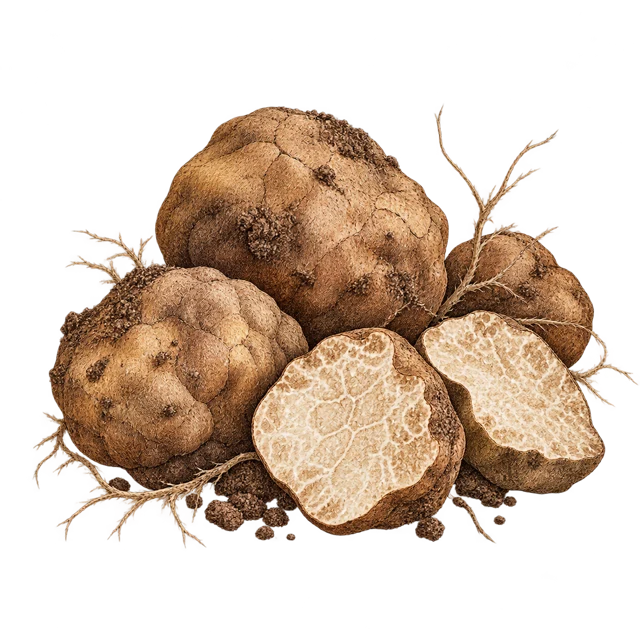
Key cautions
- Historical accounts of raw eating are not contemporary safety recommendations.
- Do not infer edibility of an unknown underground fungus from a regional name or photograph.
What’s inside
A single constituent profile cannot responsibly represent this regional multi-species group. The historical and taxonomic sources establish diversity and food use rather than a uniform medicinal chemical composition.
Uses in brief

- Roasted or ash-baked food
- Seasonal food gathering
- Oral environmental knowledge
History, folklore and reported uses
History, folklore and traditional uses
Australian desert truffles are not the gourmet Tuber species of Europe, nor are they one Australian species. Research records several central Australian taxa, including Elderia arenivaga and Mycoclelandia bulundari, within a food history sustained by Aboriginal ecological knowledge.
The Australian National Botanic Gardens describes a Pitjantjatjara link between witita, truffle, and wititata, grey shrike-thrush: a post-rain bird call is associated with truffle growth. This is particular environmental lore, not proof that birds cause the fungi to grow or that the story identifies one scientific species.
A closer look at its history
A bird call linked with rain
The Botanic Gardens account records a Pitjantjatjara relationship between witita, truffle, and wititata, the grey shrike-thrush. A post-rain call is linked in the account with truffle growth. Present this as locally attributed environmental lore, not as a literal biological cause or a field identification test.
Collection history is not discovery history
A documented non-Aboriginal collection of E. arenivaga dates to the Elder expedition in 1891. That museum/scientific record is a different event from Aboriginal knowledge and use, which preceded it. Avoid describing the expedition as discovering the food for everyone.
Additional history reviewed 2026-10-09
Traditional, historical and reported uses
- Roasted or ash-baked food
Food or household practiceWhy this label?
The claim documents roasted or ash-baked food as a culinary, craft, gardening, or practical material use; it reports neither a treatment outcome nor measured nutrient content.
Research documents roasting or baking in ashes within the regional truffle food tradition. The record concerns a group rather than a single universal species.
- Seasonal food gathering
Food or household practiceWhy this label?
The claim documents seasonal food gathering as a culinary, craft, gardening, or practical material use; it reports neither a treatment outcome nor measured nutrient content.
Knowledge of landscape and rainfall supports seasonal food gathering in the documented central Australian communities.
- Oral environmental knowledge
Traditional accountWhy this label?
The claim describes Pitjantjatjara orally conveyed environmental knowledge, a culturally attributed traditional account.
The Pitjantjatjara bird-and-truffle association conveys ecological and cultural knowledge about rain and food availability.
Three well-supported food and cultural roles are included. No uniform medicinal or nutritional profile can be assigned to this diverse group.
Story sources
- Trappe et al. 2008: Desert truffles of the Australian Outback
- Author-hosted Australian Outback truffle research
- Australian National Botanic Gardens: desert truffle case study
- Trappe et al. 2010: Comparative taxonomy of desert truffles
- Atlas of Living Australia / AusFungi: Elderia arenivaga, Pezizaceae
- NCBI Taxonomy with primary taxonomic reference: Mycoclelandia bulundari
Features and lookalikes to study
A group including Elderia arenivaga (formerly Choiromyces aboriginum) and Mycoclelandia bulundari; other taxa occur.
Common names vary between regions and suppliers; the scientific scope above governs this card.
Morphology described in sources
- This is a regional multi-species group of underground fungi, including Elderia arenivaga and Mycoclelandia bulundari. The genera are not interchangeable and include distinct internal/spore anatomies.
- Habitat and substrate
- See the source-linked morphology and comparison notes below; a separate habitat summary has not been verified for this card.
- Geographic scope
- A complete regional range is not established here. Broad common names and commercial labels can span different species.
- Season in the cited region
- No region-specific fruiting season has been verified for this card. Do not infer a local season from trade availability.
Other Australian desert-truffle genera: Mattirolomyces, Reddellomyces, Ulurua and Horakiella
Taxonomic research distinguishes several superficially similar underground fungi, even including both ascomycetes and a basidiomycete in the regional assemblage.
A smooth round exterior, desert habitat or soil crack cannot establish genus, species or edibility. Microscopy and sometimes sequence data are needed.
Scleroderma and other earthball-like fungi
Some poisonous rounded fungi may be casually called truffles.
This is a broad identification warning, not a claim that every desert species shares one poisonous twin. Do not use a pale interior or an animal’s interest as a safety test.
Limits and regional differences
- Respect local Aboriginal knowledge as community-specific; do not turn a recorded food name into a scientific identity for an unknown specimen. Older Choiromyces aboriginum records correspond to the Elderia arenivaga naming history.
- Educational comparison only. Neither this card, an illustration, a photograph, a spore-print colour nor a checklist establishes that a wild collection is safe to eat. A qualified local mycologist must assess uncertain material; do not taste an unknown fungus. Cooking does not reliably eliminate mushroom toxins.
Regional reading paths
These sourced notes describe cultivation, trade, food traditions or material history. A regional connection does not claim exclusive origin.
Australia & Oceania
native; central Australia
Documented Aboriginal seasonal food traditions.
Identity & detailed reference
Identity
A group including Elderia arenivaga (formerly Choiromyces aboriginum) and Mycoclelandia bulundari; other taxa occur.
Ingredient details, preparation and research
Also known as: Australian desert truffles; Choiromyces aboriginum (older name associated with E. arenivaga); Witita (Pitjantjatjara truffle term; not a secure species identification)
Source plant or material
Underground fruiting bodies of several central Australian fungi. Species identity and specific community use must be kept separate.
Fungal family: Pezizaceae for the named anchors Elderia arenivaga and Mycoclelandia bulundari; a regional group, not one species
Forms and route
Seasonal food in documented traditions, including roasted or ash-baked truffles; no standardized supplement form.
Vitamins and minerals
Documented as seasonal food, but no reliable shared serving or nutrient profile is assigned across these taxa. Food heritage alone does not establish a vitamin/mineral claim.
Absorption and preparation
Historical roasting and ash baking are described as cultural food practices. Old accounts of raw eating are not current safety advice, and no foraging or medicinal preparation protocol is supplied.
Traditional and reported uses
- Research documents roasting or baking in ashes within the regional truffle food tradition. The record concerns a group rather than a single universal species.
- Knowledge of landscape and rainfall supports seasonal food gathering in the documented central Australian communities.
- The Pitjantjatjara bird-and-truffle association conveys ecological and cultural knowledge about rain and food availability.
Contraindications and cautions
- Historical accounts of raw eating are not contemporary safety recommendations.
- Do not infer edibility of an unknown underground fungus from a regional name or photograph.
- A 2008 report of declining use is a dated observation, not evidence of current loss across all communities.
Similar items and how they compare
- Kalahari truffle
Both connect desert fungi, rain and local food knowledge.
Kalahari truffle here is one named African species; Australian desert truffles are a regional multi-species group.
Fungus, family and material
Australian desert-truffle group, including Elderia arenivaga and Mycoclelandia bulundari. Pezizaceae for the named anchors Elderia arenivaga and Mycoclelandia bulundari; a regional group, not one species. Underground fruiting bodies of several central Australian fungi. Species identity and specific community use must be kept separate.
- Trappe et al. 2008: Desert truffles of the Australian Outback
- Author-hosted Australian Outback truffle research
- Australian National Botanic Gardens: desert truffle case study
- Trappe et al. 2010: Comparative taxonomy of desert truffles
- Atlas of Living Australia / AusFungi: Elderia arenivaga, Pezizaceae
- NCBI Taxonomy with primary taxonomic reference: Mycoclelandia bulundari
Preparation and evidence
Historical roasting and ash baking are described as cultural food practices. Old accounts of raw eating are not current safety advice, and no foraging or medicinal preparation protocol is supplied.
- Trappe et al. 2008: Desert truffles of the Australian Outback
- Author-hosted Australian Outback truffle research
- Australian National Botanic Gardens: desert truffle case study
- Trappe et al. 2010: Comparative taxonomy of desert truffles
- Atlas of Living Australia / AusFungi: Elderia arenivaga, Pezizaceae
- NCBI Taxonomy with primary taxonomic reference: Mycoclelandia bulundari
Constituents and nutrition
A single constituent profile cannot responsibly represent this regional multi-species group. The historical and taxonomic sources establish diversity and food use rather than a uniform medicinal chemical composition. Documented as seasonal food, but no reliable shared serving or nutrient profile is assigned across these taxa. Food heritage alone does not establish a vitamin/mineral claim.
- Trappe et al. 2008: Desert truffles of the Australian Outback
- Author-hosted Australian Outback truffle research
- Australian National Botanic Gardens: desert truffle case study
- Trappe et al. 2010: Comparative taxonomy of desert truffles
- Atlas of Living Australia / AusFungi: Elderia arenivaga, Pezizaceae
- NCBI Taxonomy with primary taxonomic reference: Mycoclelandia bulundari
History and documented uses
Australian desert truffles are not the gourmet Tuber species of Europe, nor are they one Australian species. Research records several central Australian taxa, including Elderia arenivaga and Mycoclelandia bulundari, within a food history sustained by Aboriginal ecological knowledge. The Australian National Botanic Gardens describes a Pitjantjatjara link between witita, truffle, and wititata, grey shrike-thrush: a post-rain bird call is associated with truffle growth. This is particular environmental lore, not proof that birds cause the fungi to grow or that the story identifies one scientific species.
- Trappe et al. 2008: Desert truffles of the Australian Outback
- Author-hosted Australian Outback truffle research
- Australian National Botanic Gardens: desert truffle case study
- Trappe et al. 2010: Comparative taxonomy of desert truffles
- Atlas of Living Australia / AusFungi: Elderia arenivaga, Pezizaceae
- NCBI Taxonomy with primary taxonomic reference: Mycoclelandia bulundari
Safety and interpretation
Historical accounts of raw eating are not contemporary safety recommendations. Do not infer edibility of an unknown underground fungus from a regional name or photograph. A 2008 report of declining use is a dated observation, not evidence of current loss across all communities.
- Trappe et al. 2008: Desert truffles of the Australian Outback
- Author-hosted Australian Outback truffle research
- Australian National Botanic Gardens: desert truffle case study
- Trappe et al. 2010: Comparative taxonomy of desert truffles
- Atlas of Living Australia / AusFungi: Elderia arenivaga, Pezizaceae
- NCBI Taxonomy with primary taxonomic reference: Mycoclelandia bulundari
Entry sources
- Trappe et al. 2008: Desert truffles of the Australian Outback
- Author-hosted Australian Outback truffle research
- Australian National Botanic Gardens: desert truffle case study
- Trappe et al. 2010: Comparative taxonomy of desert truffles
- Atlas of Living Australia / AusFungi: Elderia arenivaga, Pezizaceae
- NCBI Taxonomy with primary taxonomic reference: Mycoclelandia bulundari
Reference entry 231 · Recorded content review: 2026-10-08 · Review scope and dates