


Key cautions
- Check Cedrus atlantica wood oil; Juniperus cedarwoods and Thuja leaf oil differ
- Do not swallow or use neat; stop for irritation or fragrance reactions
What’s inside
Sesquiterpenes commonly include alpha-, beta- and gamma-himachalene, with variable himachalol, atlantones and related compounds. Origin and processing alter the profile.
Uehara et al. (2017): Odor-active constituents of Cedrus atlantica wood essential oil · Ailli et al. (2023): Composition and laboratory activities of six aromatic-plant oils
Chemistry and scent are different measurements
A 2023 Moroccan wood-oil analysis found beta-himachalene about 40%, alpha-himachalene about 16% and gamma-himachalene about 10%; these are one sample’s results, not a universal specification. The earlier 12-panelist GC-olfactometry study found strong odor contributions from small constituents, including vestitenone. It even found the tested atlantones odorless under its assay conditions. A large GC percentage or strong smell cannot be translated into a medicinal dose.
Ailli et al. (2023): Composition and laboratory activities of six aromatic-plant oils · Uehara et al. (2017): Odor-active constituents of Cedrus atlantica wood essential oil · Ailli et al. (2023): Full text, methods and Table 9 oil-relative abundance
Reading an oil analysis
The percentages describe relative abundance in the analyzed essential oil, as reported in the study’s chromatographic table; they are not percentages of the original wood, nutrient amounts or recommended skin concentrations. The 2023 analysis used retention indices and mass spectra to assign constituents. Such laboratory assignments describe that sample rather than a guaranteed specification for every bottle. Extraction yield is a different measure: volume of recovered oil relative to dry plant mass. Neither measurement states a safe human dose.
Ailli et al. (2023): Full text, methods and Table 9 oil-relative abundance
Uses in brief

- Woody perfumery and formulated cosmetic fragrance
- Limited alopecia-areata blend research; no established cedarwood-alone treatment
- Scalp evidence: Atlas cedarwood appeared in a small essential-oil blend study; individual growth or circulation benefit is unestablished.
History, folklore and reported uses
Botanical identity and material boundaries
Kew accepts Atlas cedar as Cedrus atlantica in Pinaceae. The cosmetic ingredient is obtained from wood. Virginia and Texas cedarwood oils originate from Juniperus species and differ chemically and in odor; Thuja foliage oil is separate again. Matching a common name alone is unsafe, and findings from a cedar leaf, seed, wood tar or extract do not automatically describe this distilled wood oil.
Kew: Cedrus atlantica, accepted name and Pinaceae family · COSMILE Europe: Cedrus atlantica wood oil, cosmetic fragrance role · Uehara et al. (2017): Odor-active constituents of Cedrus atlantica wood essential oil · MedlinePlus: Cedar-leaf oil poisoning
History and defensible cosmetic role
Atlas wood has a long practical aromatic-timber history in North Africa; modern production can use sawdust from wood processing. COSMILE lists the distilled wood oil as a fragrance ingredient. Hair/scalp inclusion therefore has a clear scent role, while the 1998 investigators described longstanding anecdotal use of aromatic mixtures for alopecia. Anecdote and pleasant aroma do not establish scalp-sebum regulation.
Uehara et al. (2017): Odor-active constituents of Cedrus atlantica wood essential oil · COSMILE Europe: Cedrus atlantica wood oil, cosmetic fragrance role · Hay et al. (1998): Four-essential-oil scalp blend in alopecia areata
North African wood and sawmill history
Atlas cedarwood oil belongs to the mountain forests and woodworking economy of Morocco and neighbouring North Africa. Cedrus atlantica timber has long been valued for construction and craft, and its aromatic character is part of that material appeal. The oil offers another route for the wood: researchers have documented the recovery of essential oil from Moroccan cedar sawdust, including material collected at an Azrou sawmill in the Middle Atlas. The scent in a small bottle can therefore begin with the by-products of a much larger timber trade.
Chalchat et al. (1994): Essential Oil Components in Sawdust of Cedrus atlantica from Morocco · Fidah et al. (2016): Cedrus atlantica wood essential oil from Azrou sawmill material · Uehara et al. (2017): Odor-active constituents of Cedrus atlantica wood essential oil
A distinct perfumery history
The modern perfumery story has its own depth. A study of the wood’s odour-active constituents traces chemical work on Atlas cedarwood oil to 1902 and explains the continuing effort to identify what creates its characteristic smell. This is a sounder lineage for this particular distillate than attaching every ancient ‘cedar’ reference to it. Lebanon cedar, junipers sold as cedarwood, wood smoke and tar preparations have separate identities; famous accounts of temples or embalming do not by themselves identify modern Atlas cedar essential oil.
Chalchat et al. (1994): Essential Oil Components in Sawdust of Cedrus atlantica from Morocco · Fidah et al. (2016): Cedrus atlantica wood essential oil from Azrou sawmill material · Uehara et al. (2017): Odor-active constituents of Cedrus atlantica wood essential oil
Grounding during stress or meditation
AromaWeb’s founder describes Atlas cedarwood oil as grounding and calming, especially during conflict or reflective practice. This is a contemporary use of Cedrus atlantica wood distillate.
AromaWeb: Atlas cedarwood essential oil, species-specific practitioner uses
Cough and chest aromatherapy
The profile’s Julia Lawless-based repertoire includes cough and bronchitis. These respiratory-care intentions belong to modern aromatic practice rather than unidentified ancient cedar incense.
AromaWeb: Atlas cedarwood essential oil, species-specific practitioner uses · National Capital Poison Center: Essential oils can be poisonous when misused · DermNet: Allergic contact dermatitis to essential oils
Oily, blemished or irritated skin
AromaWeb records Atlas cedarwood oil for acne and dermatitis in the practitioner literature. The intended application is an appropriate aromatic skin preparation.
AromaWeb: Atlas cedarwood essential oil, species-specific practitioner uses · National Capital Poison Center: Essential oils can be poisonous when misused · DermNet: Allergic contact dermatitis to essential oils
Scalp and dandruff care
Dandruff is another separately listed use in the Atlas cedarwood profile. Its place in aromatic hair care concerns the wood oil, not cedar tar or a juniper-derived cedarwood oil.
AromaWeb: Atlas cedarwood essential oil, species-specific practitioner uses
Arthritic and joint discomfort
Lawless’s repertoire, as reproduced by AromaWeb, also includes arthritis. This retains the oil’s reported role in comfort-oriented body care alongside its better-known grounding scent.
AromaWeb: Atlas cedarwood essential oil, species-specific practitioner uses
A lasting woody perfume base
IFF identifies Moroccan Cedrus atlantica wood essential oil, obtained by hydrodistillation, as a fragrance ingredient. Its lasting woody and resinous character supplies a perfume base; this is the exact Atlas oil, not a Juniperus cedarwood substitute.
Urinary-care intentions in practitioner literature
The same Lawless-based list reproduced by AromaWeb includes cystitis, meaning bladder inflammation. This is an attributed aromatic-practice claim, not evidence from a clinical urinary-infection trial.
AromaWeb: Atlas cedarwood essential oil, species-specific practitioner uses
Regional reading paths
These sourced notes describe cultivation, trade, food traditions or material history. A regional connection does not claim exclusive origin.
Africa
Native/processed: Morocco and Algeria’s Atlas cedar region.
Wood-distilled fragrance oil for formulated products.
Identity & detailed reference
Identity
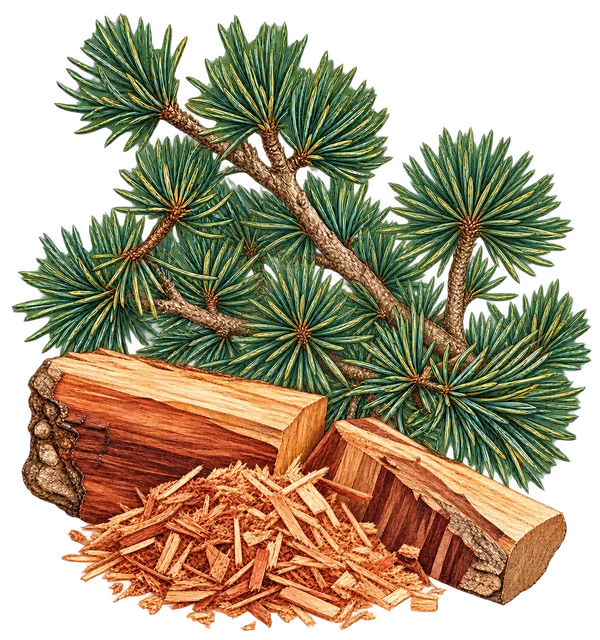
Cedrus atlantica (Endl.) G.Manetti ex Carrière wood essential oil, commonly hydrodistilled or steam-distilled from wood chips, heartwood or sawdust. Atlas cedar is a true cedar in Pinaceae; Virginia/Texas cedarwoods are Juniperus materials, and Thuja cedar-leaf oil is another distinct preparation.
Ingredient details, preparation and research
Source plant or material
Cedrus atlantica (Endl.) G.Manetti ex Carrière; wood, including heartwood or sawdust, is the source of the oil covered here.
Plant family / material: Pinaceae (pine family).
Forms and route
Concentrated volatile wood oil; aromatic/perfumery ingredient and ingredient in finished skin, massage or scalp products. Cedar leaf, seed oil, tar, solvent extract and a carrier oil are different materials. A label saying only cedarwood is insufficient for substitution.
Food sources
Not a routine food or nutrient source. A cosmetic/aromatherapy bottle is not a culinary ingredient.
Vitamins and minerals
This distilled fragrance is not a dietary vitamin, mineral or essential-fat source. Topical or aromatic exposure supplies no established nutritional serving. Do not calculate food-oil calories, tablespoon nutrients or a percent Daily Value for it.
Absorption and preparation
Volatile molecules can be encountered through inhalation and skin contact, but scent intensity and a count of drops do not quantify an effective absorbed dose. No validated Atlas-cedarwood human exposure–response or absorption-boosting regimen was identified. A carrier controls contact and spreading; it does not prove delivery to hair follicles or treatment benefit.
Practical preparation
Choose a finished product that specifies Cedrus atlantica wood oil and the intended skin or aroma use. Follow that product’s directions and storage/expiry information. Do not copy the old trial’s multi-oil recipe, convert drops universally to milliliters, or add undispersed concentrate directly to a bath. A small-area tolerance check does not exclude delayed allergy.
Combination notes
A fragrance blend may be chosen for scent. The alopecia comparison included four essential oils and two carriers, with scalp massage in both groups; it cannot identify the effective component or demonstrate pharmacological synergy. Adding more oils increases formulation complexity and potential allergens.
Traditional and reported uses
- Woody fragrance in perfume, aromatic blends and formulated personal-care products; the cosmetic function is scent.
- Included with thyme, lavender and rosemary in an older alopecia-areata scalp trial. This is limited combination evidence, not proof that Atlas cedarwood alone regrows hair.
- Laboratory antioxidant and antimicrobial findings are research observations; they do not establish treatment of scalp infection, dandruff, acne or respiratory disease.
- Scalp evidence: Atlas cedarwood appeared in a small essential-oil blend study; individual growth or circulation benefit is unestablished.
Contraindications and cautions
- Use only by the labeled external/aromatic route; avoid neat skin application, eyes and ingestion. Keep the concentrate away from children.
- Confirm the species and plant part. Thuja cedar-leaf oil can cause serious poisoning and cannot replace Atlas wood oil.
- Fragrance can irritate or cause allergy. Stop for rash or breathing discomfort; do not keep using an irritating scalp mixture to try to stimulate growth.
- Human interaction and pregnancy/child-use data for medicinal exposure are inadequate. Seek product-specific professional advice for these situations; a woody smell is not a safety test.
Similar items and how they compare
- Virginia/Texas cedarwood oils
Comparable woody perfumery names.
Usually Juniperus-derived; chemistry and safety assessment differ from Cedrus atlantica wood oil.
- Rosemary essential oil
Appeared in the same old alopecia-areata scalp mixture.
The blend cannot isolate either oil; rosemary has a different volatile profile.
- Frankincense essential oil
Another woody/resinous aromatic ingredient.
Distilled from Boswellia resin and commonly monoterpene-rich; not the same species or plant part.
What the alopecia study tested
The seven-month 1998 study compared daily scalp massage with thyme, rosemary, lavender and Atlas cedarwood oils in jojoba/grapeseed carriers against the carriers alone. Improvement was reported in 19/43 versus 6/41 participants. This concerned alopecia areata, an autoimmune pattern of hair loss, and cannot be generalized to every cause of thinning. Neither cedarwood alone nor synergy among the oils was tested.
A major trial-method limitation
Although the original paper called the allocation randomized, the authors’ 1999 reply explained that alternate participants received active treatment or the carrier control. Alternation is predictable allocation rather than a concealed random sequence, leaving selection-bias concerns. Distinctive fragrance also makes participant blinding difficult. These issues further lower confidence in the small blend study; its title should not be treated as definitive proof.
Laboratory work is not a treatment trial
The six-oil study chemically profiled the oils and tested microorganisms and antioxidant reactions outside the human body. Such assays can help generate hypotheses but do not establish a safe antimicrobial concentration on scalp or skin, nor prevention or cure of infection. No robust cedarwood-alone clinical efficacy evidence was identified in this targeted review.
Skin, inhalation and identity precautions
A formulated fragrance can still provoke contact allergy or irritation. Avoid eyes and mucosa, stop if symptoms occur, and obtain assessment for persistent scalp disease rather than escalating concentration. MedlinePlus specifically describes serious cedar-leaf-oil poisoning; that warning illustrates a hazardous naming substitution, rather than proving that all cedar oils have identical toxicology.
Absorption, nutrition and preparation
Aromatherapy involves exposure to volatile mixtures, with route and formulation affecting exposure. There is no validated nutritional serving or human dose-response for Atlas cedarwood here. Use product-specific directions instead of a universal drops conversion or an absorption-enhancing food combination; the old scalp mixture is a study description rather than a home prescription.
Hair care: cosmetic role and evidence limits
Atlas cedarwood essential oil appeared in the same thyme, rosemary and lavender blend used in a small alopecia-areata study. The small seven-month study concerned alopecia areata, not all forms of hair loss. It compared a blend with carrier oils and could not isolate an individual essential oil. The authors later described alternating allocation, which weakens the original randomization claim. The study is not a home-mixing recipe. There is insufficient clinical evidence that cedarwood alone improves hair growth or scalp circulation. Scent, warmth or tingling cannot establish improved circulation. Use only an appropriately formulated topical product according to its label; do not substitute another “cedar” species.
Entry sources
- Kew: Cedrus atlantica, accepted name and Pinaceae family
- COSMILE Europe: Cedrus atlantica wood oil, cosmetic fragrance role
- Uehara et al. (2017): Odor-active constituents of Cedrus atlantica wood essential oil
- Ailli et al. (2023): Composition and laboratory activities of six aromatic-plant oils
- Hay et al. (1998): Four-essential-oil scalp blend in alopecia areata
- Hay and Ormerod (1999): Author reply clarifying alternate-subject allocation
- MedlinePlus: Cedar-leaf oil poisoning
- National Capital Poison Center: Essential oils can be poisonous when misused
- DermNet: Allergic contact dermatitis to essential oils
- National Cancer Institute: Aromatherapy with essential oils, evidence and safety
- IFF LMR Naturals: Cedarwood Oil Atlas
- Hay et al. (1998): Essential-oil blend trial in alopecia areata
Reference entry 75 · Recorded content review: 2026-10-05 · Review scope and dates