


Key cautions
- If taking warfarin, keep vitamin-K intake consistent and discuss major dietary changes with your clinician.
- Wash leaves and follow recalls; home growing and an organic label do not make raw leaves sterile.
What’s inside
Fiber, carotenoids, vitamin C and vitamin K; amounts change with cultivar and preparation.
Uses in brief

- Raw salad
- Cooked greens
- Soup ingredient
History, folklore and reported uses
History, folklore and traditional uses
Utah State’s student farm newsletter describes kale as important in colder regions because it tolerates frost. It records the Scottish household kale-yard and kail-pot, with kail sometimes standing for dinner itself.
Modern Extension food guides preserve that everyday role while extending it to salads, smoothies and crisp baked chips. These are culinary adaptations, not evidence that kale needs to be eaten raw or concentrated to be useful food.
Traditional, historical and reported uses
- Raw salad
Food or household practiceWhy this label?
The claim documents raw salad as a culinary, craft, gardening, or practical material use; it reports neither a treatment outcome nor measured nutrient content.
Purdue documents raw kale salads.
- Cooked greens
Food or household practiceWhy this label?
The claim documents cooked greens as a culinary, craft, gardening, or practical material use; it reports neither a treatment outcome nor measured nutrient content.
Steaming or sautéing softens kale for a side dish.
- Soup ingredient
Food or household practiceWhy this label?
The claim documents soup ingredient as a culinary, craft, gardening, or practical material use; it reports neither a treatment outcome nor measured nutrient content.
Purdue includes chicken vegetable soup with kale.
- Smoothie ingredient
Food or household practiceWhy this label?
The claim documents smoothie ingredient as a culinary, craft, gardening, or practical material use; it reports neither a treatment outcome nor measured nutrient content.
Raw kale is included in the guide’s smoothie suggestions.
- Baked chips
Food or household practiceWhy this label?
The claim documents baked chips as a culinary, craft, gardening, or practical material use; it reports neither a treatment outcome nor measured nutrient content.
Purdue provides a kale-chip recipe as a crisp snack preparation.
Five distinct culinary applications are documented; these are food practices, not five medicinal indications.
Regional reading paths
These sourced notes describe cultivation, trade, food traditions or material history. A regional connection does not claim exclusive origin.
Europe
Cultivated: UK garden and winter vegetable crop.
Edible leaves cooked or prepared as a vegetable.
Identity & detailed reference
Identity
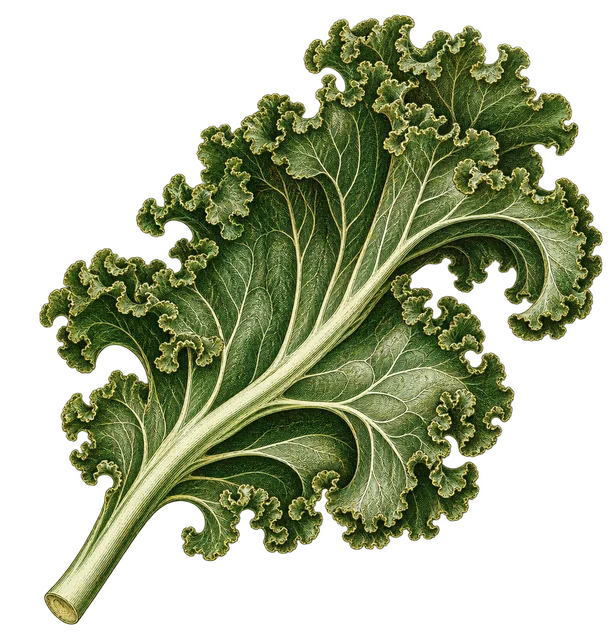
Edible kale leaves and tender stalks; kale is a culinary crop group rather than one uniformly named cultivar.
Ingredient details, preparation and research
Also known as: curly kale; lacinato kale; dinosaur kale
Source plant or material
Brassica oleracea L. leafy cultivars; some Russian/Siberian kales belong to B. napus L.; Edible kale leaves and tender stalks; kale is a culinary crop group rather than one uniformly named cultivar.
Plant family / material: Brassicaceae
Forms and route
Fresh or cooked leafy greens, frozen kale and baked chips; curly and lacinato forms differ in texture.
Vitamins and minerals
Kale contributes leafy-green nutrients including vitamin K and carotenoids. Cup measurements change greatly when leaves are chopped or cooked down; no unverified raw-to-cooked equivalence is supplied.
Absorption and preparation
Carotenoids and vitamin K are fat-soluble. Ordinary mixed meals are appropriate; no requirement for a large added-oil dose is established.
Practical preparation
Wash leaves, remove tough stems as needed and use raw or cook until tender. Store refrigerated.
Combination context
Kale works with grains, beans, eggs or other vegetables. People taking warfarin should keep vitamin-K intake consistent rather than suddenly adding large daily portions.
Traditional and reported uses
- Purdue documents raw kale salads.
- Steaming or sautéing softens kale for a side dish.
- Purdue includes chicken vegetable soup with kale.
- Raw kale is included in the guide’s smoothie suggestions.
- Purdue provides a kale-chip recipe as a crisp snack preparation.
Contraindications and cautions
- If taking warfarin, keep vitamin-K intake consistent and discuss major dietary changes with your clinician.
- Wash leaves and follow recalls; home growing and an organic label do not make raw leaves sterile.
Similar items and how they compare
- Collard greens
Both are leafy brassica vegetables.
Leaf form and culinary texture differ; portions and recipes are not nutritionally identical.
- Cabbage
Often the same species selected for a different crop form.
Heading cabbage and loose-leaved kale differ in structure and culinary use.
Food identity and preparation
Fresh or cooked leafy greens, frozen kale and baked chips; curly and lacinato forms differ in texture. Wash leaves, remove tough stems as needed and use raw or cook until tender. Store refrigerated.
Nutrition and evidence limits
Kale contributes leafy-green nutrients including vitamin K and carotenoids. Cup measurements change greatly when leaves are chopped or cooked down; no unverified raw-to-cooked equivalence is supplied. Carotenoids and vitamin K are fat-soluble. Ordinary mixed meals are appropriate; no requirement for a large added-oil dose is established.
Evidence limits
- Nutrient information is qualitative; no unverified USDA food code, portion or numerical analysis is supplied.
- Culinary history does not establish a treatment effect. No medicinal dose is proposed.
Entry sources
- Purdue Extension FoodLink: kale
- Utah State University Student Organic Farm: Kale newsletter, 2010
- Utah State University: Kale in the Garden
- NIH ODS: Vitamin K
- NIH ODS: Vitamin A and Carotenoids
- FDA: Selecting and Serving Produce Safely
- University of Wisconsin Extension: Growing Salad Greens, kale species
Reference entry 175 · Recorded content review: 2026-10-07 · Review scope and dates