


Key cautions
- Do not infer that an unknown mushroom is safe merely because it grows near termites.
- Use authenticated food-grade specimens; identification, storage and environmental contamination matter.
What’s inside
Studies of named Termitomyces species report protein, lipids, fibre and mineral residue; polysaccharides have been isolated from T. schimperi. Composition is species- and sample-dependent.
Uses in brief

- Cooked household food
- Seasonal market income
- Local naming and food knowledge
History, folklore and reported uses
History, folklore and traditional uses
Termitomyces broadens mushroom history beyond the familiar cultivated species of Europe and East Asia. A field survey near Lubumbashi records edible fungi and their Kilamba and Kibemba names among Lamba and Bemba people. Namibian work documents T. schimperi as food and an informal-market product.
Their relationship with fungus-growing termites is another form of agriculture in the ecosystem. For people, recognizing seasons and local taxa supports both household food and trade. A local name can cover several taxa, and a taxon can have several local names, so particular community knowledge deserves precise attribution.
A closer look at its history
The original fungal cultivators
Termites maintain fungus combs from collected plant matter, and Termitomyces breaks down that material within their mutualistic system. Humans value the mushrooms that sometimes emerge, adding seasonal food and income to a relationship that already existed underground. Local names and food traditions need attribution to particular communities rather than all of Africa.
Additional history reviewed 2026-10-09
Traditional, historical and reported uses
- Cooked household food
Food or household practiceWhy this label?
The claim documents cooked household food as a culinary, craft, gardening, or practical material use; it reports neither a treatment outcome nor measured nutrient content.
Named species are cooked and eaten in documented Lamba, Bemba and Namibian food traditions.
- Seasonal market income
Mixed/contextual sourcesWhy this label?
The research documents informal market sales and household consumption as economic context, not efficacy.
Namibian research records sale of T. schimperi through informal markets alongside household consumption.
- Local naming and food knowledge
Traditional accountWhy this label?
Community naming and food knowledge are ethnomycological traditions, rather than nutrient or intervention findings.
Kilamba and Kibemba naming records preserve distinctions and food knowledge within the studied communities.
- Studying fungus–termite partnerships
Mixed/contextual sourcesWhy this label?
The claim concerns fungus-termite ecology supported by taxonomic research; a laboratory or human study setting is not established.
Termitomyces provides a scientific model for the close relationships between fungus-growing termites and their cultivated fungi. This ecological research role is separate from human nutrition claims.
Four food, livelihood, knowledge and research roles are distinguished. Laboratory bioactivity has not been turned into human treatment claims.
Story sources
- Kasongo et al.: Edible fungi consumed by Lamba and Bemba people of Haut-Katanga
- University of Namibia: wild mushrooms as food and income
- FAO: wild useful fungi species list
- Primary taxonomic study: New species of Termitomyces, Lyophyllaceae, from Sabah
- Primary analysis: Nutrient content of Termitomyces species consumed in Cameroon
- University of Namibia: Extraction, purification, characterization and bioactivities of polysaccharides isolated from selected Namibian mushrooms
Features and lookalikes to study
Termitomyces species, with T. schimperi and T. titanicus as useful named anchors. This genus name is not an edibility guarantee.
Common names vary between regions and suppliers; the scientific scope above governs this card.
Morphology described in sources
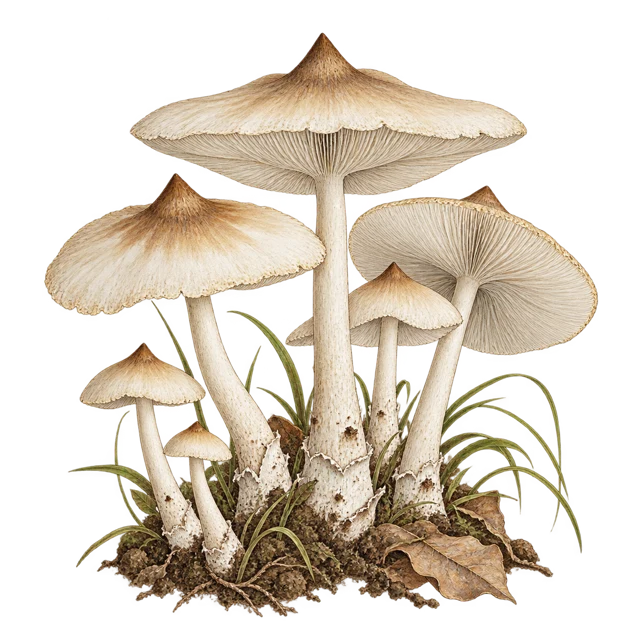
- Termitomyces lives with fungus-growing termites. Many species have a root-like pseudorhiza and a prominent central cap structure, but neither feature is universal. T. schimperi can lack an obvious perforatorium; tiny T. microcarpus lacks a long pseudorhiza.
- Habitat and substrate
- See the source-linked morphology and comparison notes below; a separate habitat summary has not been verified for this card.
- Geographic scope
- A complete regional range is not established here. Broad common names and commercial labels can span different species.
- Season in the cited region
- No region-specific fruiting season has been verified for this card. Do not infer a local season from trade availability.
Termitomyces schimperi, T. titanicus and T. letestui
Regional keys separate these large species by veil scales, cap-centre structure, proportions and microscopic characters. T. schimperi has conspicuous coarse veil scales; T. letestui has a conspicuous raised centre; T. titanicus can be exceptionally large.
Size overlaps and a juvenile giant is small. Species assignments need mature morphology, locality and specialist confirmation. Do not generalise a regional key across Africa and Asia.
Other pale, terrestrial gilled mushrooms near termite mounds
Termitomyces identity rests on a suite of anatomical and ecological evidence, not proximity to a mound.
This reference does not provide a reliable visual exclusion rule for every regional Amanita, Chlorophyllum or other gilled genus. Never equate “near termites” with edible.
Limits and regional differences
- A genus-level card is not an edible-species list. Species determination may require spores, cystidia and DNA. Do not dig apart termite colonies or destroy habitat simply to seek a confirming pseudorhiza.
- Educational comparison only. Neither this card, an illustration, a photograph, a spore-print colour nor a checklist establishes that a wild collection is safe to eat. A qualified local mycologist must assess uncertain material; do not taste an unknown fungus. Cooking does not reliably eliminate mushroom toxins.
Regional reading paths
These sourced notes describe cultivation, trade, food traditions or material history. A regional connection does not claim exclusive origin.
Africa
Native/traditional food: DR Congo, Zambia and other tropical African countries.
Correctly identified edible species cooked as food; genus alone is not an edibility guarantee.
Identity & detailed reference
Identity
Termitomyces species, with T. schimperi and T. titanicus as useful named anchors. This genus name is not an edibility guarantee.
Ingredient details, preparation and research
Also known as: Termite mushrooms; Omajowa (Namibian T. schimperi context)
Source plant or material
Authenticated edible fruiting bodies of locally recognized Termitomyces species; the genus name alone does not establish a specimen’s edibility.
Fungal family: Lyophyllaceae
Forms and route
Fresh cooked mushrooms and locally traded food mushrooms; experimental isolated polysaccharides are separate research materials.
Vitamins and minerals
Can contribute protein and other food nutrients. Published dry-weight analyses of particular species are not the composition of every fresh mushroom sold under a local name.
Absorption and preparation
Use correctly identified, food-grade mushrooms with proper storage and cooking. Neither termite association nor a common name is a sufficient identification or safety test.
Traditional and reported uses
- Named species are cooked and eaten in documented Lamba, Bemba and Namibian food traditions.
- Namibian research records sale of T. schimperi through informal markets alongside household consumption.
- Kilamba and Kibemba naming records preserve distinctions and food knowledge within the studied communities.
- Termitomyces provides a scientific model for the close relationships between fungus-growing termites and their cultivated fungi. This ecological research role is separate from human nutrition claims.
Contraindications and cautions
- Do not infer that an unknown mushroom is safe merely because it grows near termites.
- Use authenticated food-grade specimens; identification, storage and environmental contamination matter.
- Results for one Termitomyces species or extract do not apply automatically to the entire genus.
Fungus, family and material
Termitomyces species, including T. schimperi and T. titanicus. Lyophyllaceae. Authenticated edible fruiting bodies of locally recognized Termitomyces species; the genus name alone does not establish a specimen’s edibility.
- Kasongo et al.: Edible fungi consumed by Lamba and Bemba people of Haut-Katanga
- University of Namibia: wild mushrooms as food and income
- FAO: wild useful fungi species list
- Primary taxonomic study: New species of Termitomyces, Lyophyllaceae, from Sabah
- Primary analysis: Nutrient content of Termitomyces species consumed in Cameroon
- University of Namibia: Extraction, purification, characterization and bioactivities of polysaccharides isolated from selected Namibian mushrooms
Preparation and evidence
Use correctly identified, food-grade mushrooms with proper storage and cooking. Neither termite association nor a common name is a sufficient identification or safety test.
- Kasongo et al.: Edible fungi consumed by Lamba and Bemba people of Haut-Katanga
- University of Namibia: wild mushrooms as food and income
- FAO: wild useful fungi species list
- Primary taxonomic study: New species of Termitomyces, Lyophyllaceae, from Sabah
- Primary analysis: Nutrient content of Termitomyces species consumed in Cameroon
- University of Namibia: Extraction, purification, characterization and bioactivities of polysaccharides isolated from selected Namibian mushrooms
Constituents and nutrition
Studies of named Termitomyces species report protein, lipids, fibre and mineral residue; polysaccharides have been isolated from T. schimperi. Composition is species- and sample-dependent. Can contribute protein and other food nutrients. Published dry-weight analyses of particular species are not the composition of every fresh mushroom sold under a local name.
- Kasongo et al.: Edible fungi consumed by Lamba and Bemba people of Haut-Katanga
- University of Namibia: wild mushrooms as food and income
- FAO: wild useful fungi species list
- Primary taxonomic study: New species of Termitomyces, Lyophyllaceae, from Sabah
- Primary analysis: Nutrient content of Termitomyces species consumed in Cameroon
- University of Namibia: Extraction, purification, characterization and bioactivities of polysaccharides isolated from selected Namibian mushrooms
History and documented uses
Termitomyces broadens mushroom history beyond the familiar cultivated species of Europe and East Asia. A field survey near Lubumbashi records edible fungi and their Kilamba and Kibemba names among Lamba and Bemba people. Namibian work documents T. schimperi as food and an informal-market product. Their relationship with fungus-growing termites is another form of agriculture in the ecosystem. For people, recognizing seasons and local taxa supports both household food and trade. A local name can cover several taxa, and a taxon can have several local names, so particular community knowledge deserves precise attribution.
- Kasongo et al.: Edible fungi consumed by Lamba and Bemba people of Haut-Katanga
- University of Namibia: wild mushrooms as food and income
- FAO: wild useful fungi species list
- Primary taxonomic study: New species of Termitomyces, Lyophyllaceae, from Sabah
- Primary analysis: Nutrient content of Termitomyces species consumed in Cameroon
- University of Namibia: Extraction, purification, characterization and bioactivities of polysaccharides isolated from selected Namibian mushrooms
Safety and interpretation
Do not infer that an unknown mushroom is safe merely because it grows near termites. Use authenticated food-grade specimens; identification, storage and environmental contamination matter. Results for one Termitomyces species or extract do not apply automatically to the entire genus.
- Kasongo et al.: Edible fungi consumed by Lamba and Bemba people of Haut-Katanga
- University of Namibia: wild mushrooms as food and income
- FAO: wild useful fungi species list
- Primary taxonomic study: New species of Termitomyces, Lyophyllaceae, from Sabah
- Primary analysis: Nutrient content of Termitomyces species consumed in Cameroon
- University of Namibia: Extraction, purification, characterization and bioactivities of polysaccharides isolated from selected Namibian mushrooms
Entry sources
- Kasongo et al.: Edible fungi consumed by Lamba and Bemba people of Haut-Katanga
- University of Namibia: wild mushrooms as food and income
- FAO: wild useful fungi species list
- Primary taxonomic study: New species of Termitomyces, Lyophyllaceae, from Sabah
- Primary analysis: Nutrient content of Termitomyces species consumed in Cameroon
- University of Namibia: Extraction, purification, characterization and bioactivities of polysaccharides isolated from selected Namibian mushrooms
Reference entry 228 · Recorded content review: 2026-10-08 · Review scope and dates