


Key cautions
- Chaga products have been associated with oxalate kidney injury, including irreversible renal failure.
- Potential interactions with blood-thinning and glucose-lowering medicines are based largely on preclinical evidence; their clinical magnitude is uncertain. Seek clinician review before use.
What’s inside
Research identifies polysaccharides, triterpenoids such as inotodiol, sterol-related compounds and oxalate. Composition depends on material and extraction; high oxalate content is a safety concern.
Uses in brief

- Historical medicinal drinks
- Khanty cleansing preparations
- Tea and supplement commerce
History, folklore and reported uses
History, folklore and traditional uses
Chaga’s familiar black growth is not a conventional mushroom cap. Its folk-medicine history belongs particularly to northern Eurasia, including documented Khanty practices in western Siberia. The cultural record describes drinks and cleansing applications without establishing that they cured disease.
Modern marketing turns this unusual birch-associated material into teas, powders and extracts. That change of format matters: laboratory findings are not proof of benefit in people, while reports of oxalate-related kidney injury, including irreversible kidney failure, are clinically important.
A closer look at its history
A fungal material outside the cap-and-stem idea
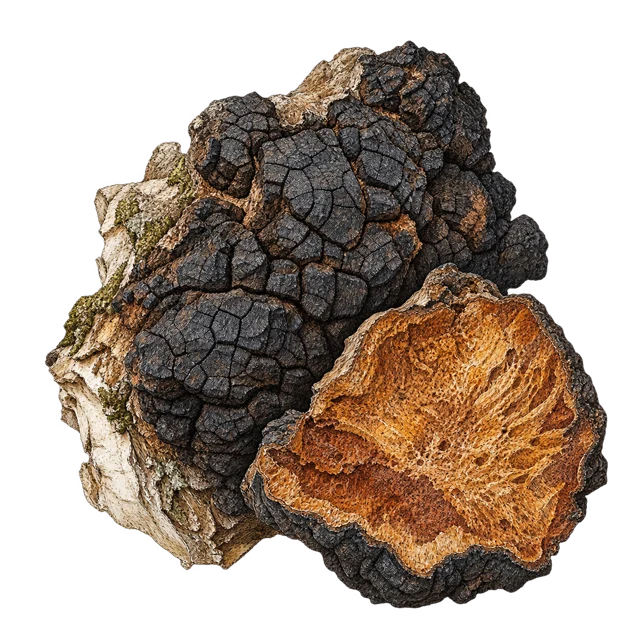
Chaga’s everyday trade form is a long-lived sterile growth. The fungus’s reproductive structure generally appears only in a different phase associated with host death, so commercial images seldom show the whole life cycle. This explains why asking for a cap or gills is the wrong biological question for chaga.
Keep traditional knowledge locally attributed
Saar’s 1991 ethnomycological study specifically documents fungal uses among Khanty communities of western Siberia, including I. obliquus. It supports a community-linked traditional-use history; it should not be retold as a universal Siberian practice or clinical proof of efficacy.
Additional history reviewed 2026-10-09
Traditional, historical and reported uses
- Historical medicinal drinks
Traditional accountWhy this label?
The claim records hot-water preparations in northern Eurasian folk medicine, rather than measured therapeutic success.
Northern Eurasian traditions used hot-water chaga preparations as folk medicine; therapeutic success is not established by these accounts.
- Khanty cleansing preparations
Food or household practiceWhy this label?
The claim documents khanty cleansing preparations as a culinary, craft, gardening, or practical material use; it reports neither a treatment outcome nor measured nutrient content.
Ethnographic research records Khanty “soap water” and cleansing uses. This is a historical nonfood practice, not a modern skin-treatment instruction.
- Tea and supplement commerce
Mixed/contextual sourcesWhy this label?
The exact claim is modern tea/supplement commerce with a human-evidence limitation, not a clinical result.
Conk-derived teas, powders and supplements are sold today, despite inadequate human evidence for disease-treatment claims.
Three distinct historical and commercial roles are supported. Additional disease claims would exceed reliable human evidence.
Features and lookalikes to study
Inonotus obliquus. The familiar black birch growth is a sterile conk containing fungal and host material, not the normal spore-producing fruiting body.
Common names vary between regions and suppliers; the scientific scope above governs this card.
Morphology described in sources
- The commonly traded black, fissured growth is a sterile conk, usually associated with living birch, with yellow-brown internal tissue. It is not the normal spore-producing fruiting body.
- Habitat and substrate
- See the source-linked morphology and comparison notes below; a separate habitat summary has not been verified for this card.
- Geographic scope
- A complete regional range is not established here. Broad common names and commercial labels can span different species.
- Season in the cited region
- No region-specific fruiting season has been verified for this card. Do not infer a local season from trade availability.
Fomes fomentarius and other birch brackets
Fomes produces a regular woody bracket with a pore-bearing underside, unlike the irregular sterile chaga conk.
Several fungi share birch hosts; host alone does not identify a growth. Weathered brackets may darken, so a black exterior is not diagnostic.
Woody swellings or charred/damaged tree tissue
A sterile fungal conk is biologically different from ordinary wood, even though it can resemble burnt bark or a woody lump.
Do not infer fungal identity from colour or cut into a living tree to “test” an uncertain lump. A mycologist or forest pathologist should assess it.
Limits and regional differences
- The absence of a spore print from the traded sterile conk is expected, not evidence of purity. Powdered material cannot be authenticated by colour, and non-birch claims need especially careful expert review.
- Educational comparison only. Neither this card, an illustration, a photograph, a spore-print colour nor a checklist establishes that a wild collection is safe to eat. A qualified local mycologist must assess uncertain material; do not taste an unknown fungus. Cooking does not reliably eliminate mushroom toxins.
Identity & detailed reference
Identity
Inonotus obliquus. The familiar black birch growth is a sterile conk containing fungal and host material, not the normal spore-producing fruiting body.
Ingredient details, preparation and research
Also known as: Chaga
Source plant or material
The dark sterile conk associated especially with birch: fungal growth mixed with host material, distinct from the normal spore-producing fruiting body.
Fungal family: Hymenochaetaceae
Forms and route
Historical hot-water drinks and external preparations; modern conk chunks, powders, teas and supplements.
Vitamins and minerals
Chaga is not a dependable dietary nutrient source. A tea or supplement’s marketing does not establish nutritional benefit, and kidney risk is more important than an assumed wellness value.
Absorption and preparation
Hot-water drinks are historical preparations, not a proven safe or effective dosage system. No absorption-enhancement recipe or routine chaga regimen is established.
Traditional and reported uses
- Northern Eurasian traditions used hot-water chaga preparations as folk medicine; therapeutic success is not established by these accounts.
- Ethnographic research records Khanty “soap water” and cleansing uses. This is a historical nonfood practice, not a modern skin-treatment instruction.
- Conk-derived teas, powders and supplements are sold today, despite inadequate human evidence for disease-treatment claims.
Contraindications and cautions
- Chaga products have been associated with oxalate kidney injury, including irreversible renal failure.
- Potential interactions with blood-thinning and glucose-lowering medicines are based largely on preclinical evidence; their clinical magnitude is uncertain. Seek clinician review before use.
- No routine wellness dose is recommended, particularly for anyone with kidney problems.
Fungus, family and material
Inonotus obliquus. Hymenochaetaceae. The dark sterile conk associated especially with birch: fungal growth mixed with host material, distinct from the normal spore-producing fruiting body.
Preparation and evidence
Hot-water drinks are historical preparations, not a proven safe or effective dosage system. No absorption-enhancement recipe or routine chaga regimen is established.
Constituents and nutrition
Research identifies polysaccharides, triterpenoids such as inotodiol, sterol-related compounds and oxalate. Composition depends on material and extraction; high oxalate content is a safety concern. Chaga is not a dependable dietary nutrient source. A tea or supplement’s marketing does not establish nutritional benefit, and kidney risk is more important than an assumed wellness value.
History and documented uses
Chaga’s familiar black growth is not a conventional mushroom cap. Its folk-medicine history belongs particularly to northern Eurasia, including documented Khanty practices in western Siberia. The cultural record describes drinks and cleansing applications without establishing that they cured disease. Modern marketing turns this unusual birch-associated material into teas, powders and extracts. That change of format matters: laboratory findings are not proof of benefit in people, while reports of oxalate-related kidney injury, including irreversible kidney failure, are clinically important.
Safety and interpretation
Chaga products have been associated with oxalate kidney injury, including irreversible renal failure. Potential interactions with blood-thinning and glucose-lowering medicines are based largely on preclinical evidence; their clinical magnitude is uncertain. Seek clinician review before use. No routine wellness dose is recommended, particularly for anyone with kidney problems.
Entry sources
- Distribution and ecology of sterile Inonotus obliquus conks
- Saar 1991: Fungi in Khanty folk medicine
- Memorial Sloan Kettering: Chaga mushroom
- Species Fungorum: Inonotus taxonomy
Reference entry 225 · Recorded content review: 2026-10-08 · Review scope and dates