


Key cautions
- Supplements can rarely cause serious liver injury. Stop for jaundice, dark urine or persistent nausea and seek care.
- Review liver/bile disease, pregnancy and medicines first. Added piperine or “better absorption” does not establish better safety.
- Medsafe advises avoiding turmeric/curcumin supplements alongside medicines that affect bleeding, including selective serotonin reuptake inhibitors (SSRIs), a common class of antidepressants. Its concern is potentially additive bleeding effects, not proof of an interaction with every SSRI. Do not stop the prescribed medicine; ask a pharmacist or prescriber about the supplement.
What’s inside
Whole turmeric combines yellow curcuminoid pigments, aromatic oil and the carbohydrates and nutrients of a rhizome. A curcumin-rich extract and distilled turmeric oil each select a different part of that mixture.
EMA: Assessment report on Curcuma longa rhizome, revision 1
The yellow curcuminoids
Curcumin, demethoxycurcumin and bisdemethoxycurcumin belong to the curcuminoid group. Curcumin contributes the familiar yellow colour. A product’s curcuminoid percentage describes that product, not all fresh rhizomes, spice powders or extracts.
EMA: Assessment report on Curcuma longa rhizome, revision 1 · NCCIH: Turmeric, updated April 2025
Aromatic oil
The volatile fraction includes aromatic turmerone, alpha- and beta-turmerone, zingiberene and other compounds. Distilled oil is not equivalent to curcumin or to eating the whole ground rhizome.
Whole spice and extract formulations
Whole powder also contains carbohydrate, fibre, protein and minerals. Extracts may be concentrated or combined with piperine, oils or other delivery systems intended to alter uptake. Their labels and clinical evidence must be read separately from ordinary culinary turmeric.
USDA Standard Reference Release 28 (2015): spices and herbs · EMA: Assessment report on Curcuma longa rhizome, revision 1 · NCCIH: Turmeric, updated April 2025
Minerals in a realistic spice portion
USDA’s 2015 ground-turmeric record uses 3 g for a teaspoon. A teaspoon divided among four servings gives each person about a quarter teaspoon. These calculated mineral amounts describe the food, not how much the body absorbs; strained tea and extract capsules are not equivalent servings. The iron figures do not establish an anemia treatment.
- One teaspoon: about 0.59 mg manganese (26% Daily Value) and 1.65 mg iron (9%)
- One-quarter teaspoon: about 0.15 mg manganese (6% Daily Value) and 0.41 mg iron (2%)
USDA Standard Reference Release 28 (2015): spices and herbs · FDA: Current Daily Values for nutrients
Uses in brief

- Culinary color and flavor; documented traditional digestive and skin uses.
- Early human evidence for some oral extracts in knee osteoarthritis; benefit is not established for every product or condition.
History, folklore and reported uses
Digestive and respiratory traditions
NCCIH records turmeric in Indian Ayurvedic, Chinese, Islamic and Thai medical traditions. Ayurvedic and Chinese accounts describe a bitter digestive remedy and relief of gas; Indian accounts also describe stomach ailments, excess mucus, cough, runny nose and sinus complaints. EMA recognizes specified oral preparations for traditional relief of fullness, slow digestion and gas, based on longstanding use. Historical use for liver complaints does not establish that supplements treat liver disease or are safe for someone with it.
Prasad and Aggarwal: Turmeric, the Golden Spice, Herbal Medicine (2011), section 13.5 · The Met: Far from Home · EMA: Curcumae longae rhizoma, public summary and current documents · NCCIH: Turmeric, updated April 2025
Skin, wounds and aching joints
South Asian traditions used turmeric preparations on cuts, bruises and other skin complaints, and for sprains, swelling and rheumatic pain. The Met also records a skin application for eruptions in Hortus Sanitatis, a fifteenth-century illustrated natural-history book. Topical turmeric or curcumin can cause itching, hives or irritation.
Prasad and Aggarwal: Turmeric, the Golden Spice, Herbal Medicine (2011), section 13.5 · The Met: Far from Home · NCCIH: Turmeric, updated April 2025
Golden colour in ceremony
The Gardens Trust describes turmeric as a sacred colourant in Hindu and Buddhist ceremonies. Prasad and Aggarwal record turmeric paste applied to brides and grooms in parts of India, Bangladesh and Pakistan as a beautifying and cleansing preparation. These particular cultural practices connect the rhizome’s cosmetic, ceremonial and medicinal histories.
The Gardens Trust: Journeys of Empire—Turmeric from South India · Prasad and Aggarwal: Turmeric, the Golden Spice, Herbal Medicine (2011), section 13.5
Trade, dyes and a simple chemical indicator
The Met notes Marco Polo’s comparison of turmeric with saffron on encountering it in China, despite their different flavours. Turmeric later featured in trade and colonial collecting. Kew records rhizome dye for silk, cotton and wool in South Asia, and yellow paint in Madhya Pradesh folk art; the textile colour can fade. Turmeric-treated paper also turns toward red in alkaline conditions, linking a familiar pigment with a simple chemical indicator.
The Met: Far from Home · The Gardens Trust: Journeys of Empire—Turmeric from South India · Kew Plants of the World Online: Curcuma longa L.
A crop passed from hand to hand
Kew describes culinary turmeric as sterile and propagated by rhizomes, with uncertain precise ancestry. Saving, dividing and exchanging rhizome pieces is therefore central to its crop history. An ornamental Curcuma is not automatically the same plant as culinary turmeric.
A botanical illustration made from shop roots
The Gardens Trust recounts how Elizabeth Blackwell drew turmeric for A Curious Herbal in the 1730s. Roots bought in shops supplied part of the model; a specimen from Leiden’s botanical garden supplied the leaves and flowers. The illustration joined a traded medicinal commodity to a living plant in a European collection.
The Gardens Trust: Journeys of Empire—Turmeric from South India
Colour on an eighteenth-century table
A manuscript recipe book probably made in Yorkshire around 1750 describes Portuguese chicken soup served with rice coloured partly white and partly yellow with turmeric. The Gardens Trust also records turmeric colouring pickled melons to resemble mangoes. These examples place the imported colourant in particular British kitchens rather than treating every yellow dish as an ancient tradition.
The Gardens Trust: Journeys of Empire—Turmeric from South India
A knee-pain trial and what it did not show
In a 12-week, placebo-controlled trial of 70 people with symptomatic knee osteoarthritis and excess joint fluid and inflammation of the joint lining, a Curcuma longa extract improved pain by about 9 mm more than placebo on a 100-mm scale. It did not improve the measured joint-fluid/inflammation volume or cartilage-composition outcome. The sample was small and the study short. NCCIH describes the overall knee evidence as promising but not definitive; it does not establish cartilage repair, a universal product or equivalence to food turmeric.
Wang et al.: Curcuma longa extract for knee osteoarthritis, randomized trial (2020) · NCCIH: Turmeric, updated April 2025
Why supplement liver injury matters
The U.S. Drug-Induced Liver Injury Network series documented ten turmeric-associated liver injuries assessed by an expert review process; five people were hospitalized and one died. Piperine was found in three of seven tested products, so its absence does not exclude risk. Case series identify a serious signal, not the incidence among all users. TGA advises avoiding medicinal turmeric/curcumin with current or previous liver problems and notes that the concern does not appear to extend to typical dietary amounts.
Halegoua-DeMarzio et al.: Ten turmeric-associated liver-injury cases in DILIN (2023) · TGA: Medicines containing turmeric or curcumin and rare liver injury
Symptoms that need prompt attention
Stop a turmeric/curcumin supplement and obtain prompt medical advice for jaundice, dark urine, persistent nausea/vomiting, unusual fatigue or abdominal pain. Gallstones, bile-duct obstruction, cholangitis (inflammation of the bile ducts) or other bile-system disease also warrant avoiding unsupervised medicinal use. Pregnancy supplements may be unsafe; evidence is inadequate for higher-than-food amounts during breastfeeding, and EMA’s medicinal use is adult-only.
TGA: Medicines containing turmeric or curcumin and rare liver injury · Health Canada: Turmeric, oral monograph with 2025 safety updates · EMA: Assessment report on Curcuma longa rhizome, revision 1 · NCCIH: Turmeric, updated April 2025
Warfarin and other medicines
Medsafe reported a marked rise in INR, a test used to monitor warfarin’s effect on clotting, after a turmeric product was added to warfarin, and later reported another case involving a turmeric tonic. These are safety reports rather than proof that every food-level serving causes an interaction. Review supplements with warfarin, other anticoagulants, antiplatelet medicines and nonsteroidal anti-inflammatory drugs (NSAIDs), such as ibuprofen; do not change prescribed treatment yourself. Concentrated piperine and other blend ingredients need their own check.
Medsafe: Turmeric/curcumin products and warfarin interaction (2018) · Medsafe: Warfarin, eat, drink and be wary, December 2022 Prescriber Update · Health Canada: Turmeric, oral monograph with 2025 safety updates
Absorption claims need a closer look
An early human experiment reported higher curcumin blood exposure with measured piperine. A 2025 crossover study in nine healthy men found no piperine benefit with the formulation it tested; it also distinguished unchanged curcumin from the compounds the body makes from it. Different products and measurement methods complicate comparisons. Neither study established better arthritis outcomes or a safe home pepper ratio. Higher uptake may also change adverse-effect and interaction risks, and a piperine-free label does not guarantee safety.
Shoba et al.: Piperine and curcumin pharmacokinetics in human volunteers (1998) · NCCIH: Turmeric, updated April 2025 · TGA: Medicines containing turmeric or curcumin and rare liver injury · Halegoua-DeMarzio et al.: Ten turmeric-associated liver-injury cases in DILIN (2023) · Kroon et al. (2025): Curcumin formulations and absorption
Skin products are a separate exposure
Traditional skin use and an oral knee-pain trial do not validate a homemade joint rub or concentrated essential-oil application. NCCIH considers topical knee-pain evidence unclear and records itching/hives with topical curcumin. Discontinue an irritating skin product; oral liver-risk findings should not be presented as proof that all ordinary cosmetic applications have identical exposure.
Laboratory activity and human outcomes
The EMA assessment discusses anti-inflammatory and antioxidant experiments in cells and animals. Such work helps identify questions to test; it does not establish that a spoonful of spice reaches the same concentrations or treats a disease. A clinical benefit must be demonstrated with the actual preparation and outcome being considered.
Growing notes
Curcuma longa culinary turmeric; other Curcuma species and ornamental gingers are not interchangeable.
- Climate and lifecycle
- A tropical rhizomatous perennial, often harvested annually. Cool-climate gardens may need a long protected season. Kew recommends indoor or heated-greenhouse culture in temperate regions; avoiding outdoor frost is a precaution, not proof of suitable warmth. [1] [2]
- Planting material
- Propagate a known culinary C. longa by healthy bud-bearing rhizome pieces. Kew describes the crop as sterile and maintained vegetatively; packets of unspecified ornamental Curcuma seed are not equivalent planting material. [2]
- Light, soil and water
- UGA recommends bright shade, humidity and rich loamy soil. Give regular moisture while actively growing, with drainage that prevents saturation. Reduce water as foliage dies down; do not keep dormant rhizomes in a sodden pot. [1]
- Harvest and pollination
- Kew gives roughly 7–10 months to harvest, with yellowing lower leaves as a maturity sign. Dig carefully when growth declines. No pollination is required for a rhizome harvest; reserve only healthy material if replanting. [2]
- Pests and disease
- Tamil Nadu Agricultural University identifies rhizome rot and scale insects as problems carried in planting rhizomes. Inspect starts and discard damaged or rotting pieces; seek locally current diagnosis and controls rather than copying an overseas pesticide schedule. [3]
Growing sources and regional guidance
Growing notes reviewed 2026-10-12
Women’s Health: traditions, evidence and cautions
Historical use does not establish benefit or safety. Pregnancy, breastfeeding and fertility care require particular caution: food, tea, essential oil and concentrated extract are not interchangeable. These records are not treatment, dosing or pregnancy-management instructions. Discuss supplements with a qualified clinician or pharmacist; do not delay evaluation of persistent symptoms.
Turmeric
Curcuma longa L.
- Plant part / material
- Rhizome
- Preparation studied or reported
- Culinary rhizome/spice; Indonesian turmeric–tamarind jamu drink; isolated or enhanced-bioavailability curcumin is a separate product.
In Indonesia, kunyit asam combines turmeric and tamarind in a jamu drink associated with menstrual comfort. A 2026 Yogyakarta study documents contemporary use of this combination; it does not establish turmeric alone as the active treatment.
menstrual pain
Documented contemporary traditional use; weak uncontrolled clinical evidence for the cited mixture.
Reported or traditional useTraditional turmeric–tamarind drinks are used for menstrual cramps.
What the evidence supportsThe cited study used a one-group before-and-after design, so changes cannot securely be attributed to the drink. Results of curcumin capsules or mixtures cannot be transferred to food turmeric or used as fertility evidence.
Turmeric supplements may be unsafe in pregnancy; medicinal amounts during breastfeeding lack adequate safety data. Enhanced-absorption curcumin products have been linked to liver injury.
- Food use is distinct from concentrated curcumin therapy.
- Seek care for jaundice, dark urine or persistent unexplained symptoms while using supplements.
Regional reading paths
These sourced notes describe cultivation, trade, food traditions or material history. A regional connection does not claim exclusive origin.
Asia
Cultivated: India, including southern and northeastern states.
Rhizome supplies culinary colour and flavour.
Australia & Oceania
introduced/traded and cultivated; Fiji
Rhizome spice and food colour.
Identity & detailed reference
Identity
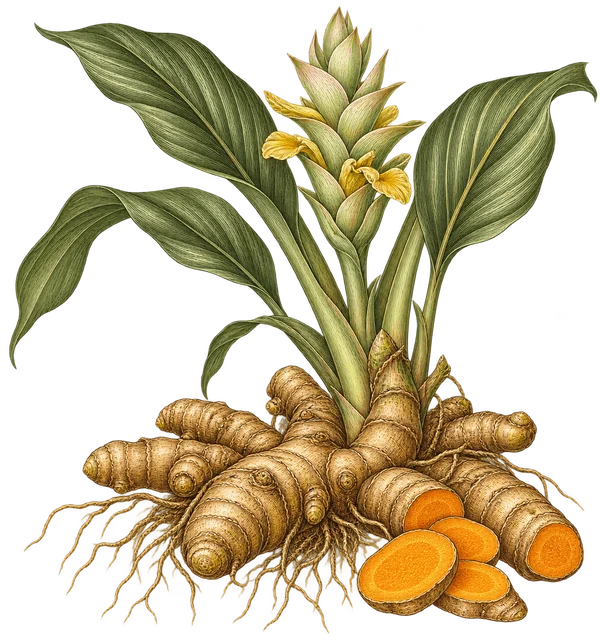
Curcuma longa L. (syn. Curcuma domestica), family Zingiberaceae; turmeric is the rhizome, an underground stem. Curcumin is one of its constituents, not a synonym for the whole spice.
Ingredient details, preparation and research
Source plant or material
Curcuma longa L. (syn. Curcuma domestica); rhizome. This entry does not treat every Curcuma species as the same botanical material.
Plant family / material: Zingiberaceae (ginger family).
Forms and route
Fresh rhizome, ground culinary spice, infusions/decoctions, powder, tinctures and extracts. Concentrated curcuminoid capsules, including piperine, phospholipid, micellar or other enhanced-absorption products, are separate formulations; turmeric essential oil is not a curcumin capsule.
Food sources
Use culinary turmeric in lentils, rice, soups, eggs/tofu or vegetables. A USDA reference teaspoon of ground turmeric weighs 3 g; a quarter teaspoon is approximately 0.75 g. Fresh-rhizome spoon weights and extract concentrations are not equivalent.
Traditional and reported uses
- Culinary color and flavor; documented traditional digestive and skin uses.
- Early human evidence for some oral extracts in knee osteoarthritis; benefit is not established for every product or condition.
Contraindications and cautions
- Rare, sometimes serious liver injury has been associated with turmeric/curcumin supplements. Stop and seek medical advice for yellow eyes/skin, dark urine, persistent nausea, unusual fatigue or abdominal pain.
- Avoid supplement self-use with current or past liver disease; gallstones, bile-duct obstruction or other biliary problems need clinical review.
- Check medicines, especially warfarin and other drugs affecting bleeding; review piperine and every other added ingredient. Do not stop prescribed medicines to take turmeric.
- Avoid supplement-strength use during pregnancy. Breastfeeding and under-18 medicinal use lack adequate safety evidence. Ordinary food use is a different exposure.
- Oral products may cause reflux, nausea, diarrhea or constipation. Topical products can cause itching, hives or contact irritation.
- Medsafe advises avoiding turmeric/curcumin supplements alongside medicines that affect bleeding, including selective serotonin reuptake inhibitors (SSRIs), a common class of antidepressants. Its concern is potentially additive bleeding effects, not proof of an interaction with every SSRI. Do not stop the prescribed medicine; ask a pharmacist or prescriber about the supplement.
Similar items and how they compare
- Ginger
Both are aromatic ginger-family rhizomes used in food and digestive traditions, with composition affected by drying and extraction.
Turmeric emphasizes yellow curcuminoids; ginger emphasizes pungent gingerols and nausea-related uses.
- White willow bark
Both are used in herbal practice for joint or other discomfort, often as extracts with preparation-specific constituent profiles.
Willow contains salicylate precursors and salicylate cautions; turmeric contains curcuminoids and turmerones.
Current warnings and preparation-specific decisions
Health Canada’s January 2026 notice confirms updated oral-turmeric/curcuminoid monographs and expected label changes for liver risk, while excluding normal food use from that review. EMA’s 2025 addendum, published in 2026, reviewed liver and interaction reports but found no need to revise its existing herbal monograph. That decision concerns its defined preparations and should not be read as blanket approval of every highly concentrated or enhanced-absorption supplement.
Food preparation and combinations
For flavor, stir culinary turmeric into a lentil soup, rice dish, scrambled eggs/tofu or vegetables; ginger, cumin or a little ordinary black pepper can be seasonings. Oil, milk or yogurt may improve taste and texture, but this is a cooking choice, not a verified medical absorption strategy. A strained infusion does not deliver the whole powder’s listed minerals, and an extract capsule does not provide an equivalent spice serving. Avoid combining medicinal willow, turmeric and other pain products as an assumed synergistic regimen.
- USDA FoodData Central: Spices, turmeric, ground, SR Legacy FDC 172231
- EMA: Curcumae longae rhizoma, public summary and current documents
- Shoba et al.: Piperine and curcumin pharmacokinetics in human volunteers (1998)
- EMA: European Union herbal monograph on Salix species, cortex (2017)
- Medsafe: Turmeric/curcumin products and warfarin interaction (2018)
Entry sources
- NCCIH: Turmeric, updated April 2025
- EMA: Curcumae longae rhizoma, public summary and current documents
- TGA: Medicines containing turmeric or curcumin and rare liver injury
- Health Canada: Hepatotoxicity and natural health products, January 2026 InfoWatch
- Health Canada: Turmeric, oral monograph with 2025 safety updates
- Kew Plants of the World Online: Curcuma longa L.
- EMA: Assessment report on Curcuma longa rhizome, revision 1
- EMA: Final addendum to turmeric assessment, adopted November 2025, published 2026
- Wang et al.: Curcuma longa extract for knee osteoarthritis, randomized trial (2020)
- Halegoua-DeMarzio et al.: Ten turmeric-associated liver-injury cases in DILIN (2023)
- Shoba et al.: Piperine and curcumin pharmacokinetics in human volunteers (1998)
- Medsafe: Turmeric/curcumin products and warfarin interaction (2018)
- Medsafe: Warfarin, eat, drink and be wary, December 2022 Prescriber Update
- USDA FoodData Central: Spices, turmeric, ground, SR Legacy FDC 172231
- USDA FoodData Central: official downloadable datasets
- FDA: Daily Value on the Nutrition and Supplement Facts Labels
- EMA: European Union herbal monograph on Salix species, cortex (2017)
- Kew Plants of the World Online: Curcuma longa, species profile
Reference entry 17 · Recorded content review: 2026-10-05 · Review scope and dates