


Key cautions
- Cook authenticated food-grade mushrooms; do not eat mushrooms grown for pollutant-removal experiments.
- High spore exposure in enclosed growing spaces can cause respiratory symptoms; harvesting areas need ventilation.
What’s inside
Analyses identify proteins, carbohydrates, fatty acids and aroma compounds. This white-rot fungus also produces enzymes that break down woody material; those enzymes underpin environmental research rather than a dietary drug claim.
Uses in brief

- Cooked food
- Food from plant residues
- Home and small-scale growing
History, folklore and reported uses
History, folklore and traditional uses
Oyster mushrooms tell a modern cultivation story as well as a woodland one. India’s National Horticulture Board records experimental P. ostreatus growing in Germany in 1917. Later cultivation methods helped turn plant residues into a food crop in many countries.
The everyday name spans multiple species, including mushrooms with different colours and growing needs. This card focuses on grey or pearl oyster, P. ostreatus. Its capacity to decay wood supports both small-scale food growing and research into pollutants, but the food and cleanup settings need different safety controls.
A closer look at its history
A mushroom crop built around residues
Oyster mushroom production can use appropriately prepared agricultural residues. Its rapid colonisation and relatively flexible substrate range help explain its role in small enterprises. This is a cultivation use with quality controls, not permission to grow food on chemically contaminated waste.
Additional history reviewed 2026-10-09
Traditional, historical and reported uses
- Cooked food
Food or household practiceWhy this label?
The claim documents cooked food as a culinary, craft, gardening, or practical material use; it reports neither a treatment outcome nor measured nutrient content.
Food-grade oyster mushrooms are used sautéed, roasted and in stir-fries.
- Food from plant residues
Food or household practiceWhy this label?
The claim documents food from plant residues as a culinary, craft, gardening, or practical material use; it reports neither a treatment outcome nor measured nutrient content.
Cultivation on suitable agricultural residues converts otherwise low-value plant material into saleable mushrooms.
- Home and small-scale growing
Food or household practiceWhy this label?
The claim documents home and small-scale growing as a culinary, craft, gardening, or practical material use; it reports neither a treatment outcome nor measured nutrient content.
Commercial spawn and grow kits support household growing and practical learning about fungi.
- Further uses for spent substrate
Food or household practiceWhy this label?
The claim documents further uses for spent substrate as a culinary, craft, gardening, or practical material use; it reports neither a treatment outcome nor measured nutrient content.
The National Horticulture Board describes spent oyster-growing straw in composting, livestock-feed and biogas systems. These are managed agricultural applications, not permission to feed any spent substrate to animals.
- Environmental-cleanup research
Laboratory/animal researchWhy this label?
The exact claim is laboratory study of fungal enzymes degrading pollutants, not proof that contaminated sites or mushrooms are safe.
P. ostreatus enzymes are studied for breaking down dyes and other pollutants. Laboratory success does not establish that a contaminated site has been made safe or that its mushrooms are edible.
Story sources
Features and lookalikes to study
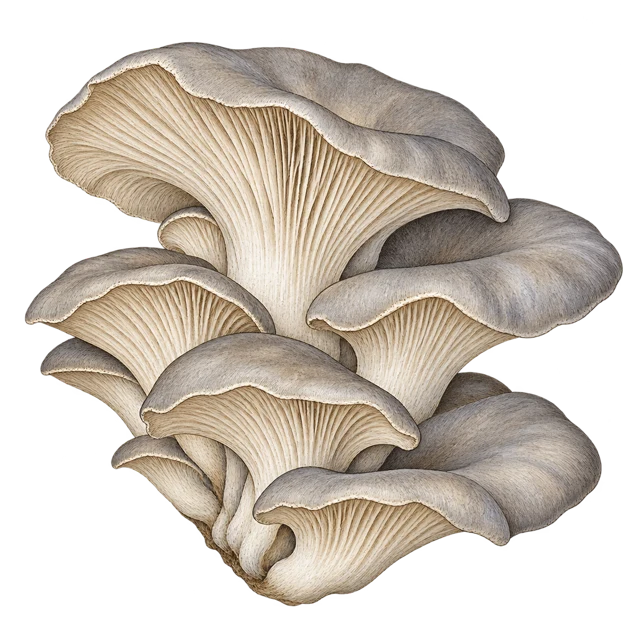
Pleurotus ostreatus (grey / pearl oyster). Other cultivated “oysters,” including P. eryngii, P. citrinopileatus and P. djamor, are separate taxa.
Common names vary between regions and suppliers; the scientific scope above governs this card.
Morphology described in sources
- Oyster-type Pleurotus have laterally attached or eccentric caps with pale gills running toward the attachment, usually on hardwood. Cap colour and stem length are variable.
- Habitat and substrate
- See the source-linked morphology and comparison notes below; a separate habitat summary has not been verified for this card.
- Geographic scope
- A complete regional range is not established here. Broad common names and commercial labels can span different species.
- Season in the cited region
- No region-specific fruiting season has been verified for this card. Do not infer a local season from trade availability.
Pleurocybella porrigens (angel wings; serious poisoning association)
Angel wings are usually thin, white and conifer-associated; P. ostreatus-type oysters are generally more fleshy and commonly on hardwood.
Some Pleurotus occur on conifers and colour varies. Thinness and substrate are supporting clues, not an eating clearance. NAMA documents fatal encephalopathy associated with angel wings in Japan, especially among people with kidney disease.
Pleurotus pulmonarius and P. populinus
These closely related oysters differ in combinations of host, season, colour and microscopic characters; P. populinus is associated with Populus.
All have historically been called P. ostreatus. A photo usually cannot establish exact species, and a shared common name does not make research products interchangeable.
Limits and regional differences
- Unknown pale, wood-growing gilled fungi should remain unidentified without a qualified local review. Species-complex work can require microscopy or molecular evidence.
- Educational comparison only. Neither this card, an illustration, a photograph, a spore-print colour nor a checklist establishes that a wild collection is safe to eat. A qualified local mycologist must assess uncertain material; do not taste an unknown fungus. Cooking does not reliably eliminate mushroom toxins.
Regional reading paths
These sourced notes describe cultivation, trade, food traditions or material history. A regional connection does not claim exclusive origin.
Europe
Native and cultivated: European woodlands, including the UK.
Cultivated or expertly identified fruiting bodies are cooked as food.
Identity & detailed reference
Identity
Pleurotus ostreatus (grey / pearl oyster). Other cultivated “oysters,” including P. eryngii, P. citrinopileatus and P. djamor, are separate taxa.
Ingredient details, preparation and research
Also known as: Grey oyster mushroom; Pearl oyster mushroom; Dhingri (broader oyster-mushroom name in India)
Source plant or material
Cultivated food-grade fruiting bodies of P. ostreatus. King, golden and pink oyster mushrooms are other species.
Fungal family: Pleurotaceae
Forms and route
Fresh or dried food mushrooms; grow-kit spawn and growing substrates are cultivation materials, not ready-to-eat food.
Vitamins and minerals
Oyster mushrooms supply protein and other food nutrients. USDA research found variable vitamin D2 and sterols; the actual product and serving matter more than a generic “high vitamin D” claim.
Absorption and preparation
Cook food-grade mushrooms thoroughly. Plant-residue cultivation requires suitable clean inputs; mushrooms used to investigate pollutant removal are not automatically safe to eat. No special absorption recipe is established.
Traditional and reported uses
- Food-grade oyster mushrooms are used sautéed, roasted and in stir-fries.
- Cultivation on suitable agricultural residues converts otherwise low-value plant material into saleable mushrooms.
- Commercial spawn and grow kits support household growing and practical learning about fungi.
- The National Horticulture Board describes spent oyster-growing straw in composting, livestock-feed and biogas systems. These are managed agricultural applications, not permission to feed any spent substrate to animals.
- P. ostreatus enzymes are studied for breaking down dyes and other pollutants. Laboratory success does not establish that a contaminated site has been made safe or that its mushrooms are edible.
Contraindications and cautions
- Cook authenticated food-grade mushrooms; do not eat mushrooms grown for pollutant-removal experiments.
- High spore exposure in enclosed growing spaces can cause respiratory symptoms; harvesting areas need ventilation.
- Laboratory bioactivity does not prove that eating oyster mushrooms treats cancer or cardiovascular disease.
Fungus, family and material
Pleurotus ostreatus. Pleurotaceae. Cultivated food-grade fruiting bodies of P. ostreatus. King, golden and pink oyster mushrooms are other species.
Preparation and evidence
Cook food-grade mushrooms thoroughly. Plant-residue cultivation requires suitable clean inputs; mushrooms used to investigate pollutant removal are not automatically safe to eat. No special absorption recipe is established.
Constituents and nutrition
Analyses identify proteins, carbohydrates, fatty acids and aroma compounds. This white-rot fungus also produces enzymes that break down woody material; those enzymes underpin environmental research rather than a dietary drug claim. Oyster mushrooms supply protein and other food nutrients. USDA research found variable vitamin D2 and sterols; the actual product and serving matter more than a generic “high vitamin D” claim.
History and documented uses
Oyster mushrooms tell a modern cultivation story as well as a woodland one. India’s National Horticulture Board records experimental P. ostreatus growing in Germany in 1917. Later cultivation methods helped turn plant residues into a food crop in many countries. The everyday name spans multiple species, including mushrooms with different colours and growing needs. This card focuses on grey or pearl oyster, P. ostreatus. Its capacity to decay wood supports both small-scale food growing and research into pollutants, but the food and cleanup settings need different safety controls.
Safety and interpretation
Cook authenticated food-grade mushrooms; do not eat mushrooms grown for pollutant-removal experiments. High spore exposure in enclosed growing spaces can cause respiratory symptoms; harvesting areas need ventilation. Laboratory bioactivity does not prove that eating oyster mushrooms treats cancer or cardiovascular disease.
Entry sources
- Kew Grow Wild: Oyster
- India National Horticulture Board: Oyster Mushroom
- Index Fungorum: Pleurotus ostreatus, Pleurotaceae
- Primary analysis: Bioactive Compounds and Volatile Profiles of Five Transylvanian Wild Edible Mushrooms
- USDA ARS: Vitamin D and sterol composition of ten types of mushrooms
Reference entry 221 · Recorded content review: 2026-10-08 · Review scope and dates