


Key cautions
- Never eat morels raw. Cooking may reduce risk but cannot guarantee safety.
- CDC linked 51 illnesses and two deaths in a 2023 Montana outbreak to likely morel exposure.
What’s inside
Morchella research has characterized polysaccharides and protein-associated fractions; retail morel samples also contain ergosterol and vitamin D2. Isolated experimental fractions are different from a serving of mushrooms.
Uses in brief

- Cooked seasonal dishes
- Drying for later meals
- Forest-product livelihoods
History, folklore and reported uses
History, folklore and traditional uses
Morels are associated with seasonal food gathering across Europe, Asia and North America. Their distinctive market identity conceals a diverse genus: a history written as Morchella esculenta need not describe every modern species sold as a morel.
The US Forest Service documents food, preservation and commercial harvest from Mexico to Alaska, including western North American post-fire landscapes. That culinary prestige does not remove the preparation hazard: CDC’s investigation of a 2023 Montana outbreak found morels the likely source, with raw servings especially strongly associated with illness.
A closer look at its history
After-fire mushrooms and a mobile harvest
Some western North American Morchella fruit prolifically after forest fires, supporting a mobile commercial harvest; others occur in unburned habitats. The Forest Service separates ecological groups and their management rather than treating “morel season” as one universal event. A burn site is habitat evidence, not proof of identity.
A modern caution inside a food tradition
CDC investigated a 2023 restaurant outbreak associated with morels. Its relevance is not to erase morels’ food history, but to show that a familiar food name cannot replace correct sourcing and handling.
Additional history reviewed 2026-10-09
Traditional, historical and reported uses
- Cooked seasonal dishes
Food or household practiceWhy this label?
The claim documents cooked seasonal dishes as a culinary, craft, gardening, or practical material use; it reports neither a treatment outcome nor measured nutrient content.
True morels are a sought-after seasonal cooking ingredient; raw eating is unsafe.
- Drying for later meals
Food or household practiceWhy this label?
The claim documents drying for later meals as a culinary, craft, gardening, or practical material use; it reports neither a treatment outcome nor measured nutrient content.
Drying preserves a seasonal harvest for storage and trade. Dried morels still require appropriate preparation and cooking.
- Forest-product livelihoods
Mixed/contextual sourcesWhy this label?
The claim concerns commercial forest harvesting and international trade, an economic use supported by contextual forestry evidence.
Commercial harvesting and international sale provide seasonal income, including harvests associated with post-fire western North American forests.
Three established culinary and economic roles are included. Laboratory studies do not justify adding medicinal promises.
Story sources
- US Forest Service: Ecology and Management of Morels Harvested From the Forests of Western North America
- CDC: Morel mushroom outbreak, Montana 2023
- US Forest Service: Four new species of Morchella from the Americas
- Primary research: Isolation, Characterization, and Medicinal Potential of Polysaccharides of Morchella esculenta
- USDA ARS: Vitamin D and sterol composition of ten types of mushrooms
Features and lookalikes to study
Morchella species; a species group, not one worldwide Morchella esculenta. Excludes Gyromitra and other “false morels.”
Common names vary between regions and suppliers; the scientific scope above governs this card.
Morphology described in sources
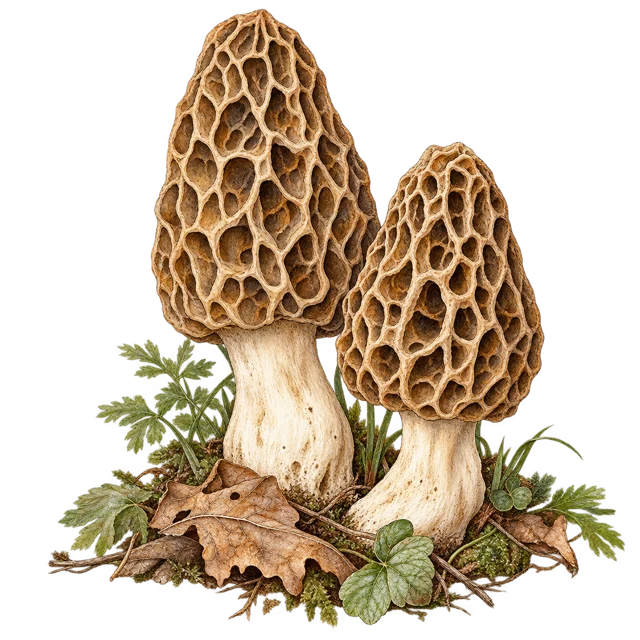
- Morchella has a structured network of pits and ridges rather than a merely wrinkled brain-like cap. Longitudinal anatomy and how the cap joins the stem are part of an expert examination.
- Habitat and substrate
- See the source-linked morphology and comparison notes below; a separate habitat summary has not been verified for this card.
- Geographic scope
- A complete regional range is not established here. Broad common names and commercial labels can span different species.
- Season in the cited region
- No region-specific fruiting season has been verified for this card. Do not infer a local season from trade availability.
Gyromitra species (false morels; some dangerously poisonous)
Many Gyromitra have irregular lobes or brain-like folds and chambered/internal tissue, unlike the characteristic pitted cap and hollow construction of Morchella.
This is not a complete hollow-versus-solid test. Shapes vary within both groups, and a damaged specimen can mislead. No preparation method is supplied to make Gyromitra safe.
Verpa species
Verpa caps hang from attachment near the stem top; young stems can contain cottony tissue. True morels have different cap attachment, though half-free Morchella complicate simplified rules.
A hollow stem or a partly detached cap does not by itself distinguish all Verpa from Morchella. Regional expertise is needed.
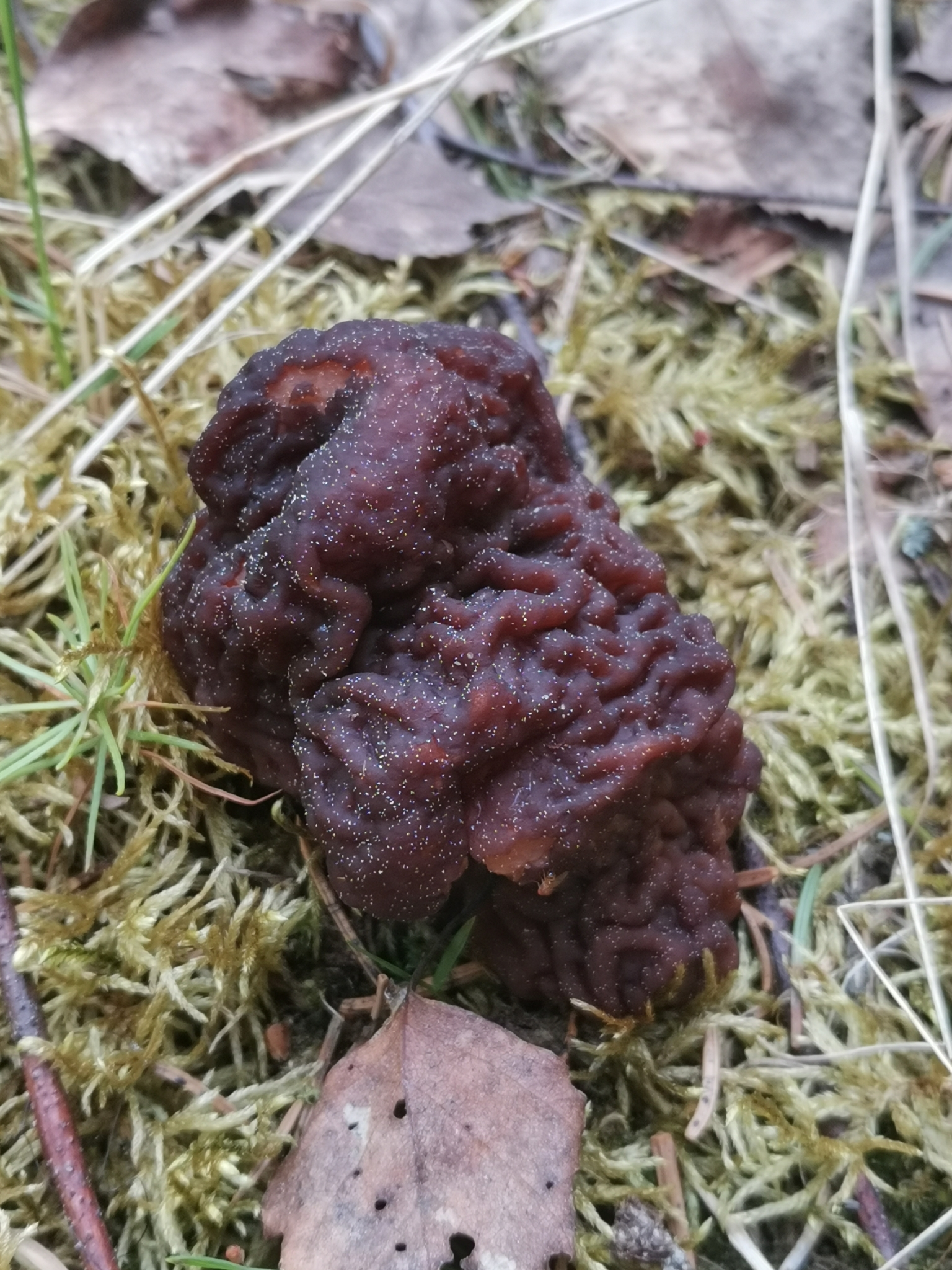
Source-labeled Gyromitra esculenta, Finland, 22 May 2023. Photograph by Ilkka Kaita-aho, CC0 1.0. A source-labeled false morel photographed in one region; resemblance cannot establish identity or safe consumption.
This view shows a dark, folded cap surface. Stem attachment and internal anatomy are hidden; an exterior resemblance cannot distinguish every morel-like fungus.
Photograph source and attribution · CC0 1.0. Original image, unmodified. Species attribution comes from the source; no independent specimen authentication is claimed.

This limited photo pilot is not a complete atlas or an edibility decision aid. Do not eat a wild mushroom based on this photograph.
Limits and regional differences
- Even correctly identified morels have caused serious illness. The 2023 Montana investigation shows identification is only one part of food safety; raw or incompletely cooked morels must not be treated as safe. Do not reduce the comparison to a single cut-open test.
- Educational comparison only. Neither this card, an illustration, a photograph, a spore-print colour nor a checklist establishes that a wild collection is safe to eat. A qualified local mycologist must assess uncertain material; do not taste an unknown fungus. Cooking does not reliably eliminate mushroom toxins.
Regional reading paths
These sourced notes describe cultivation, trade, food traditions or material history. A regional connection does not claim exclusive origin.
Europe
Traditional processing: documented in French cookery, including Escoffier.
Edible true morels require expert identification and thorough cooking; never substitute false morels.
North America
Wild-harvested: United States Mid-Atlantic forests.
Cooked culinary mushrooms after expert identification; toxic look-alikes exist.
South America
harvested; Chile
Commercial food mushrooms; expert identification and cooking required.
Identity & detailed reference
Identity
Morchella species; a species group, not one worldwide Morchella esculenta. Excludes Gyromitra and other “false morels.”
Ingredient details, preparation and research
Also known as: True morel; Morel
Source plant or material
Authenticated Morchella fruiting bodies; this group excludes Gyromitra and other fungi called false morels.
Fungal family: Morchellaceae
Forms and route
Fresh morels for thorough cooking; dried morels for storage and subsequent cooking.
Vitamins and minerals
Morels contribute nutrients as food, and vitamin D2 has been measured in retail samples. Levels vary; a dried-weight analysis cannot be treated as the composition of a fresh serving.
Absorption and preparation
Never eat raw morels. Thorough cooking may reduce toxic effects but does not guarantee safety; drying or brief contact with hot sauce is not a substitute for adequate cooking. No universal safe dose or cooking protocol is established here.
Traditional and reported uses
- True morels are a sought-after seasonal cooking ingredient; raw eating is unsafe.
- Drying preserves a seasonal harvest for storage and trade. Dried morels still require appropriate preparation and cooking.
- Commercial harvesting and international sale provide seasonal income, including harvests associated with post-fire western North American forests.
Contraindications and cautions
- Never eat morels raw. Cooking may reduce risk but cannot guarantee safety.
- CDC linked 51 illnesses and two deaths in a 2023 Montana outbreak to likely morel exposure.
- Use authenticated true morels; this entry supplies no false-morel detoxification instructions.
Fungus, family and material
Morchella species (true morels). Morchellaceae. Authenticated Morchella fruiting bodies; this group excludes Gyromitra and other fungi called false morels.
- US Forest Service: Ecology and Management of Morels Harvested From the Forests of Western North America
- CDC: Morel mushroom outbreak, Montana 2023
- US Forest Service: Four new species of Morchella from the Americas
- Primary research: Isolation, Characterization, and Medicinal Potential of Polysaccharides of Morchella esculenta
- USDA ARS: Vitamin D and sterol composition of ten types of mushrooms
Preparation and evidence
Never eat raw morels. Thorough cooking may reduce toxic effects but does not guarantee safety; drying or brief contact with hot sauce is not a substitute for adequate cooking. No universal safe dose or cooking protocol is established here.
- US Forest Service: Ecology and Management of Morels Harvested From the Forests of Western North America
- CDC: Morel mushroom outbreak, Montana 2023
- US Forest Service: Four new species of Morchella from the Americas
- Primary research: Isolation, Characterization, and Medicinal Potential of Polysaccharides of Morchella esculenta
- USDA ARS: Vitamin D and sterol composition of ten types of mushrooms
Constituents and nutrition
Morchella research has characterized polysaccharides and protein-associated fractions; retail morel samples also contain ergosterol and vitamin D2. Isolated experimental fractions are different from a serving of mushrooms. Morels contribute nutrients as food, and vitamin D2 has been measured in retail samples. Levels vary; a dried-weight analysis cannot be treated as the composition of a fresh serving.
- US Forest Service: Ecology and Management of Morels Harvested From the Forests of Western North America
- CDC: Morel mushroom outbreak, Montana 2023
- US Forest Service: Four new species of Morchella from the Americas
- Primary research: Isolation, Characterization, and Medicinal Potential of Polysaccharides of Morchella esculenta
- USDA ARS: Vitamin D and sterol composition of ten types of mushrooms
History and documented uses
Morels are associated with seasonal food gathering across Europe, Asia and North America. Their distinctive market identity conceals a diverse genus: a history written as Morchella esculenta need not describe every modern species sold as a morel. The US Forest Service documents food, preservation and commercial harvest from Mexico to Alaska, including western North American post-fire landscapes. That culinary prestige does not remove the preparation hazard: CDC’s investigation of a 2023 Montana outbreak found morels the likely source, with raw servings especially strongly associated with illness.
- US Forest Service: Ecology and Management of Morels Harvested From the Forests of Western North America
- CDC: Morel mushroom outbreak, Montana 2023
- US Forest Service: Four new species of Morchella from the Americas
- Primary research: Isolation, Characterization, and Medicinal Potential of Polysaccharides of Morchella esculenta
- USDA ARS: Vitamin D and sterol composition of ten types of mushrooms
Safety and interpretation
Never eat morels raw. Cooking may reduce risk but cannot guarantee safety. CDC linked 51 illnesses and two deaths in a 2023 Montana outbreak to likely morel exposure. Use authenticated true morels; this entry supplies no false-morel detoxification instructions.
- US Forest Service: Ecology and Management of Morels Harvested From the Forests of Western North America
- CDC: Morel mushroom outbreak, Montana 2023
- US Forest Service: Four new species of Morchella from the Americas
- Primary research: Isolation, Characterization, and Medicinal Potential of Polysaccharides of Morchella esculenta
- USDA ARS: Vitamin D and sterol composition of ten types of mushrooms
Entry sources
- US Forest Service: Ecology and Management of Morels Harvested From the Forests of Western North America
- CDC: Morel mushroom outbreak, Montana 2023
- US Forest Service: Four new species of Morchella from the Americas
- Primary research: Isolation, Characterization, and Medicinal Potential of Polysaccharides of Morchella esculenta
- USDA ARS: Vitamin D and sterol composition of ten types of mushrooms
Reference entry 220 · Recorded content review: 2026-10-08 · Review scope and dates