


Key cautions
- Medicinal cone-berry use is unsuitable with serious kidney disease or a medically required fluid restriction.
- Medicinal use is not recommended during pregnancy or breastfeeding; seek care for urinary fever, pain or blood.
What’s inside
Cone berries contain a volatile-oil fraction with monoterpenes including pinene, myrcene, limonene and terpinen-4-ol. Profiles vary; the separated oil is more concentrated than the whole cone.
Uses in brief

- Food-grade cone berries as a seasoning and gin botanical.
- Traditional cone-berry medicinal uses for digestive and minor urinary complaints.
- Species-qualified reference to historical aromatic plague practices.
History, folklore and reported uses
History, folklore and traditional uses
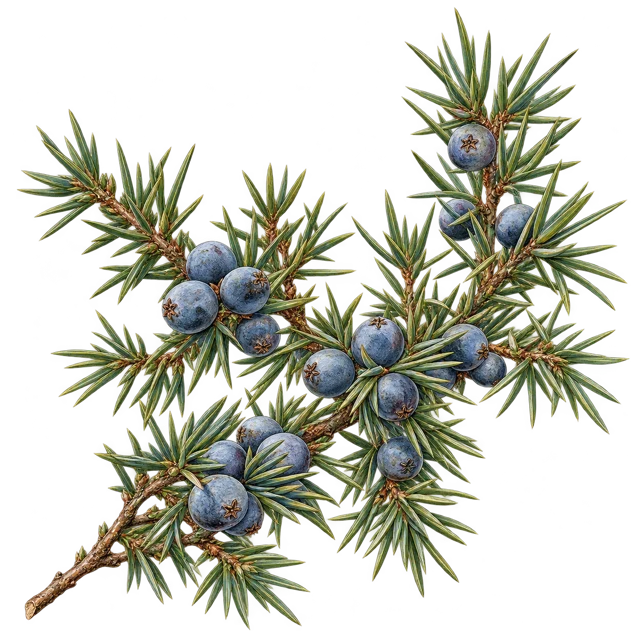
Juniper connects the kitchen and the distillery: its fleshy cones contribute a resinous flavor to dishes and to gin. Calling them berries is convenient culinary language, although botanically they are cones. The European herbal record concerns this identified cone material rather than an unspecified branch, wood or oil.
Early-modern writers also named juniper among aromatics intended to correct dangerous air. Odeuropa places that practice within anti-miasma thinking. Those passages are kept as Juniperus-level history when the species is not established, so the history does not falsely identify every old juniper as J. communis.
Traditional, historical and reported uses
- Food seasoning
Food or household practiceWhy this label?
The claim documents food seasoning as a culinary, craft, gardening, or practical material use; it reports neither a treatment outcome nor measured nutrient content.
Kew documents juniper berries in casseroles and marinades. The entry concerns identified culinary cone berries, not ornamental juniper foliage.
- Gin botanical
Food or household practiceWhy this label?
The claim documents gin botanical as a culinary, craft, gardening, or practical material use; it reports neither a treatment outcome nor measured nutrient content.
Juniper is a defining gin flavoring. This beverage history does not give alcoholic drinks medicinal properties.
- Traditional digestive use
Traditional accountWhy this label?
The EMA monograph explicitly uses long-standing-use support for digestive indications, rather than established clinical efficacy.
EMA records cone-berry preparations for indigestion and flatulence on a long-standing-use basis rather than well-established clinical efficacy.
- Traditional urinary use
Traditional accountWhy this label?
The monograph records a traditional urinary indication and excludes treating kidney infection.
EMA also records increasing urine flow for minor urinary complaints. This is not treatment for kidney infection or a reason to delay assessment.
- Plague-era aromatic practice, species unresolved
Historical recordWhy this label?
A scholarly smell-history account documents plague-era juniper aromatics; botanical identity remains unresolved and no infection protection is established.
Odeuropa records juniper among European plague aromatics. The common name alone cannot identify every historical species or material, and the practice did not establish infection protection.
Historical-use additions reviewed 2026-10-08
Story sources
- USDA PLANTS: Juniperus communis
- Kew: Plants behind cocktails, juniper and its food uses
- EMA: Juniper cone berry, herbal assessment portal
- EMA: Juniperus communis cone-berry monograph, revision 1 (2023)
- EMA: Juniperi fructus, veterinary summary report (composition only)
- Study of essential oil from Juniperus communis cones growing in Greece (1993)
- Odeuropa Encyclopedia of Smell History and Heritage: Plague
- CDC: Clinical Care of Plague
Regional reading paths
These sourced notes describe cultivation, trade, food traditions or material history. A regional connection does not claim exclusive origin.
Europe
Native and traditional processing: European juniper; documented European flavouring and herbal traditions.
Identified ripe cone-berries flavour foods and beverages. Do not substitute ornamental junipers.
Identity & detailed reference
Identity
Common juniper, Juniperus communis, with ripe berry-like cones as the culinary and monograph material. This is not the broom sometimes called biblical juniper; unspecified historical Juniperus records remain species-unresolved.
Ingredient details, preparation and research
Also known as: Common juniper; Juniper cone berry; Juniper berry (botanically a cone)
Source plant or material
Juniperus communis; ripe cone berries for culinary and oral-herbal records. Historical aromatic accounts may concern other parts or Juniperus species.
Plant family / material: Cupressaceae (cypress family)
Forms and route
Food-grade dried cone berries; separately labeled cone-berry herbal preparations. Essential oil, wood, foliage and historical aromatic materials are not interchangeable.
Absorption and preparation
A seasoning, a cone-berry herbal preparation and an essential oil provide different exposures. No food-pairing or absorption-enhancement instruction is established for them here.
Traditional and reported uses
- Food-grade cone berries as a seasoning and gin botanical.
- Traditional cone-berry medicinal uses for digestive and minor urinary complaints.
- Species-qualified reference to historical aromatic plague practices.
Contraindications and cautions
- Medicinal cone-berry use is unsuitable with serious kidney disease or a medically required fluid restriction.
- Medicinal use is not recommended during pregnancy or breastfeeding; seek care for urinary fever, pain or blood.
- Use reliably identified food-grade J. communis for culinary use; other junipers and biblical broom are not substitutes.
- Do not ingest essential oil or substitute fumigation for medical care.
Identity boundary
USDA identifies J. communis as a member of Cupressaceae. Keep this botanical separate from broom identifications under biblical juniper and from generic historical Juniperus material.
Cone chemistry and form
The cone contains an aromatic oil fraction. Published cone-oil analyses and EMA composition records concern that fraction and do not justify administering isolated essential oil as if it were a seasoning.
Medicinal caution
The traditional monograph cautions against use with severe renal disease or fluid restriction and during pregnancy or breastfeeding. Urinary fever, painful urination or blood requires professional assessment.
Historical plague claims and present care
No historical plant or material here is established to prevent or cure plague. Suspected plague requires urgent medical assessment and prompt antibiotics.
Entry sources
- USDA PLANTS: Juniperus communis
- Kew: Plants behind cocktails, juniper and its food uses
- EMA: Juniper cone berry, herbal assessment portal
- EMA: Juniperus communis cone-berry monograph, revision 1 (2023)
- EMA: Juniperi fructus, veterinary summary report (composition only)
- Study of essential oil from Juniperus communis cones growing in Greece (1993)
- Odeuropa Encyclopedia of Smell History and Heritage: Plague
- CDC: Clinical Care of Plague
Reference entry 234 · Recorded content review: 2026-10-08 · Review scope and dates