


Key cautions
- Poisonous lookalikes make expert identification essential; this card is not a foraging guide.
What’s inside
Analyses of C. cibarius identify protein, carbohydrates, fatty acids, phenolic compounds and volatile aroma molecules. Ergosterol and vitamin D2 have also been measured in chanterelle samples; amounts vary.
Uses in brief

- Seasonal table mushrooms
- Kashaya Pomo hot-rock baking
- Household gathering and market income
History, folklore and reported uses
History, folklore and traditional uses
Golden chanterelles belong to many local food histories rather than one worldwide species. European culinary familiarity sits alongside Pacific North American species such as Cantharellus formosus. An older name in a food-history source may therefore require a different modern taxonomic interpretation.
The US Forest Service records chanterelle eating among Nlaka’pamux people and hot-rock baking among Kashaya Pomo people in northern Sonoma County. It also documents the growth of Pacific Northwest commercial gathering during the 1980s. These are particular community and regional histories, not claims about every Indigenous nation.
A closer look at its history
A forest crop that needs its trees
Commercial chanterelle gathering links household food knowledge, regional markets and forest management. Unlike mushrooms cultivated on dead straw, chanterelles depend on living tree partners. The US Forest Service monograph treats harvest practice, local traditions and forest ecology together, explaining why maintaining habitat matters more than simply leaving a cap behind.
Additional history reviewed 2026-10-09
Traditional, historical and reported uses
- Seasonal table mushrooms
Food or household practiceWhy this label?
The claim documents seasonal table mushrooms as a culinary, craft, gardening, or practical material use; it reports neither a treatment outcome nor measured nutrient content.
Cooked chanterelles are valued seasonal food in European and North American traditions.
- Kashaya Pomo hot-rock baking
Food or household practiceWhy this label?
The claim documents kashaya pomo hot-rock baking as a culinary, craft, gardening, or practical material use; it reports neither a treatment outcome nor measured nutrient content.
The Forest Service monograph records hot-rock baking of chanterelles among Kashaya Pomo people; this is a named community’s food practice.
- Household gathering and market income
Mixed/contextual sourcesWhy this label?
The monograph documents subsistence and commercial forest livelihoods rather than a therapeutic or compositional finding.
Subsistence collection and commercial sales connect chanterelles with forest livelihoods, including the modern Pacific Northwest harvest.
Three distinct culinary, cultural and livelihood uses are documented here. Separate medical uses have not been established.
Story sources
- US Forest Service: Ecology and management of commercially harvested chanterelle mushrooms
- US Forest Service chanterelle monograph, cultural history p. 43
- US Forest Service: Cantharellus species, Cantharellaceae
- Primary analysis: Bioactive Compounds and Volatile Profiles of Five Transylvanian Wild Edible Mushrooms
- USDA ARS: Vitamin D and sterol composition of ten types of mushrooms
Features and lookalikes to study
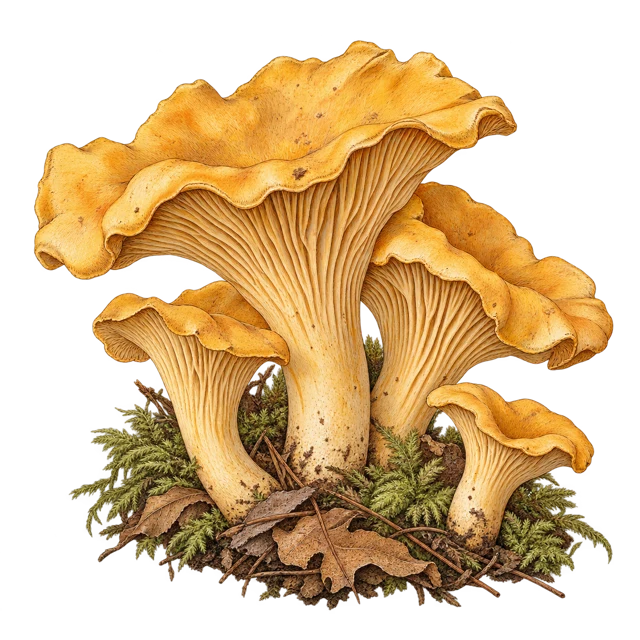
Cantharellus cibarius and related edible Cantharellus species; North American golden chanterelles include C. formosus and other distinct taxa.
Common names vary between regions and suppliers; the scientific scope above governs this card.
Morphology described in sources
- Golden chanterelles have fleshy caps and an underside ranging from shallow blunt, branching ridges to nearly smooth; these are not the thin blade-like true gills of typical agarics. They form mycorrhizal relationships with trees.
- Habitat and substrate
- See the source-linked morphology and comparison notes below; a separate habitat summary has not been verified for this card.
- Geographic scope
- A complete regional range is not established here. Broad common names and commercial labels can span different species.
- Season in the cited region
- No region-specific fruiting season has been verified for this card. Do not infer a local season from trade availability.
Omphalotus species (jack-o’-lantern mushrooms; poisonous)
Omphalotus has developed true gills and commonly forms dense clusters from wood, including buried wood. Chanterelles generally fruit from soil as separate mushrooms or scattered groups.
Buried wood can make Omphalotus appear terrestrial. Neither orange colour, clustering alone nor an attempted glow-in-the-dark test is reliable.
Hygrophoropsis aurantiaca group (false chanterelles)
False chanterelles have true, thin gills rather than the blunt folds typical of golden Cantharellus.
The gills can fork, so “forked equals chanterelle” is unsafe. The source monograph discusses regional lookalikes; an expert must assess the full collection.
Limits and regional differences
- Cantharellus cibarius is not a universal name for golden chanterelles. Species delimitation may need microscopy and molecular evidence; odour and colour overlap.
- Educational comparison only. Neither this card, an illustration, a photograph, a spore-print colour nor a checklist establishes that a wild collection is safe to eat. A qualified local mycologist must assess uncertain material; do not taste an unknown fungus. Cooking does not reliably eliminate mushroom toxins.
Regional reading paths
These sourced notes describe cultivation, trade, food traditions or material history. A regional connection does not claim exclusive origin.
Europe
Native/wild-collected: Finnish forests and wider northern Europe.
Identified edible chanterelles cooked as a seasonal food.
North America
Wild-harvested: United States Mid-Atlantic and other regional forests.
Cooked culinary mushrooms; do not assign every North American species to C. cibarius.
Identity & detailed reference
Identity
Cantharellus cibarius and related edible Cantharellus species; North American golden chanterelles include C. formosus and other distinct taxa.
Ingredient details, preparation and research
Also known as: Golden chanterelle; Girolle; Pacific golden chanterelle (C. formosus)
Source plant or material
Edible fruiting bodies from an authenticated Cantharellus species; European and North American golden chanterelles are not all C. cibarius.
Fungal family: Cantharellaceae
Forms and route
Fresh cooked mushrooms and preserved culinary products.
Vitamins and minerals
Chanterelles can supply dietary nutrients, including vitamin D2 in studied samples. Species, light exposure and preparation affect composition; the vitamin content of one sample is not a guarantee for every harvest.
Absorption and preparation
Use authenticated edible mushrooms in cooked dishes. Culinary preparation is not a demonstrated treatment or a standardized way to increase medicinal absorption.
Traditional and reported uses
- Cooked chanterelles are valued seasonal food in European and North American traditions.
- The Forest Service monograph records hot-rock baking of chanterelles among Kashaya Pomo people; this is a named community’s food practice.
- Subsistence collection and commercial sales connect chanterelles with forest livelihoods, including the modern Pacific Northwest harvest.
Contraindications and cautions
- Poisonous lookalikes make expert identification essential; this card is not a foraging guide.
Similar items and how they compare
- Porcini / cep / penny bun
Both are gathered forest-food groups with trade histories.
Porcini are Boletus relatives; golden chanterelles belong to Cantharellus. Neither group is one worldwide species.
Fungus, family and material
Cantharellus cibarius and related edible Cantharellus species. Cantharellaceae. Edible fruiting bodies from an authenticated Cantharellus species; European and North American golden chanterelles are not all C. cibarius.
- US Forest Service: Ecology and management of commercially harvested chanterelle mushrooms
- US Forest Service chanterelle monograph, cultural history p. 43
- US Forest Service: Cantharellus species, Cantharellaceae
- Primary analysis: Bioactive Compounds and Volatile Profiles of Five Transylvanian Wild Edible Mushrooms
- USDA ARS: Vitamin D and sterol composition of ten types of mushrooms
Preparation and evidence
Use authenticated edible mushrooms in cooked dishes. Culinary preparation is not a demonstrated treatment or a standardized way to increase medicinal absorption.
- US Forest Service: Ecology and management of commercially harvested chanterelle mushrooms
- US Forest Service chanterelle monograph, cultural history p. 43
- US Forest Service: Cantharellus species, Cantharellaceae
- Primary analysis: Bioactive Compounds and Volatile Profiles of Five Transylvanian Wild Edible Mushrooms
- USDA ARS: Vitamin D and sterol composition of ten types of mushrooms
Constituents and nutrition
Analyses of C. cibarius identify protein, carbohydrates, fatty acids, phenolic compounds and volatile aroma molecules. Ergosterol and vitamin D2 have also been measured in chanterelle samples; amounts vary. Chanterelles can supply dietary nutrients, including vitamin D2 in studied samples. Species, light exposure and preparation affect composition; the vitamin content of one sample is not a guarantee for every harvest.
- US Forest Service: Ecology and management of commercially harvested chanterelle mushrooms
- US Forest Service chanterelle monograph, cultural history p. 43
- US Forest Service: Cantharellus species, Cantharellaceae
- Primary analysis: Bioactive Compounds and Volatile Profiles of Five Transylvanian Wild Edible Mushrooms
- USDA ARS: Vitamin D and sterol composition of ten types of mushrooms
History and documented uses
Golden chanterelles belong to many local food histories rather than one worldwide species. European culinary familiarity sits alongside Pacific North American species such as Cantharellus formosus. An older name in a food-history source may therefore require a different modern taxonomic interpretation. The US Forest Service records chanterelle eating among Nlaka’pamux people and hot-rock baking among Kashaya Pomo people in northern Sonoma County. It also documents the growth of Pacific Northwest commercial gathering during the 1980s. These are particular community and regional histories, not claims about every Indigenous nation.
- US Forest Service: Ecology and management of commercially harvested chanterelle mushrooms
- US Forest Service chanterelle monograph, cultural history p. 43
- US Forest Service: Cantharellus species, Cantharellaceae
- Primary analysis: Bioactive Compounds and Volatile Profiles of Five Transylvanian Wild Edible Mushrooms
- USDA ARS: Vitamin D and sterol composition of ten types of mushrooms
Safety and interpretation
Poisonous lookalikes make expert identification essential; this card is not a foraging guide. Traditional eating does not establish that chanterelles treat parasites or other illnesses.
- US Forest Service: Ecology and management of commercially harvested chanterelle mushrooms
- US Forest Service chanterelle monograph, cultural history p. 43
- US Forest Service: Cantharellus species, Cantharellaceae
- Primary analysis: Bioactive Compounds and Volatile Profiles of Five Transylvanian Wild Edible Mushrooms
- USDA ARS: Vitamin D and sterol composition of ten types of mushrooms
Entry sources
- US Forest Service: Ecology and management of commercially harvested chanterelle mushrooms
- US Forest Service chanterelle monograph, cultural history p. 43
- US Forest Service: Cantharellus species, Cantharellaceae
- Primary analysis: Bioactive Compounds and Volatile Profiles of Five Transylvanian Wild Edible Mushrooms
- USDA ARS: Vitamin D and sterol composition of ten types of mushrooms
Reference entry 219 · Recorded content review: 2026-10-08 · Review scope and dates