


Key cautions
- Purchase identified food-grade porcini; a general description of boletes cannot establish edibility.
What’s inside
B. edulis analyses identify protein, carbohydrates, fatty acids, phenolic compounds and aroma volatiles. Drying changes the volatile profile; it does not create one standardized porcini extract.
Uses in brief

- Fresh seasonal cooking
- Preserving the harvest
- Aroma through drying
History, folklore and reported uses
History, folklore and traditional uses
Porcini move between woodland and pantry. Their Italian name means “little pigs,” while cep and penny bun belong to other regional naming traditions. The name is a culinary umbrella: Kew found that dried market packets can contain several species rather than only the familiar Boletus edulis.
Their story is also about the trees that feed them. Porcini form living partnerships with roots, linking a valuable gathered food to woodland ecology. Drying extends a seasonal harvest and changes its aroma, allowing a forest crop to enter kitchens far from the place where it grew.
A closer look at its history
A familiar food hiding unfamiliar species
DNA research on commercial porcini illustrates a recurring problem: a well-established food name can unite several biological species. Kew’s account of new porcini species shows why a packet name, a culinary tradition and a scientific species are different kinds of evidence.
Additional history reviewed 2026-10-09
Traditional, historical and reported uses
- Fresh seasonal cooking
Food or household practiceWhy this label?
The claim documents fresh seasonal cooking as a culinary, craft, gardening, or practical material use; it reports neither a treatment outcome nor measured nutrient content.
Authenticated porcini fruiting bodies are used as a fresh seasonal ingredient in regional food traditions.
- Preserving the harvest
Food or household practiceWhy this label?
The claim documents preserving the harvest as a culinary, craft, gardening, or practical material use; it reports neither a treatment outcome nor measured nutrient content.
Drying turns perishable mushrooms into a storable ingredient for later cooking and international trade.
- Aroma through drying
Mixed/contextual sourcesWhy this label?
The claim summarizes food-processing aroma research, including a source on volatile composition and sensory profile, without specifying a single human or laboratory setting.
Food research documents changes in B. edulis aroma during drying, helping explain why dried porcini have a distinct culinary role rather than simply duplicating fresh mushrooms.
- Forest gathering and trade
Mixed/contextual sourcesWhy this label?
The claim documents seasonal gathering, species naming, and trade income, providing economic/contextual evidence.
Gathering and selling edible porcini provide seasonal forest-product income. Commercial names may cover different local species.
Four uses and functions are distinguished here. The richer record concerns food, preservation and trade; medicinal claims would overstate the evidence.
Story sources
Features and lookalikes to study
Boletus edulis and the porcini species group; European commercial species also include B. aereus, B. pinophilus and B. reticulatus.
Porcini is a culinary group. Cep, penny bun and Steinpilz are regional names often centred on B. edulis; the trade is not confined to that species.
Morphology described in sources
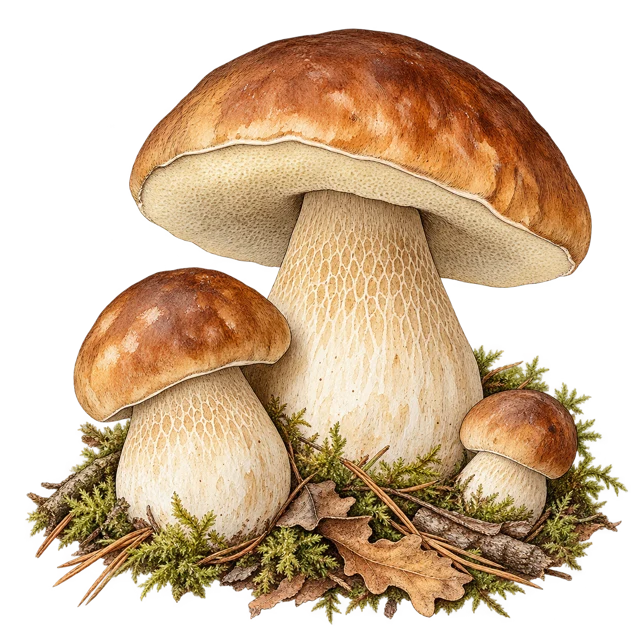
- The European B. edulis concept has a brown cap, stout stem with fine netting, and pores changing from pale to yellowish/olive with maturity. Those traits describe a complex rather than one globally uniform mushroom.
- Habitat and substrate
- See the source-linked morphology and comparison notes below; a separate habitat summary has not been verified for this card.
- Geographic scope
- A complete regional range is not established here. Broad common names and commercial labels can span different species.
- Season in the cited region
- No region-specific fruiting season has been verified for this card. Do not infer a local season from trade availability.
Tylopilus species, including bitter-bolete lookalikes
Many Tylopilus develop pinkish pores and a pinkish-brown deposit, unlike mature olive-pored edulis-group boletes.
Young Tylopilus pores may still be white. Species-level distinctions need a whole developmental series; never taste an unknown bolete as a shortcut.
Other edulis-like Boletus species
North American edulis-like mushrooms differ in host, season, cap surface, stem ornament and microscopic or genetic characters.
A European B. edulis name should not be imposed on a North American or Asian collection solely because it looks like a porcini photograph.
Limits and regional differences
- No universal rule based on red pores, blue bruising or their absence separates all poisonous from edible boletes. A regional expert must determine species; atypical or immature material may require microscopy/DNA.
- Educational comparison only. Neither this card, an illustration, a photograph, a spore-print colour nor a checklist establishes that a wild collection is safe to eat. A qualified local mycologist must assess uncertain material; do not taste an unknown fungus. Cooking does not reliably eliminate mushroom toxins.
Regional reading paths
These sourced notes describe cultivation, trade, food traditions or material history. A regional connection does not claim exclusive origin.
Europe
Native/wild-collected: Finland and continental European forests; Romanian research examines culinary mushrooms.
Identified edible porcini cooked fresh or dried for soups and sauces.
Identity & detailed reference
Identity
Boletus edulis and the porcini species group; European commercial species also include B. aereus, B. pinophilus and B. reticulatus.
Ingredient details, preparation and research
Also known as: Cep; Cèpe; Penny bun; Porcino
Source plant or material
Fruiting bodies of authenticated edible porcini, fresh or dried; the market name covers several Boletus species.
Fungal family: Boletaceae
Forms and route
Fresh mushrooms, dried slices and food powders made from dried porcini.
Vitamins and minerals
A food ingredient whose composition varies with species, moisture and preparation. Fresh and dried weights are not nutritionally interchangeable; no universal vitamin or mineral serving is assigned to this multi-species group.
Absorption and preparation
Dried porcini are a preserved cooking ingredient; rehydration and cooking serve culinary preparation rather than a proven absorption-enhancement protocol. Buy authenticated food-grade material.
Traditional and reported uses
- Authenticated porcini fruiting bodies are used as a fresh seasonal ingredient in regional food traditions.
- Drying turns perishable mushrooms into a storable ingredient for later cooking and international trade.
- Food research documents changes in B. edulis aroma during drying, helping explain why dried porcini have a distinct culinary role rather than simply duplicating fresh mushrooms.
- Gathering and selling edible porcini provide seasonal forest-product income. Commercial names may cover different local species.
Contraindications and cautions
- Purchase identified food-grade porcini; a general description of boletes cannot establish edibility.
Similar items and how they compare
- Golden chanterelles
Both are gathered forest-food groups with trade histories.
Porcini are Boletus relatives; golden chanterelles belong to Cantharellus. Neither group is one worldwide species.
Fungus, family and material
Boletus edulis and related porcini species. Boletaceae. Fruiting bodies of authenticated edible porcini, fresh or dried; the market name covers several Boletus species.
Preparation and evidence
Dried porcini are a preserved cooking ingredient; rehydration and cooking serve culinary preparation rather than a proven absorption-enhancement protocol. Buy authenticated food-grade material.
Constituents and nutrition
B. edulis analyses identify protein, carbohydrates, fatty acids, phenolic compounds and aroma volatiles. Drying changes the volatile profile; it does not create one standardized porcini extract. A food ingredient whose composition varies with species, moisture and preparation. Fresh and dried weights are not nutritionally interchangeable; no universal vitamin or mineral serving is assigned to this multi-species group.
History and documented uses
Porcini move between woodland and pantry. Their Italian name means “little pigs,” while cep and penny bun belong to other regional naming traditions. The name is a culinary umbrella: Kew found that dried market packets can contain several species rather than only the familiar Boletus edulis. Their story is also about the trees that feed them. Porcini form living partnerships with roots, linking a valuable gathered food to woodland ecology. Drying extends a seasonal harvest and changes its aroma, allowing a forest crop to enter kitchens far from the place where it grew.
Safety and interpretation
Purchase identified food-grade porcini; a general description of boletes cannot establish edibility. This is food and cultural history, not evidence that porcini prevent or treat disease.
Entry sources
- Kew: Discovering new species of porcini
- Kew taxonomy: Boletus edulis, Boletaceae
- Primary analysis: Bioactive Compounds and Volatile Profiles of Five Transylvanian Wild Edible Mushrooms
- Primary food study: The Influence of Drying Method on Volatile Composition and Sensory Profile of Boletus edulis
Reference entry 218 · Recorded content review: 2026-10-08 · Review scope and dates