


Key cautions
- Kidney disease and potassium-raising medicines can make added potassium dangerous.
- Food, salt substitutes, supplements and prescription citrate are not freely interchangeable.
- Before use, disclose dehydration, diabetes, adrenal disease, gastrointestinal blockage or slow stomach emptying, ulcers and urinary infection. The U.S. extended-release label also contraindicates use in conditions predisposing to high potassium, including extensive tissue breakdown; severe heart disease can impair potassium handling.
- The British liquid’s cystitis indication does not override the U.S. extended-release tablet’s active-urinary-infection contraindication. Formulation, diagnosis and local prescribing information must all match.
- Anticholinergic medicines can delay tablet passage and increase injury from potassium salts. This is an additional interaction beyond the potassium-raising drugs already listed below.
- Pregnancy and breastfeeding require a specific benefit–risk discussion. The U.S. extended-release label has not established pediatric safety and effectiveness; a different product’s pediatric instructions do not authorize substituting the tablet.
- If a tablet seems stuck or causes chest pressure, obtain prompt medical advice before another dose. Black stools, vomiting blood, severe weakness, abnormal heartbeat or breathing difficulty require urgent assessment. Suspected overdose needs immediate poison-center or emergency advice; do not wait for symptoms.
- The cited British liquid contains sucrose, relevant to diabetes and certain inherited sugar-intolerance disorders. Its label also flags cardiac glycosides and medicines whose urinary elimination changes with pH. Ask a pharmacist to check the entire formulation and medicine list.
What’s inside
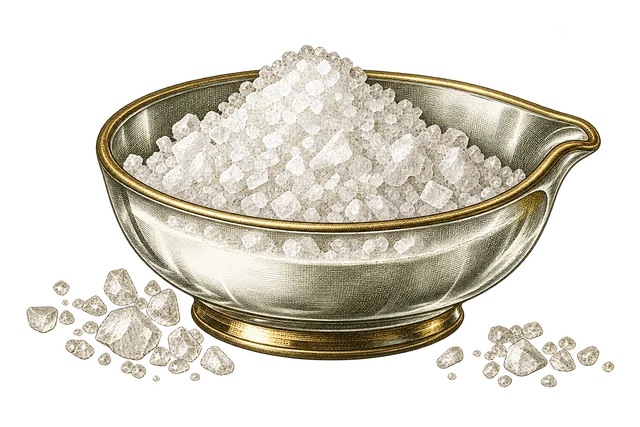
Potassium citrate is a salt containing potassium ions and citrate. Its composition combines an essential mineral with a component that affects urine chemistry.
NIH ODS: Potassium, health-professional fact sheet · DailyMed: Potassium citrate extended-release tablets, clinical pharmacology and indications
Separate nutrition from medicine
Potassium supports membrane electrical activity, muscle function and fluid balance. Potassium citrate has an additional citrate/alkali effect on urine. “Contains potassium” does not establish treatment equivalence: a food, potassium-chloride salt substitute, low-dose supplement and prescription citrate tablet differ in composition and intended use.
NIH ODS: Potassium, health-professional fact sheet · DailyMed: Potassium citrate extended-release tablets, clinical pharmacology and indications
Reading potassium units
Milligrams of potassium describe the element; milligrams of potassium citrate include the accompanying citrate and, for a hydrated salt, water. A milliequivalent (mEq) describes electrical charge: for potassium, 1 mEq equals 1 mmol, about 39.1 mg of elemental potassium. These units clarify a label; they are not a recipe for substituting products.
The accompanying citrate matters
Citrate metabolism supplies alkali, and urinary citrate can bind calcium. Raising urine pH also favors the more soluble form of uric acid. The balance differs for calcium-phosphate stones, which are more stable in alkaline urine, so increasing pH indefinitely is not a treatment goal.
DailyMed: Potassium citrate extended-release tablets, clinical pharmacology and indications
A food portion is not a medicinal preparation
The cooked-legume and peeled-banana examples below describe edible food portions. They cannot be transferred to dry seeds, extracts or powders. Food contains several potassium salts and other nutrients; measuring food potassium does not establish its citrate content.
Uses in brief

- Food potassium contributes to normal electrolyte nutrition.
- Prescribed potassium citrate treats selected stone-related conditions after clinical assessment.
History, folklore and reported uses
Cooling draughts in fever
John Scudder’s 1898 American Eclectic Materia Medica described a citrate-of-potash solution for feverish thirst and hot, dry skin. He called it a cooling medicine intended to encourage perspiration and favored effervescence for recurring or fluctuating fevers. This places the preparation within a nineteenth-century American medical school and its symptom-based prescribing.
Scudder, 1898: Liquor Potassae Citratis, original materia-medica transcription
Settling an irritable stomach
Scudder attributed a stomach-calming effect to the carbonic acid in the effervescent drink, also saying it masked the salt’s taste. This was a claim about the prepared fizzy mixture, not proof of a gastrointestinal benefit from isolated potassium citrate. His account predates modern controlled clinical trials.
Scudder, 1898: Liquor Potassae Citratis, original materia-medica transcription
Relief of cystitis discomfort
The British Potassium Citrate Mixture product information describes relief of painful urination in mild urinary infection, especially cystitis. Its liquid contains 1.5 g potassium citrate per 5 mL, a product concentration rather than elemental potassium or a suggested dose. This pharmacy tradition concerns symptom relief, not bacterial eradication.
Thornton & Ross: Potassium Citrate Mixture, product characteristics
Urinary stones and acid–base disorders
The U.S. extended-release label covers renal tubular acidosis with calcium stones, calcium oxalate stones with low urinary citrate, and uric-acid stones with or without calcium stones. Treatment aims at urine chemistry and is selected by stone type; it is not a general body-alkalizing remedy. Blood potassium, kidney function and urine monitoring are part of care.
DailyMed: Potassium citrate extended-release tablets, clinical pharmacology and indications
What a controlled stone trial found
Barceló and colleagues’ 1993 double-blind study randomized 57 people with recurrent calcium stones and low urinary citrate to oral wax-matrix potassium-citrate tablets or placebo. Among participants reported after three years, 13 of 18 receiving citrate and 4 of 20 receiving placebo were in remission. Stone formation was lower with citrate. The abstract’s three-year groups are smaller than the initial randomized sample, an important limitation; the finding concerns selected stone-formers, not general prevention in healthy people. The studied regimen is not a self-treatment schedule.
How broad is the clinical evidence?
A 2015 Cochrane review included seven trials and 477 adults, mostly with oxalate stones. Only three trials studied potassium citrate alone; others used potassium–sodium or potassium–magnesium citrate. Pooled findings favored citrate salts for preventing new stones, but reporting quality was moderate to poor, and withdrawals due to adverse effects were more frequent. This review includes the 1993 trial above, so it is not wholly separate evidence. Its conclusions cannot be assigned unchanged to every citrate formulation.
Why monitoring remains part of treatment
The U.S. label’s pivotal studies were not randomized or placebo-controlled and sometimes included dietary changes. Treatment also requires follow-up blood and urine tests alongside symptoms: feeling better does not establish a safe potassium level or an appropriate urine pH. Renal tubular acidosis is a kidney disorder affecting acid balance, rather than a reason for general “alkaline body” supplementation.
DailyMed: Potassium citrate extended-release tablets, clinical pharmacology and indications
Identity & detailed reference
Identity
Potassium citrate is a potassium salt of citric acid. Potassium is an essential electrolyte; prescribed citrate also changes urinary citrate and acidity.
Ingredient details, preparation and research
Source plant or material
A manufactured mineral salt, not an herb. Foods contain potassium with several accompanying ions, including citrate, phosphate and sulfate.
Plant family / material: Not applicable: potassium citrate is a chemical salt with no botanical family.
Forms and route
Oral supplements and prescription extended-release tablets. Elemental potassium, potassium-citrate compound weight and milliequivalents (mEq) are different label quantities.
Food sources
Lentils, beans, vegetables, potatoes, dairy and fruit supply potassium. Their amounts do not specify a medicinal potassium-citrate dose.
Vitamins and minerals
USDA examples: cooked lentils, 198 g (1 cup), about 731 mg potassium; a medium peeled banana, 118 g, 422 mg; cooked chickpeas, 82 g (1/2 cup), 239 mg. These are elemental potassium amounts in foods.
Absorption and preparation
Food potassium is well absorbed. For prescribed extended-release potassium citrate, follow its exact label, including food and water instructions and swallowing tablets whole; meal timing chiefly reduces gastrointestinal irritation.
Combination context
A varied meal can include potassium-containing legumes and vegetables. Do not add a potassium salt substitute or supplement to improve another product’s absorption; the combined potassium load matters.
Nutritional role and uses
Dietary potassium supports nerves, muscles and fluid balance. Prescription potassium citrate is used for selected kidney-stone disorders; a nutrition supplement or potassium-rich food is not automatically an equivalent treatment.
Contraindications and cautions
- High blood potassium can cause dangerous heart rhythms with few warning symptoms; impaired kidney function greatly increases risk.
- Check potassium-sparing diuretics, ACE inhibitors, ARBs, other RAAS drugs, NSAIDs, salt substitutes and additional potassium products.
- Extended-release tablets have gastrointestinal restrictions; severe vomiting, abdominal pain or gastrointestinal bleeding needs urgent medical assessment.
- Before use, disclose dehydration, diabetes, adrenal disease, gastrointestinal blockage or slow stomach emptying, ulcers and urinary infection. The U.S. extended-release label also contraindicates use in conditions predisposing to high potassium, including extensive tissue breakdown; severe heart disease can impair potassium handling.
- The British liquid’s cystitis indication does not override the U.S. extended-release tablet’s active-urinary-infection contraindication. Formulation, diagnosis and local prescribing information must all match.
- Anticholinergic medicines can delay tablet passage and increase injury from potassium salts. This is an additional interaction beyond the potassium-raising drugs already listed below.
- Pregnancy and breastfeeding require a specific benefit–risk discussion. The U.S. extended-release label has not established pediatric safety and effectiveness; a different product’s pediatric instructions do not authorize substituting the tablet.
- If a tablet seems stuck or causes chest pressure, obtain prompt medical advice before another dose. Black stools, vomiting blood, severe weakness, abnormal heartbeat or breathing difficulty require urgent assessment. Suspected overdose needs immediate poison-center or emergency advice; do not wait for symptoms.
- The cited British liquid contains sucrose, relevant to diabetes and certain inherited sugar-intolerance disorders. Its label also flags cardiac glycosides and medicines whose urinary elimination changes with pH. Ask a pharmacist to check the entire formulation and medicine list.
Similar items and how they compare
- Potassium chloride
Both salts supply potassium, connecting them through the same essential electrolyte used in nerve signaling and muscle function.
Chloride does not supply citrate; the salts differ in accompanying ion and clinical purpose.
- Calcium citrate
Both are mineral citrate salts, sharing a citrate component while supplying different essential mineral elements to the body.
Calcium citrate supplies calcium rather than potassium; equal salt weights do not provide equivalent mineral amounts.
Adult nutritional reference values
The 2019 U.S./Canadian AIs for healthy adults 19+ are 3,400 mg/day for men and 2,600 mg/day for women; pregnancy 2,900 mg and lactation 2,800 mg. They describe total nutritional intake, not potassium-citrate prescriptions, and do not apply with impaired potassium excretion. No UL was established because evidence was insufficient; this does not mean unlimited supplemental potassium is safe.
Food potassium in useful portions
USDA SR Legacy records give approximately 731 mg potassium in 198 g cooked lentils (1 cup), 422 mg in a peeled medium banana (118 g), and 239 mg in 82 g cooked chickpeas (1/2 cup). A half-cup of lentils supplies about 365 mg. These are typical food portions, not conversion instructions for replacing a prescribed citrate product.
Labels and formulation-specific use
Compare the declared elemental potassium and the prescribed product/strength, rather than matching compound milligrams. Extended-release citrate is taken with or shortly after food and water as its label directs; swallow tablets whole. Do not crush or substitute a powder based only on its name. A pharmacist can check the actual labels and formulation.
Absorption does not require a booster
About 85–90% of food potassium is absorbed. There is no established need to pair it with fat, an herb or another mineral to increase uptake. Taking the prescribed tablet with food is chiefly a tolerability instruction. Dietary AIs must not be converted into supplement amounts as though food supplied no potassium.
Kidney and interaction precautions
Kidney impairment, existing hyperkalemia and other problems with potassium excretion can make even otherwise ordinary potassium loads unsafe. ACE inhibitors, ARBs and potassium-sparing diuretics are important examples; the prescription label also flags other RAAS inhibitors and NSAIDs. Potassium-containing salt substitutes can be concentrated sources. Review the full medication and product list before adding them.
Gut safety and practical related items
Extended-release tablets can injure the gastrointestinal tract and are unsuitable in specified ulcer, obstruction or delayed-transit situations. Severe abdominal pain, vomiting or bleeding requires urgent assessment. Potassium chloride supplies a different accompanying ion; calcium citrate supplies a different mineral. Neither is a self-selected substitute for the prescribed citrate formulation.
Evidence limits
- No treatment dose, laboratory target or replacement schedule is prescribed. Nutritional potassium and medicinal citrate are kept distinct.
- The February 2025 U.S. extended-release label was reviewed; other formulations and jurisdictions require their own label review.
- Food examples assume ordinary preparation and reference portions; kidney-related dietary restrictions must be individualized.
Entry sources
- NIH ODS: Potassium, health-professional fact sheet
- DailyMed: ANI potassium citrate extended-release tablets, prescribing information revised February 2025
- Memorial Sloan Kettering: Potassium citrate patient instructions
- National Academies: Dietary Reference Intakes for Sodium and Potassium, 2019, summary
- NIDDK: Treatment for kidney stones
- USDA FoodData Central: SR Legacy records 172421, 173944 and 173757
Reference entry 55 · Recorded content review: 2026-10-05 · Review scope and dates