


Key cautions
- Keep the edible arils separate from medicinal root, stem and peel preparations; large amounts of those other parts may be harmful.
- Pomegranate can cause digestive symptoms or allergic reactions in some people.
What’s inside
Arils supply natural sugars, dietary fiber, vitamin C, folate, vitamin K and potassium. The plant contains polyphenols; the distribution differs between juice, peel, seeds and extracted products. Rind-rich or whole-fruit extracts should not be described as an ordinary aril portion.
Uses in brief

- Eat the arils or use them as a tart-sweet ingredient; their edible seeds contribute to the whole-food texture and fiber.
- Juice, concentrated sauces and preserves have distinct culinary histories and serving sizes.
In the King James Bible
In the King James Bible
Named material
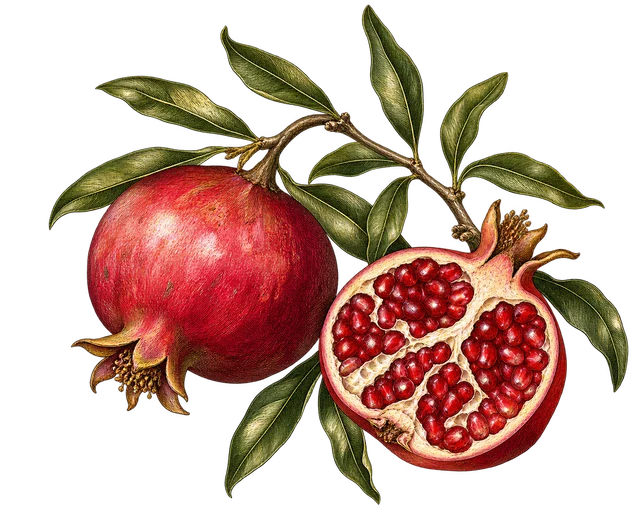
Pomegranate fruit and trees are named directly in the KJV and conventionally identified as Punica granatum. This card profiles edible arils; juice, syrup, peel, bark and root are separate preparations.
A land of wheat, and barley, and vines, and fig trees, and pomegranates; a land of oil olive, and honey;
Deuteronomy 8:8 (KJV)
Thy plants are an orchard of pomegranates, with pleasant fruits; camphire, with spikenard,
Song of Solomon 4:13 (KJV)
Scripture and identification sources
Words & their stories
WORDS & THEIR STORIES
The name behind the KJV
Biblical Hebrew · Deuteronomy 8:8 (KJV)
וְרִמּוֹןwərimmōn
“And pomegranates,” among the land’s produce.
Dictionary form: רִמּוֹן · rimmōn
The singular is collective here; wə- means “and.”
Biblical Hebrew · Song of Solomon 4:13 (KJV)
רִמּוֹנִיםrimmōnīm
Pomegranates, in the image of an orchard.
Dictionary form: רִמּוֹן · rimmōn
The verse uses the plural after the word for an orchard or park.
What the language reveals
A crop and a garden image
Deuteronomy lists produce, while the Song draws on a cultivated orchard in its poetry.
The same name can describe ornaments
BDB also records rimmōn for pomegranate-shaped decorations. Context distinguishes a fruit from a representation of it.
The pomegranate identification is strong. These produce and orchard passages do not specify aril processing, juice extracts or medicinal peel, root or bark preparations.
History, folklore and reported uses
History, folklore and traditional uses
Pomegranate belongs to the abundance of Deuteronomy and the orchard imagery of the Song of Solomon. Its crowded jewel-like seeds and distinctive shape also made it a model for decoration: Exodus describes pomegranate forms on the priestly robe, and Kings describes them on temple pillars. These are representations of a valued fruit, not evidence that every decorative reference describes eating it.
The kitchen history ranges from sweet dessert varieties to sharply tart ones. Musselman describes the sour fruit used in cooking in place of lemon or made into drinks. The National Park Service records juice used in sauces, wine and jelly, and remembers pomegranate beverages carried on journeys through dry country. Arils, juice and reduced sauces each preserve a different part of that food tradition.
Pomegranate also has a medicinal record involving diarrhea, intestinal parasites and throat complaints, with preparations taken by mouth or used as gargles. Some remedies used rind or tree bark rather than the edible seed coverings. That distinction remains important today: the pleasant food does not establish the safety of concentrated preparations from every part of the plant.
Traditional, historical and reported uses
- Tart juice as a cooking ingredient
Food or household practiceWhy this label?
Sour juice used in cooking and beverages.
Sour pomegranate varieties were used to acidify food and make refreshing drinks. This culinary function differs from the sweet arils eaten as dessert.
- Preserving and fermenting the juice
Food or household practiceWhy this label?
Juice processing into sauces, jelly and wine.
The National Park Service records juice made into sauces, jelly and wine. These are transformations of a harvest, with different sugar, fiber or alcohol characteristics from fresh arils.
- Religious textile and architectural motifs
Historical recordWhy this label?
Specific biblical passages document religious decorative motifs.
Pomegranate forms decorate the priestly robe in Exodus and temple pillars in Kings. These passages document artistic and religious uses of the fruit’s form.
- Traditional digestive and parasite remedies
Traditional accountWhy this label?
Traditional medicinal digestive and parasite uses.
NCCIH records historical use for diarrhea and intestinal parasitic infection. This is a record of medicinal practice, often involving plant materials other than edible arils; root, stem and peel require particular caution.
- Throat and mouth preparations
Traditional accountWhy this label?
Traditional local throat and mouth preparations.
Traditional pomegranate preparations were used for sore throat and as gargles or mouthwashes. The intended route and material differ from drinking an ordinary fruit beverage.
- Rind and flower dyes
Food or household practiceWhy this label?
Rind and flowers used as textile-dye materials.
Morton’s crop account records pomegranate rind and flowers as textile-dye materials. Smithsonian educational material also lists the rind as a source of yellow dye, a craft use of the outer fruit covering rather than its edible juice sacs.
- Tannins for leather working
Food or household practiceWhy this label?
Tannin-rich plant materials used in leather tanning.
Morton records pomegranate plant materials used in leather tanning, with trunk bark formerly important in Morocco-leather production. This is a material-processing history of bark and tannin-rich rind, not a reason to eat them.
Historical-use additions reviewed 2026-10-08
Story sources
- Lytton John Musselman, Old Dominion University: Pomegranate
- National Park Service, Tumacacori: Ethnobotany of Fruit Trees
- Exodus 28:33 (King James Version)
- 1 Kings 7:18 (King James Version)
- NCCIH (2025): Pomegranate, usefulness, evidence and safety
- Julia F. Morton (1987): Pomegranate, Fruits of Warm Climates, hosted by Purdue NewCROP, Other Uses
- Smithsonian Folklife: Art and Identity, natural-dye materials, PDF page 17
Regional reading paths
These sourced notes describe cultivation, trade, food traditions or material history. A regional connection does not claim exclusive origin.
Asia
Cultivated: Iran, including Saveh and other longstanding orchard regions.
Fresh arils and tart fruit sauces.
Identity & detailed reference
Identity
Pomegranate fruit and trees are named directly in the KJV and conventionally identified as Punica granatum. Edible arils, pressed juice, concentrated syrup, peel and medicinal bark or root products are different materials.
Ingredient details, preparation and research
Also known as: pomegranates
Source plant or material
Punica granatum L.; Edible pomegranate arils are profiled; peel, root, bark, juice and extracts are identified separately.
Plant family / material: Lythraceae (loosestrife family; older sources use Punicaceae)
Forms and route
Fresh arils, the juice-filled seed coverings together with their edible seeds; fresh or pasteurized juice; molasses-like concentrated juice, syrups, sauces and jellies. The tough rind and internal membranes are normally removed. Peel, bark, root and extract supplements are separate preparations.
Vitamins and minerals
One-half cup raw arils, including edible seeds (87 g): approximately 72 kcal, 16.3 g carbohydrate, 11.9 g sugars, 3.4 g fiber, 1.45 g protein, 206 mg potassium, 8.9 mg vitamin C, 33 micrograms folate and 14.2 micrograms vitamin K. USDA SR28 food 09286. Rind and internal membranes are excluded. These values are not for a half-cup of juice, peel powder or concentrated syrup.
Absorption and preparation
Eat the arils with their edible seeds when tolerated to retain the whole-food fiber. Juice and extracts deliver a different mixture, so no single antioxidant number establishes what the body absorbs from every product. Ordinary food use does not require fasting or a special supplement pairing; this card makes no claim that pomegranate enhances absorption of other medicines or nutrients.
Traditional and reported uses
- Eat the arils or use them as a tart-sweet ingredient; their edible seeds contribute to the whole-food texture and fiber.
- Juice, concentrated sauces and preserves have distinct culinary histories and serving sizes.
- The fruit also appears as an ornamental motif in biblical garments and temple decoration.
Contraindications and cautions
- Keep the edible arils separate from medicinal root, stem and peel preparations; large amounts of those other parts may be harmful.
- Pomegranate can cause digestive symptoms or allergic reactions in some people.
- Concentrated extracts are not interchangeable with food; discuss them with a clinician if taking medicines, pregnant or breastfeeding.
- Check added sugar and serving size in juice drinks and syrups; straining out the seeds and pulp changes fiber intake.
Similar items and how they compare
- Pomegranate juice
Made from the same fruit.
Usually much lower in intact fiber than arils; a beverage serving differs from a fruit serving.
- Pomegranate molasses
A concentrated pomegranate ingredient.
A tart-sweet condiment with concentrated sugars; recipes may include added sugar.
- Grapes
Another biblical fruit used fresh and as juice.
A different family and composition; grape or wine findings do not establish pomegranate effects.
Whole arils versus juice and extracts
The USDA food entry includes seed-and-juice sacs, commonly called arils. Modern studies often use juice or extracts, so those findings cannot be assigned unchanged to a small whole-fruit serving.
Current human-evidence summary
NCCIH reports possible blood-pressure benefit from juice or extract and small glucose effects, with further confirmation needed; it finds no clear lipid effect. These findings do not justify replacing prescribed treatment or claiming broad disease prevention.
Plant part is central to safety
NCCIH distinguishes ordinary juice from root, stem and peel, which may be harmful in large amounts. Little is known about non-juice forms in pregnancy or breastfeeding.
Evidence limits
- Explicit KJV fruit; conventional species identification
- The edible arils are distinct from ornamental representations and medicinal rind, root or bark preparations.
Entry sources
- Kew Tree of Life: Punica granatum in Lythraceae
- Lytton John Musselman, Old Dominion University: Pomegranate
- NCCIH (2025): Pomegranate, usefulness, evidence and safety
- University of Georgia Cooperative Extension: Pomegranate Production, Circular 997
- National Park Service, Tumacacori: Ethnobotany of Fruit Trees
- USDA SR28: Pomegranates, raw, food 09286, PDF page 808
- Exodus 28:33 (King James Version)
- 1 Kings 7:18 (King James Version)
- Deuteronomy 8:8 (King James Version)
- Song of Solomon 4:13 (King James Version)
- Julia F. Morton (1987): Pomegranate, Fruits of Warm Climates, hosted by Purdue NewCROP, Other Uses
- Smithsonian Folklife: Art and Identity, natural-dye materials, PDF page 17
Reference entry 154 · Recorded content review: 2026-10-06 · Review scope and dates