


Key cautions
- Do not self-treat urinary obstruction, dehydration, persistent diarrhea or kidney disease.
- Verify sclerotium versus fruiting body, species and formula ingredients.
What’s inside
Studied sclerotial constituents include polysaccharides, ergosterol and polyporusterones A and B. Cultivation partners can affect measured contents.
Uses in brief

- Urination and edema formulas
- Diarrhea traditions
- Edible fruiting bodies
History, folklore and reported uses
History, folklore and traditional uses
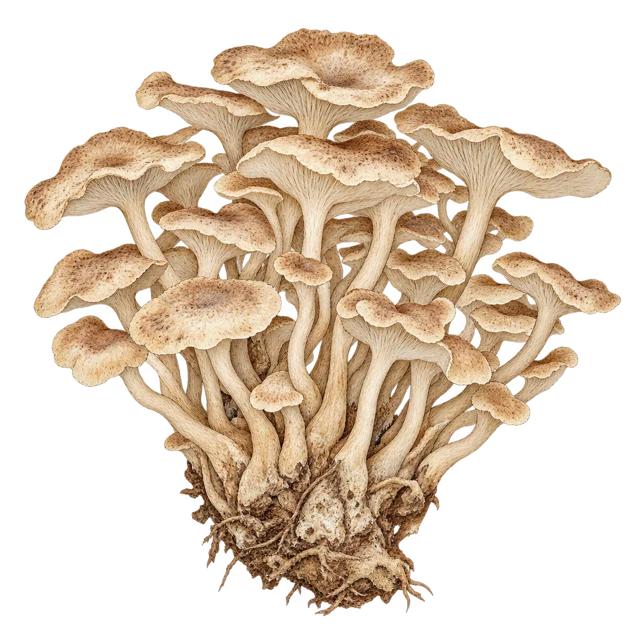
Zhu ling’s sclerotia belong to the Shen Nong Ben Cao Jing tradition, a compiled Chinese materia medica associated with roughly two millennia of history. Chinese and Korean records describe urinary and diarrhea-related uses. The underground medicinal material is distinct from the branched edible fruiting body.
Its cultivation reveals an unusual practical relationship between fungi. Growers and researchers use Armillaria partners to support development of P. umbellatus sclerotia. Field trials show that partner identity can affect yields and constituent profiles, linking traditional supply to modern agricultural research.
A closer look at its history
One fungus, two human-facing materials
The small umbrella-like fruiting caps and the buried sclerotium enter different histories: a visible food fungus and the material traded as zhu ling. Research sampling Chinese sclerotia found substantial genetic structure, making both tissue identity and provenance important when reading traditional-use or pharmacology claims.
Additional history reviewed 2026-10-09
Traditional, historical and reported uses
- Urination and edema formulas
Traditional accountWhy this label?
The claim lists traditional urinary and edema formula indications, not measured clinical benefit.
Used traditionally as a diuretic in formulas for scanty urine, urinary difficulty and edema.
- Diarrhea traditions
Traditional accountWhy this label?
The claim documents Chinese and Korean traditional diarrhea indications, without naming a specific archival passage or intervention result.
Traditional Chinese and Korean records include diarrhea among indications.
- Edible fruiting bodies
Food or household practiceWhy this label?
The claim documents edible fruiting bodies as a culinary, craft, gardening, or practical material use; it reports neither a treatment outcome nor measured nutrient content.
The above-ground fruiting body is an edible mushroom, distinct from the medicinal sclerotium.
- Cultivated medicinal crop with fungal partners
Mixed/contextual sourcesWhy this label?
The exact claim describes field co-cultivation experiments and supply development; field agriculture is not presumed to be a laboratory or human treatment study.
Field experiments co-cultivate P. umbellatus with Armillaria strains to produce sclerotia. Selecting partners affects yield and composition, offering a cultivated supply route alongside collection from the wild.
The documented roles here are urination and edema formulas, diarrhea traditions, edible fruiting bodies, cultivated medicinal crop with fungal partners. Fewer than five distinct uses are listed because additional medical claims are not needed to explain this fungus’s importance.
Story sources
- Primary phylogeographic study: P. umbellatus and historical sclerotial use
- Review of P. umbellatus food and sclerotial materials, 2025
- Zhao et al., 2013: traditional uses and quality-control review
- Korean Traditional Knowledge Portal: Jeoryeong
- NCBI Taxonomy: Polyporus umbellatus
- Primary field study: Armillaria partners and P. umbellatus cultivation, 2025
Features and lookalikes to study
Polyporus umbellatus (Pers.) Fr.; Grifola umbellata occurs in older literature.
Common names vary between regions and suppliers; the scientific scope above governs this card.
Morphology described in sources
- The above-ground umbrella polypore has many small rounded caps on discrete central stalks merging into a branched base. That base arises from buried sclerotial tissue; the medicinal sclerotium is not the cap cluster.
- Habitat and substrate
- See the source-linked morphology and comparison notes below; a separate habitat summary has not been verified for this card.
- Geographic scope
- A complete regional range is not established here. Broad common names and commercial labels can span different species.
- Season in the cited region
- No region-specific fruiting season has been verified for this card. Do not infer a local season from trade availability.
Grifola frondosa (maitake)
Maitake tends to have irregular fan-shaped fronds rather than numerous round, centrally stalked umbrellas.
Broken clusters and young material can obscure the distinction. Microscopy supports difficult identification; medicinal sclerotia cannot be identified from the cap comparison.
Limits and regional differences
- Distinguish fruiting body, sclerotium and prepared medicinal material. Published genetic variation within P. umbellatus cautions against assigning every worldwide collection to one undifferentiated taxon.
- Educational comparison only. Neither this card, an illustration, a photograph, a spore-print colour nor a checklist establishes that a wild collection is safe to eat. A qualified local mycologist must assess uncertain material; do not taste an unknown fungus. Cooking does not reliably eliminate mushroom toxins.
Identity & detailed reference
Identity
Polyporus umbellatus (Pers.) Fr.; Grifola umbellata occurs in older literature.
Ingredient details, preparation and research
Also known as: zhu ling; chorei; jeoryeong; umbrella polypore
Source plant or material
Polyporus umbellatus (Pers.) Fr.; Underground sclerotia for traditional medicine; branched above-ground fruiting bodies are a distinct edible material.
Fungal family: Polyporaceae
Forms and route
Traditional medicinal use centers on underground sclerotia. The branched above-ground fruiting bodies are a separate edible material; do not substitute cap and sclerotium automatically.
Vitamins and minerals
Edible fruiting bodies and medicinal sclerotia are different materials. No standardized vitamin/mineral contribution is assigned to a sclerotial tea or supplement.
Absorption and preparation
Traditional medicine uses processed sclerotia, often in formulas. Fruiting-body food, sclerotial decoction and purified extracts are not interchangeable, and clinical dosing cannot be inferred from laboratory extraction.
Traditional and reported uses
- Used traditionally as a diuretic in formulas for scanty urine, urinary difficulty and edema.
- Traditional Chinese and Korean records include diarrhea among indications.
- The above-ground fruiting body is an edible mushroom, distinct from the medicinal sclerotium.
- Field experiments co-cultivate P. umbellatus with Armillaria strains to produce sclerotia. Selecting partners affects yield and composition, offering a cultivated supply route alongside collection from the wild.
Contraindications and cautions
- Do not self-treat urinary obstruction, dehydration, persistent diarrhea or kidney disease.
- Verify sclerotium versus fruiting body, species and formula ingredients.
- Review concentrated products with medicines or in pregnancy; human safety data are limited.
- This card is not a foraging identification guide. Unknown wild mushrooms should not be eaten.
Similar items and how they compare
- Fu ling / poria
Both have sclerotial medicinal materials.
Zhu ling is Polyporus umbellatus; Asian fuling is Wolfiporia hoelen. Their identities and customary roles differ.
Identity, fungal material and preparation
Polyporus umbellatus (Pers.) Fr.; Grifola umbellata occurs in older literature. Underground sclerotia for traditional medicine; branched above-ground fruiting bodies are a distinct edible material. Traditional medicine uses processed sclerotia, often in formulas. Fruiting-body food, sclerotial decoction and purified extracts are not interchangeable, and clinical dosing cannot be inferred from laboratory extraction.
Constituents and food context
Studied sclerotial constituents include polysaccharides, ergosterol and polyporusterones A and B. Cultivation partners can affect measured contents. Edible fruiting bodies and medicinal sclerotia are different materials. No standardized vitamin/mineral contribution is assigned to a sclerotial tea or supplement.
Traditional uses and evidence boundaries
Historical use and laboratory activity do not establish clinical efficacy or safe unsupervised dosing. The edible fruiting body and medicinal sclerotium have different uses and are not automatic substitutes.
Safety and product distinctions
Do not self-treat urinary obstruction, dehydration, persistent diarrhea or kidney disease. Verify sclerotium versus fruiting body, species and formula ingredients. Review concentrated products with medicines or in pregnancy; human safety data are limited.
Entry sources
- Primary phylogeographic study: P. umbellatus and historical sclerotial use
- Review of P. umbellatus food and sclerotial materials, 2025
- Zhao et al., 2013: traditional uses and quality-control review
- Korean Traditional Knowledge Portal: Jeoryeong
- NCBI Taxonomy: Polyporus umbellatus
- Primary field study: Armillaria partners and P. umbellatus cultivation, 2025
Reference entry 216 · Recorded content review: 2026-10-08 · Review scope and dates