


Key cautions
- Recognized fragrance sensitizer; avoid with known allergy
- External/aromatic labeled products only; do not swallow or apply neat
- This research does not establish an oil-bottle recipe. Contact allergy is possible; “natural” and diluted do not mean safe for someone already sensitized.
- Ylang-ylang can cause contact allergy.
- Do not apply essential oils to damaged skin. Keep concentrates and fragranced diffuser liquids locked away, out of the sight and reach of children and pets.
What’s inside
Common constituents include linalool, benzyl acetate, methyl benzoate, geranyl acetate, benzyl benzoate, germacrene D and beta-caryophyllene. The balance of aromatic esters, monoterpenes and sesquiterpenes shifts with distillation fraction and origin; no single composition represents every bottle.
EFSA (2022): Ylang-ylang flower-oil characterization and handling safety; animal-feed assessment · PROSEA, Essential-oil plants: Cananga odorata, local flower uses, cultivation history and perfumery
Chemistry without a universal bottle profile
EFSA’s analytical assessment and a human-study oil description document aromatic esters such as benzyl acetate and methyl benzoate, linalool and various sesquiterpenes. Their proportions vary. EFSA evaluated use as an animal-feed flavor additive and handler exposure, not a human therapeutic oral regimen; its characterization is useful without transferring feed-use limits to people.
EFSA (2022): Ylang-ylang flower-oil characterization and handling safety; animal-feed assessment · Jung et al. (2013): Ylang-ylang aroma, blood pressure and heart rate in 29 healthy men
Reading a measured oil profile
EFSA’s five assessed batches came from Comoros and resembled First/Second fractions. Its GC–MS table reports linalool at 3.7–4.9%, benzyl acetate at 5.1–6.8% and beta-caryophyllene at 5.7–7.9% of total detected chromatographic peak area. These are analytical signal proportions, not grams per 100 g, percentages of fresh flowers or a dilution recipe. The profile does not represent every grade.
EFSA (2022): Ylang-ylang flower-oil characterization and handling safety; animal-feed assessment
Uses in brief

- Floral perfume and formulated hair/skin fragrance; traditional Macassar hair oil
- Preliminary short-term relaxation research, without a medical or sex-specific guarantee
- Mosquito-repellent research: ylang-ylang flower oil in experimental topical formulations reduced mosquito bites in human forearm tests. Results varied with the carrier and mosquito species.
- Hair products: ylang-ylang provides fragrance; growth, detangling, oil-balancing and circulation claims lack good human evidence.
History, folklore and reported uses
Botany, flowers and distillation grades
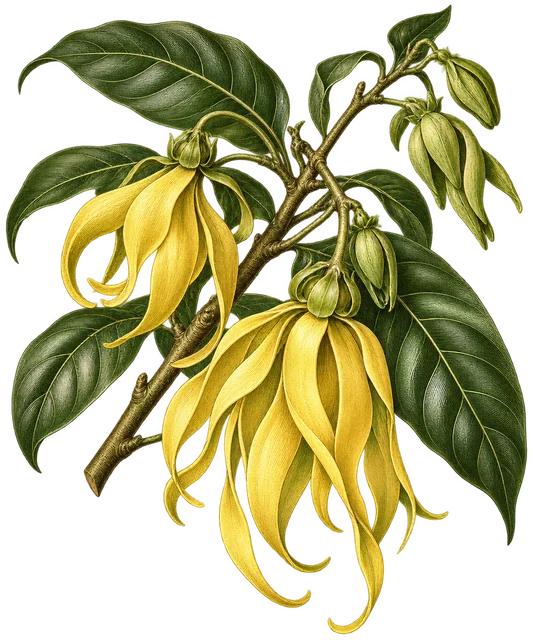
The accepted species Cananga odorata belongs to Annonaceae. Its flowers supply the perfume oil. Fractional collection during a long distillation produces oils with different volatile profiles and scent character, so a study of one grade cannot automatically establish another grade’s clinical performance or safe concentration. Check botanical name, part and formulation rather than a marketing name alone.
Kew: Cananga odorata, accepted name and Annonaceae family · EFSA (2022): Ylang-ylang flower-oil characterization and handling safety; animal-feed assessment
Attributed traditional grooming and scent use
The USDA-hosted species account describes flower garlands in Samoa and other Pacific islands and perfume in soaps, shampoos and hair oils. It identifies Macassar oil as coconut oil scented with ylang-ylang. This supports a historically attributed grooming/aroma role; it does not show that the fragrance component supplies the carrier’s lubrication or treats hair loss.
USDA Forest Service species account: Cananga odorata, perfumery and Macassar hair oil
Flowers in personal and ceremonial life
Ylang-ylang’s story starts with fragrant flowers as well as with distillation. The PROSEA botanical handbook describes Cananga odorata flowers tucked into hair, kept with clothes and used in celebrations in Southeast Asia. In Java and Bali they appear among mixed flowers and fragrant leaves used ceremonially; in Thailand, flower infusions are described as an after-bathing body preparation. These are specific flower traditions, distinct from applying concentrated essential oil.
PROSEA, Essential-oil plants: Cananga odorata, local flower uses, cultivation history and perfumery
A travelling crop and perfume trade
Commercial oil production developed through a travelling crop. PROSEA traces early cultivation for ylang-ylang oil to the Philippines, then records the tree’s eighteenth-century arrival on Réunion and later industries in the Comoros and Madagascar’s Nosy Bé. Distillers collected fragrant flower fractions for different perfumery purposes, so the named grades reflect a manufacturing tradition as well as a scent. The related cananga trade also supplied scented coconut hair oil known as Macassar oil. Together these histories connect personal adornment, bathing, flower gathering and international perfume commerce, while preserving the differences between fresh blossoms, infused preparations and distilled oils.
PROSEA, Essential-oil plants: Cananga odorata, local flower uses, cultivation history and perfumery
Cananga, fractions and other preparations
PROSEA distinguishes the Ylang-ylang and Cananga cultivated groups, both supplying flower distillates, and separately describes solvent-extracted flower concrete. Its trade account associates Extra and First fractions with fine perfumery and later fractions with soap fragrance. These product distinctions matter more than treating “ylang-ylang” as one uniform material.
PROSEA, Essential-oil plants: Cananga odorata, local flower uses, cultivation history and perfumery
Stress, anxious feelings and anger
AromaWeb describes ylang-ylang oil in emotional-support blends for stress, anxiety and coping with anger. Its author also uses it in blends centered on gratitude and happiness.
AromaWeb: Ylang-ylang essential oil, modern aromatherapy applications
Romantic and sensual fragrance
Ylang-ylang has an aphrodisiac reputation in modern aromatherapy. Here the flower distillate contributes a rich scent to a sensual setting, rather than an assured physiological effect.
AromaWeb: Ylang-ylang essential oil, modern aromatherapy applications
Oily and acne-prone skin
The practitioner profile records topical ylang-ylang preparations for oily skin and acne. This is a natural-beauty application of the distilled flower oil.
AromaWeb: Ylang-ylang essential oil, modern aromatherapy applications · DermNet: Allergic contact dermatitis to essential oils
Hair and scalp care
AromaWeb also records a reputation for ylang-ylang oil in hair-loss care. This contemporary use is distinct from the older flower and scented-coconut-oil grooming traditions.
AromaWeb: Ylang-ylang essential oil, modern aromatherapy applications
Palpitations and blood-pressure claims
Lawless’s repertoire, reproduced by AromaWeb, includes palpitations and raised blood pressure. These are practitioner claims; new palpitations or uncontrolled blood pressure should not be self-managed with an essential oil.
AromaWeb: Ylang-ylang essential oil, modern aromatherapy applications
Mosquito repellency in research
Mosquito-repellent research: ylang-ylang flower oil in experimental topical formulations reduced mosquito bites in human forearm tests. Results varied with the carrier and mosquito species. No disease-prevention outcome, product-independent duration or pet-safety conclusion follows from this study.
Soonwera & Phasomkusolsil (2015): Efficacy of Thai herbal essential oils as green repellent against mosquito vectors · Author-institution repository: Soonwera & Phasomkusolsil (2015), full abstract
Regional reading paths
These sourced notes describe cultivation, trade, food traditions or material history. A regional connection does not claim exclusive origin.
Africa
Introduced/cultivated: Madagascar and Comoros.
Distilled floral fragrance oil; not edible fixed oil.
Identity & detailed reference
Identity
Cananga odorata (Lam.) Hook.f. & Thomson flower essential oil, a rich floral fragrance in Annonaceae. Commercial fractions such as Extra, I, II, III and complete oil differ with collection stage, source and distillation; cananga-labelled oils also require a full botanical/product description.
Ingredient details, preparation and research
Source plant or material
Cananga odorata (Lam.) Hook.f. & Thomson; essential oil distilled from flowers.
Plant family / material: Annonaceae (custard-apple family).
Forms and route
Flower distillate and separated distillation fractions for perfumery/aroma; fragrance in finished hair, skin and bath products. A scented carrier product such as Macassar hair oil differs from the concentrated essential oil.
Food sources
No routine food serving is assigned. Food-flavouring or animal-feed assessments do not authorize swallowing a cosmetic essential oil.
Vitamins and minerals
Not a meaningful vitamin/mineral or dietary-fat source. Flower origin and the word oil do not make a fragrance concentrate a nutritious food. Skin or aroma use should not be counted toward nutrient requirements.
Absorption and preparation
The topical experiment reported physiological changes after an oil application; it does not establish an absorption percentage or a therapeutic blood concentration. Inhalation trials used particular devices and rooms. Grade, formulation, contact area and route matter; smelling more strongly does not mean receiving more benefit.
Practical preparation
Select a labeled finished product and note the flower-oil grade when available. Follow its site-specific directions. Store closed and away from heat/light according to the label. Use a small-area trial before wider use, but recognize that it cannot rule out allergy; avoid deliberate self-testing with neat oil. Do not improvise oral use or universal drop-based dilution.
Combination notes
Ylang-ylang can provide floral notes alongside lavender or clary sage. Fragrance compatibility is not evidence of therapeutic synergy, hormone balancing or better absorption. A coconut-oil hair preparation contains a nourishing-feel carrier, but that does not establish medicinal activity of its perfume.
Traditional and reported uses
- Perfume and cosmetic fragrance; USDA records ylang-ylang-scented coconut oil sold as Macassar hair oil and regional flower-garland and scent uses.
- Contemporary relaxing-aroma or massage use has small acute human studies of mood ratings, blood pressure and skin temperature. Long-term treatment benefit is unproven.
- A hair-oil blend may perfume and condition through its complete formula; evidence does not establish that ylang-ylang alone balances scalp oil, grows hair or changes sex hormones.
- Mosquito-repellent research: ylang-ylang flower oil in experimental topical formulations reduced mosquito bites in human forearm tests. Results varied with the carrier and mosquito species.
- Hair products: ylang-ylang provides fragrance; growth, detangling, oil-balancing and circulation claims lack good human evidence.
Contraindications and cautions
- Ylang-ylang is a documented contact sensitizer. Avoid it if known to be allergic; stop for itching, redness or a delayed rash. Dilution does not make an allergen safe for a sensitized person.
- Do not swallow the concentrate, use it neat, or put it in eyes. Use a finished product designed for the intended site.
- Stop fragrance exposure if it triggers coughing, headache, nausea or dizziness. Do not use it instead of blood-pressure or mental-health treatment.
- Medicinal use during pregnancy, breastfeeding or in children, and clinically important drug interactions, are inadequately studied. Ask for individualized advice rather than extrapolating a small healthy-volunteer study.
- This research does not establish an oil-bottle recipe. Contact allergy is possible; “natural” and diluted do not mean safe for someone already sensitized.
- Ylang-ylang can cause contact allergy.
- Do not apply essential oils to damaged skin. Keep concentrates and fragranced diffuser liquids locked away, out of the sight and reach of children and pets.
Similar items and how they compare
- Lavender essential oil
Both have floral scent components and may contain linalool.
Lavender has a different profile, evidence base and allergen mixture; benefits cannot be transferred.
- Clary sage essential oil
Both occur in floral-herbaceous fragrance blends.
Clary sage often emphasizes linalyl acetate, while ylang fractions vary in aromatic esters and sesquiterpenes.
- Coconut oil
The carrier in the historically described Macassar hair oil.
A fixed triglyceride oil supplies lubrication; it does not make ylang-ylang fragrance a nutrient or hair-regrowth drug.
Forty-person topical relaxation experiment
A 2006 study in 40 healthy volunteers reported lower blood pressure, higher skin temperature and calmer/more-relaxed self-ratings in the ylang-ylang group relative to control. It was an acute physiological experiment, not a trial demonstrating remission of anxiety or depression or sustained hypertension control. Its use of the term transdermal absorption should not be read as a measured absorption rate for every cosmetic formula.
Small inhalation study and a statistical nuance
In 2013, 29 healthy young men were assigned to ylang-ylang aroma or an unscented room. Blood pressure and several heart-rate measurements changed after exposure. The table supports a between-group post-exposure systolic-pressure difference, while the diastolic-pressure comparison was not significant despite a within-group decline. Small numbers, detectable scent and multiple measurements constrain interpretation. A male-only sample neither proves a benefit unique to men nor guarantees one for women.
Contact-sensitization evidence is more direct
The 2022 IVDK analysis included 10,930 patients selectively tested with essential oils; ylang-ylang I/II had 3.9% positive patch-test reactions among those tested for it. These were dermatology patients selected for testing, not a general-population allergy rate. Frequent concomitant fragrance reactions reinforce the need to check the whole formula. Clinical allergy testing differs from a home tolerance check.
Safety, medicines and expectations
Fragrance reactions can occur after repeated previously tolerated exposure. Avoid a known allergen and discontinue a product causing rash or respiratory symptoms. The limited blood-pressure observations do not justify replacing prescribed medication or assuming a proven drug interaction. People experiencing faintness or taking multiple medicines should discuss the intended product and route with a clinician. No reliable aphrodisiac, estrogen, fertility or other sex-specific guarantee follows from these studies.
Preparation and nutrition boundaries
Use a formula intended for its body site or an aroma product as directed. A regulatory evaluation of flavoring/animal feed does not turn an aromatherapy bottle into an oral supplement. No reliable dietary vitamin/mineral contribution or food-pairing absorption method applies. Blends can be aesthetically complementary while remaining clinically untested.
Mosquito repellency in research
Human forearm bite testing against Aedes aegypti and Culex quinquefasciatus. Tested preparations repelled mosquitoes, with lower performance against Aedes than Culex and lower overall activity than the comparator DEET formulation. No disease-prevention outcome, product-independent duration or pet-safety conclusion follows from this study.
Hair care: cosmetic role and evidence limits
Ylang-ylang is a fragrance ingredient in hair products, rather than a proven hair-growth or detangling treatment. Good human evidence for regrowth, oil-balancing or improved scalp circulation is lacking. Clinical contact-allergy surveillance identified reactions to ylang-ylang among selected dermatology patients; this does not estimate risk in the general population. Avoid it if fragrance-sensitive or previously reactive; use a properly formulated diluted product as directed and stop for burning or rash.
Entry sources
- Kew: Cananga odorata, accepted name and Annonaceae family
- USDA Forest Service species account: Cananga odorata, perfumery and Macassar hair oil
- EFSA (2022): Ylang-ylang flower-oil characterization and handling safety; animal-feed assessment
- Hongratanaworakit and Buchbauer (2006): Topical ylang-ylang experiment in 40 healthy volunteers
- Jung et al. (2013): Ylang-ylang aroma, blood pressure and heart rate in 29 healthy men
- Geier et al. (2022): IVDK essential-oil patch-test data, 2010–2019
- European Commission SCCS: Clinical evidence on fragrance and essential-oil sensitization, Annex I
- DermNet: Allergic contact dermatitis to essential oils
- COSMILE Europe: Cananga odorata flower oil
- National Capital Poison Center: Essential oils can be poisonous when misused
- National Cancer Institute: Aromatherapy with essential oils, evidence and safety
- Soonwera & Phasomkusolsil (2015): Efficacy of Thai herbal essential oils as green repellent against mosquito vectors
- Author-institution repository: Soonwera & Phasomkusolsil (2015), full abstract
Reference entry 76 · Recorded content review: 2026-10-05 · Review scope and dates