


Key cautions
- Unexplained swelling or reduced urine requires assessment rather than self-treatment with a diuretic tradition.
- Species, sclerotial fraction and accompanying formula ingredients matter.
What’s inside
Polysaccharides and triterpenoids, including pachymic acid, are studied constituents. Older chemistry literature often labels Asian material Poria cocos.
Uses in brief

- Water-regulation formulas
- Digestive formulas
- Calming and sleep formulas
History, folklore and reported uses
History, folklore and traditional uses
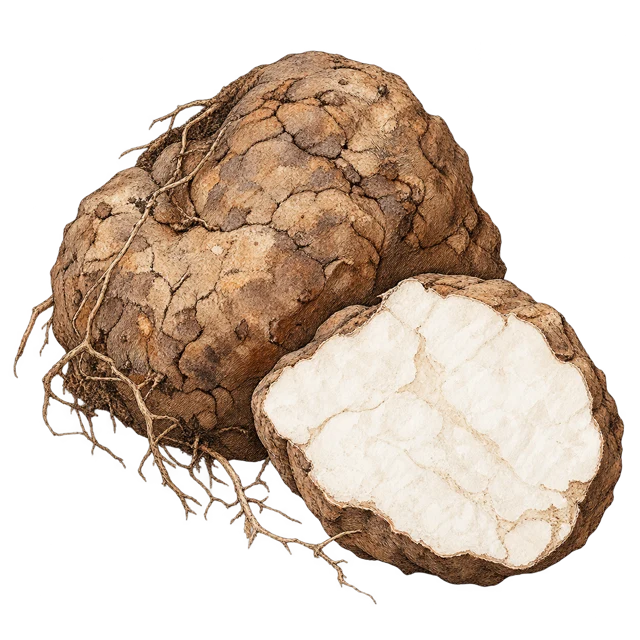
Fu ling is unlike the cap-and-stem mushrooms of a market stall: the principal material is a dense underground fungal sclerotium. East Asian practice distinguishes its skin, inner tissue and material associated with pine roots. It has a long history in formulas concerned with urination, digestion and calming the mind.
The same food–medicine tradition includes prepared poria in soups, tea and baked foods. Older sources often call the Asian material Poria cocos, but modern taxonomic work separates Asian fuling, W. hoelen or Pachyma hoelen, from North American tuckahoe. This distinction matters when comparing both traditional records and chemical research.
A closer look at its history
A medicinal name survives a taxonomic change
Fuling’s long-established material identity outlived several changes in scientific naming. The modern recommendation of W. hoelen or Pachyma hoelen tries to keep Asian fuling distinct from North American tuckahoe. Older research headed “Poria cocos” must be interpreted by specimen provenance and method, not assumed to concern all those names.
Studying a pine-wood specialist
Genome research investigates how W. hoelen breaks down fresh pine wood. That is a substantiated biotechnology and cultivation research use; it does not establish a new human treatment.
Additional history reviewed 2026-10-09
Traditional, historical and reported uses
- Water-regulation formulas
Traditional accountWhy this label?
The claim reports traditional urination, edema, and dampness formula roles rather than a clinical result.
Traditional Chinese practice used fuling to promote urination and address edema or “dampness.”
- Digestive formulas
Traditional accountWhy this label?
The claim is framed in a traditional medical system and does not assert literal organ enhancement.
Used in the traditional strengthening-spleen/harmonizing-stomach role. These terms describe a medical tradition, not literal proof of organ enhancement.
- Calming and sleep formulas
Traditional accountWhy this label?
The claim documents fuling in traditional sleep formulas and explicitly warns that formula studies cannot isolate its effect.
Fuling is a frequent ingredient in Chinese herbal formulations for insomnia; formula studies do not isolate its individual effect.
- Food–medicine ingredient
Food or household practiceWhy this label?
The claim documents food–medicine ingredient as a culinary, craft, gardening, or practical material use; it reports neither a treatment outcome nor measured nutrient content.
Prepared poria is used in soups, tea, biscuits, cakes and other foods in East Asia. Many sources use the older name Poria cocos for this Asian material; food use does not validate therapeutic claims.
The documented roles here are water-regulation formulas, digestive formulas, calming and sleep formulas, food–medicine ingredient. Fewer than five distinct uses are listed because additional medical claims are not needed to explain this fungus’s importance.
Story sources
- Wu et al., 2020: Asian fuling distinct from North American tuckahoe
- Papp et al., 2022: correct scientific name for fuling
- Review of Poria cocos traditional applications and research, 2026; retains historical taxonomy
- Traditional Chinese herbal medicine for insomnia review, 2017
- Wolfiporia hoelen genome and phylogeny, 2022
- Chinese Academy of Sciences: poria food uses and triterpenoid analysis
Features and lookalikes to study
Wolfiporia hoelen (Fr.) Y.C. Dai & V. Papp, also treated as Pachyma hoelen. Asian fuling is distinct from North American W. cocos/Pachyma cocos (tuckahoe).
Common names vary between regions and suppliers; the scientific scope above governs this card.
Morphology described in sources
- The traded material is a sclerotium, a compact storage body of fungal tissue, not the thin spore-producing surface of the fungus. Peeled cubes or powders conceal even that external morphology.
- Habitat and substrate
- See the source-linked morphology and comparison notes below; a separate habitat summary has not been verified for this card.
- Geographic scope
- A complete regional range is not established here. Broad common names and commercial labels can span different species.
- Season in the cited region
- No region-specific fruiting season has been verified for this card. Do not infer a local season from trade availability.
North American Wolfiporia cocos / Pachyma cocos, tuckahoe
Taxonomic work separates Asian fuling from North American tuckahoe, despite historical use of W. cocos and Poria cocos for Asian medicine.
Similar sclerotial form and old labels are not a visual separation key. Exact provenance, voucher-based microscopic or DNA evidence are necessary to resolve ambiguous material.
Other underground sclerotia, including Polyporus umbellatus
Zhu ling and fu ling are distinct fungal materials, although both may be traded as pieces of underground sclerotia.
A peeled pale piece is not enough to determine species; use authenticated material rather than surface colour or texture alone.
Limits and regional differences
- A sclerotium is not the same structure as a truffle, root or tuber. Commercial powders require analytical authentication; no home visual test is supplied.
- Educational comparison only. Neither this card, an illustration, a photograph, a spore-print colour nor a checklist establishes that a wild collection is safe to eat. A qualified local mycologist must assess uncertain material; do not taste an unknown fungus. Cooking does not reliably eliminate mushroom toxins.
Identity & detailed reference
Identity
Wolfiporia hoelen (Fr.) Y.C. Dai & V. Papp, also treated as Pachyma hoelen. Asian fuling is distinct from North American W. cocos/Pachyma cocos (tuckahoe).
Ingredient details, preparation and research
Also known as: fu ling; hoelen; matsuhodo; poria
Source plant or material
Wolfiporia hoelen (Fr.) Y.C. Dai & V. Papp; also Pachyma hoelen; The underground sclerotium: dense fungal storage tissue. Outer skin, inner tissue and pine-root-associated material are distinguished in traditional practice.
Fungal family: Laetiporaceae
Forms and route
The medicinal material is the dense underground sclerotium, usually dried slices or cubes; not a typical above-ground mushroom cap. Skin, inner portions and pine-root-associated material receive different traditional names.
Vitamins and minerals
Prepared sclerotium occurs in foods, but a decoction, extract and cake have different compositions. No standardized nutrient contribution is assigned to unspecified fuling products.
Absorption and preparation
Traditional dried slices or cubes are ingredients of decoctions and foods. Multi-herb formulas and isolated triterpenoid or polysaccharide extracts are distinct; formula studies cannot isolate fuling’s contribution.
Traditional and reported uses
- Traditional Chinese practice used fuling to promote urination and address edema or “dampness.”
- Used in the traditional strengthening-spleen/harmonizing-stomach role. These terms describe a medical tradition, not literal proof of organ enhancement.
- Fuling is a frequent ingredient in Chinese herbal formulations for insomnia; formula studies do not isolate its individual effect.
- Prepared poria is used in soups, tea, biscuits, cakes and other foods in East Asia. Many sources use the older name Poria cocos for this Asian material; food use does not validate therapeutic claims.
Contraindications and cautions
- Unexplained swelling or reduced urine requires assessment rather than self-treatment with a diuretic tradition.
- Species, sclerotial fraction and accompanying formula ingredients matter.
- Concentrated products need professional review with medicines or during pregnancy; absence of well-documented interactions is not proof of safety.
- This card is not a foraging identification guide. Unknown wild mushrooms should not be eaten.
Similar items and how they compare
- Zhu ling / umbrella polypore
Both provide sclerotia used in East Asian formulas.
They are different fungi with different formula histories; neither should be substituted automatically for the other.
Identity, fungal material and preparation
Wolfiporia hoelen (Fr.) Y.C. Dai & V. Papp, also treated as Pachyma hoelen. Asian fuling is distinct from North American W. cocos/Pachyma cocos (tuckahoe). The underground sclerotium: dense fungal storage tissue. Outer skin, inner tissue and pine-root-associated material are distinguished in traditional practice. Traditional dried slices or cubes are ingredients of decoctions and foods. Multi-herb formulas and isolated triterpenoid or polysaccharide extracts are distinct; formula studies cannot isolate fuling’s contribution.
Constituents and food context
Polysaccharides and triterpenoids, including pachymic acid, are studied constituents. Older chemistry literature often labels Asian material Poria cocos. Prepared sclerotium occurs in foods, but a decoction, extract and cake have different compositions. No standardized nutrient contribution is assigned to unspecified fuling products.
Traditional uses and evidence boundaries
Traditional use documents a medical practice, while most constituent research is preclinical. Findings for a multi-herb formula cannot establish fuling alone as a treatment for edema, insomnia, cancer or kidney disease.
Safety and product distinctions
Unexplained swelling or reduced urine requires assessment rather than self-treatment with a diuretic tradition. Species, sclerotial fraction and accompanying formula ingredients matter. Concentrated products need professional review with medicines or during pregnancy; absence of well-documented interactions is not proof of safety.
Entry sources
- Wu et al., 2020: Asian fuling distinct from North American tuckahoe
- Papp et al., 2022: correct scientific name for fuling
- Review of Poria cocos traditional applications and research, 2026; retains historical taxonomy
- Traditional Chinese herbal medicine for insomnia review, 2017
- Wolfiporia hoelen genome and phylogeny, 2022
- Chinese Academy of Sciences: poria food uses and triterpenoid analysis
Reference entry 214 · Recorded content review: 2026-10-08 · Review scope and dates