


Key cautions
- Avoid with walnut allergy; green-hull juice can stain and irritate skin.
- Hull products have limited long-term, pregnancy and child-safety data. Suspected parasites need diagnosis rather than a universal cleanse.
- Cutting or sanding black-walnut timber can expose skin and airways to dust. CCOHS lists black-walnut wood with skin irritation, nasal inflammation (rhinitis) and possible asthma; wood dust more broadly is an occupational carcinogen. Use dust extraction and appropriate workplace protection. These inhalation hazards should not be presented as evidence that eating sound kernels has the same risk.
- Walnut trees can release pollen that triggers seasonal eye, nose or breathing symptoms. Airborne pollen exposure is different from eating walnut protein or handling hull juice. Pollen allergy alone does not settle whether a walnut food is safe for an individual; an allergist should assess food-related reactions.
What’s inside
The edible kernel is a food rich in fat and protein, with useful mineral content. Leaves and green hulls contain a different mixture of plant chemicals; a food nutrient table cannot describe the contents of a tincture.
USDA FoodData Central: Nuts, walnuts, black, dried (FDC 170186) · Rajković et al. (2024): leaf and green-husk extracts in human lymphocytes, full laboratory study
Nutrients in an actual food portion
For edible dried kernels, 1 ounce (about 28 g) provides roughly 6.8 g protein, 1.1 mg manganese, 0.39 mg copper and 57 mg magnesium. USDA also lists 1 tablespoon as 7.8 g, supplying about 0.30 mg manganese, 0.11 mg copper and 16 mg magnesium. These are food portions, not hull-supplement doses; the values do not transfer to tinctures, leaf/bark extracts or kernel oil. At the ounce portion, the mineral amounts are approximately 48% of the US Daily Value for manganese, 43% for copper and 14% for magnesium; Daily Values are labeling references, not an individualized prescription.
USDA FoodData Central: Nuts, walnuts, black, dried (FDC 170186) · USDA FoodData Central: downloadable SR Legacy data; black walnuts FDC 170186 and ground cloves FDC 171321 · FDA: Daily Values on Nutrition and Supplement Facts labels
The weight belongs to the edible kernel
The USDA reference ounce is 28.35 g of dried edible kernels, excluding shell and hull. The same portion contains about 16.8 g fat. The listed tablespoon weighs 7.8 g; volume measures and recipes vary, so these are reference estimates rather than a measured composition for every handful or baked dish.
USDA FoodData Central: Nuts, walnuts, black, dried (FDC 170186) · USDA FoodData Central: downloadable SR Legacy data; black walnuts FDC 170186 and ground cloves FDC 171321
Reading the plant chemistry
Phenolic acids and flavonoids are families of plant chemicals rather than extra vitamins. Chemical identification and antioxidant tests can help researchers compare extracts, but they do not supply a clinically established dose. The laboratory work is described in the research section below, where the tested material and experimental setting remain explicit.
Rajković et al. (2024): leaf and green-husk extracts in human lymphocytes, full laboratory study
Uses in brief

- Edible kernels provide protein, fats and minerals.
- Unripe hull has an attributed traditional vermifuge use; leaf and root-bark uses belong to separate historical traditions.
History, folklore and reported uses
Plant and the part that matters
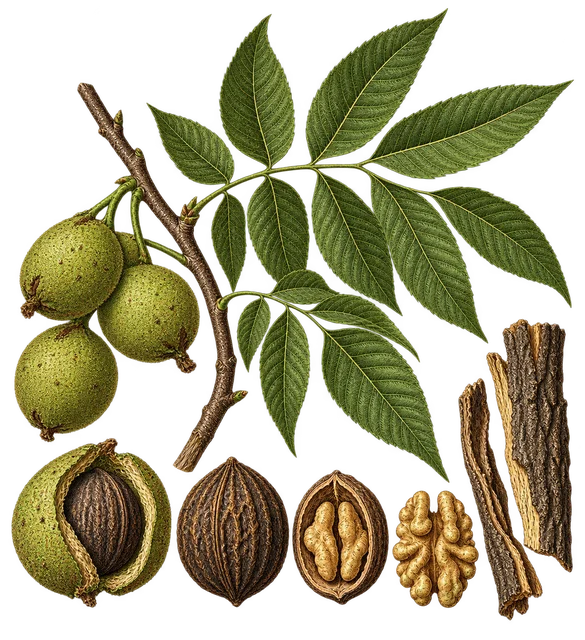
Juglans nigra L. is a North American tree in Juglandaceae. The green fleshy hull surrounds a hard shell; the edible seed kernel lies inside. Hull tincture, kernel oil, leaf and root bark are different materials. Identify both the Latin name and plant part before comparing products.
NC State Extension: Juglans nigra, botanical identity and edible kernel · Health Canada: Black walnut — Juglans nigra monograph (2024)
Food use and forms
The kernel is eaten as a strongly flavored nut, including in baking and other foods, and yields an edible oil. Herbal products commonly contain unripe-hull powder or ethanolic extracts. The food history of kernels does not by itself establish the safety or effectiveness of a concentrated hull product.
NC State Extension: Juglans nigra, botanical identity and edible kernel · Health Canada: Black walnut — Juglans nigra monograph (2024)
A food, craft and woodland history
Black walnut belongs to the food, craft and woodland history of eastern North America. Its hard shell protects a richly flavored kernel, while other parts supplied colors and household materials. The International Dendrology Society’s account, drawing on ethnobotanical records, specifically notes Cherokee use of the leaves for a green dye. That detail is a useful reminder that a tree’s cultural value cannot be reduced to the tincture now sold under its name.
International Dendrology Society: Juglans nigra, cultural and botanical history · U.S. Forest Service: A guide to medicinal plants of Appalachia, 1971 reissue, black walnut entry · Health Canada: Black walnut — Juglans nigra monograph (2024)
Different parts, different medicinal histories
Medicinal accounts also distinguish the tree’s parts. The U.S. Forest Service’s guide to Appalachian medicinal plants records root bark as a purgative and leaf preparations as astringent household remedies. A separate tradition concerns the unripe outer hull: Health Canada’s herbal monograph records its use to expel intestinal worms. This helps explain the hull’s survival in contemporary herbal blends, but does not make the edible nut, leaf tea and concentrated green-hull extract equivalents. Historical worm remedies belong to the record; suspected parasitic illness still calls for identification and appropriate treatment rather than a general-purpose cleanse.
International Dendrology Society: Juglans nigra, cultural and botanical history · U.S. Forest Service: A guide to medicinal plants of Appalachia, 1971 reissue, black walnut entry · Health Canada: Black walnut — Juglans nigra monograph (2024)
Green-hull worm remedies
Western herbal medicine used the fresh unripe outer hull in preparations intended to expel intestinal worms, a tradition documented by Health Canada. This concerns the hull, not the edible kernel.
Health Canada: Black walnut — Juglans nigra monograph (2024)
Root-bark purgatives
The U.S. Forest Service’s Appalachian guide records the inner root bark as a cathartic, or bowel-purging drug. The entry identifies the inner root bark as its drug material.
U.S. Forest Service: A guide to medicinal plants of Appalachia, 1971 reissue, black walnut entry
How to read the Appalachian guide
The guide is a historical record, not a home-treatment manual. Its foreword explicitly warns against self-medication with the listed plant drugs. “Cathartic” means bowel-purging; “astringent” describes a drying or tightening action. Neither word establishes a safe preparation for a person with current symptoms.
U.S. Forest Service: A guide to medicinal plants of Appalachia, 1971 reissue, black walnut entry
Ringworm applications in named communities
The NC Native Ethnobotany Project records Waccamaw Siouan application of the nut to ringworm and Comanche use of leaves for the same complaint. Keeping the parts and communities named preserves the differences between these practices.
NC Native Ethnobotany Project: Black walnut, named community uses
Ringworm is not an intestinal worm
Despite its name, ringworm is a fungal infection of the skin, scalp or nails. Its historical skin remedies should not be folded into the separate green-hull tradition for intestinal worms. A suspected fungal rash needs appropriate diagnosis and antifungal care rather than an assumption that an oral cleanse treats it.
CDC: Ringworm Basics · NC Native Ethnobotany Project: Black walnut, named community uses
Toothache and oral discomfort
The Cherokee record summarized by Washington University includes chewing black-walnut bark for toothache. Bark chewing is included as ethnobotanical history, not as an instruction to put an irritating bark preparation on damaged oral tissue.
Washington University: Medicinal Plants, Herbs, and Trees of Missouri, black walnut
Household insect control
The Appalachian guide records a leaf infusion used against bedbugs, as well as astringent leaf use. This household pest remedy gives the tree another practical role beyond internal medicines and food.
U.S. Forest Service: A guide to medicinal plants of Appalachia, 1971 reissue, black walnut entry
A source of dark dye
The U.S. Forest Service records Indigenous North American use of Juglans nigra roots to obtain a black dye. Its account does not name a particular community for this practice, so the attribution remains broad and the dye material is identified as root.
U.S. Forest Service, Fire Effects Information System: Juglans nigra, Other Uses
Furniture, cabinets and decorative veneer
Black walnut wood became a valued furniture and cabinet timber, with figured surfaces and veneer used for decorative interiors. The U.S. Forest Service records these woodworking uses of Juglans nigra separately from the nut, hull, bark and leaf traditions.
U.S. Forest Service, Fire Effects Information System: Juglans nigra, Other Uses
Cancer-cell findings are not cancer treatment
A 2020 study screened individual phenolic compounds previously identified in black-walnut kernels, rather than giving patients walnuts or hull tincture. Some compounds inhibited growth of both a lung-cancer cell line and a non-tumorigenic lung-cell line. Activity against cells outside the body does not establish selective tumor killing, a safe human dose, cancer prevention or treatment benefit. These findings do not justify replacing or delaying cancer care with black walnut.
Ho et al. (2020): phenolic compounds associated with black-walnut kernels, cancer-cell screening
Extraction is not absorption
Solvent, drying and processing can alter the compounds extracted from husks. That does not show how much a person absorbs or whether a stronger/darker tincture is more useful. No clinically established food pairing or absorption-enhancing method for hull products was identified in this review.
Wenzel et al.: Black walnut husk extraction and antioxidant assays; laboratory study · Rajković et al. (2024): Chemical composition of Juglans nigra leaves and green husks; laboratory study
Similar items without substitution
English/Persian walnut (Juglans regia) and butternut (Juglans cinerea) share the genus and have edible kernels, but are distinct species. Findings for J. regia food, leaves or husks cannot simply be assigned to J. nigra hull tincture. Butternut’s historical bark uses and conservation concerns also make casual substitution inappropriate.
NC State Extension: Juglans regia · NC State Extension: Juglans cinerea · NC State Extension: Juglans nigra, botanical identity and edible kernel
Food pairings are culinary choices
Chopped edible kernels can add flavor and texture to oats, baked foods or a salad. Those are ways to use a food, not methods proven to increase the absorption or therapeutic effects of hull extracts. Kernel oil is another food form: pressing out oil does not carry the kernel’s full protein and mineral content into it.
USDA FoodData Central: Nuts, walnuts, black, dried (FDC 170186) · U.S. Forest Service, Fire Effects Information System: Juglans nigra, Other Uses · International Dendrology Society: Juglans nigra, cultural and botanical history
Regional reading paths
These sourced notes describe cultivation, trade, food traditions or material history. A regional connection does not claim exclusive origin.
North America
Native/cultivated: United States, including eastern and central regions.
Edible kernel; hull tinctures are different materials.
Identity & detailed reference
Identity
Juglans nigra L., a North American walnut tree. Its edible kernel, hard shell, green outer hull, leaves and bark are different materials; hull tincture is not equivalent to eating walnuts.
Ingredient details, preparation and research
Source plant or material
Juglans nigra L.; hull products use the unripe fleshy husk outside the hard shell. The edible kernel is the seed inside. Leaves and root bark are separate materials.
Plant family / material: Juglandaceae (walnut family).
Forms and route
Food kernels and kernel oil; unripe-hull powders, tinctures and other extracts. Leaf and bark preparations have separate historical uses. Check both the botanical name and plant part.
Food sources
The sound, correctly identified kernel is the food portion; a green-hull supplement is a separate preparation.
Vitamins and minerals
For edible dried kernels, 1 ounce (about 28 g) provides roughly 6.8 g protein, 1.1 mg manganese, 0.39 mg copper and 57 mg magnesium. USDA also lists 1 tablespoon as 7.8 g, supplying about 0.30 mg manganese, 0.11 mg copper and 16 mg magnesium. These are food portions, not hull-supplement doses; the values do not transfer to tinctures, leaf/bark extracts or kernel oil.
Absorption and preparation
No established food pairing improves human absorption of black-walnut hull. Solvent, temperature and drying alter extraction, but extraction yield is not bioavailability. Different plant parts, extract ratios and solvents are not interchangeable. A darker or stronger extract does not establish greater benefit.
Traditional and reported uses
- Food use: the kernel supplies protein and fat. Evidence about eating walnuts must not be transferred to hull extracts.
- Attributed traditional use: Health Canada’s 2024 monograph records unripe hull as a herbal vermifuge or anthelmintic, traditionally used to help expel intestinal worms. This classification does not prove that a parasite cleanse eradicates infection.
- Historical record: a US Forest Service Appalachian guide describes leaf infusions as astringents and root bark as a cathartic. These are separate plant-part traditions, not hull-extract instructions.
- Laboratory research: husk extracts show antioxidant activity in test-tube assays; this does not establish clinical benefit.
Contraindications and cautions
- Walnut allergy can cause severe reactions. Do not assume a hull product is allergen-free. Allergy to other tree nuts calls for individualized advice from an allergist.
- Green hull juice stains skin and can cause dermatitis. Avoid irritating preparations on damaged skin.
- Health Canada limits its monograph to adult, occasional use and advises professional consultation beyond 14 days, for persistent symptoms, and before use in pregnancy or breastfeeding. Long-term hull-extract and pediatric safety remain insufficiently established.
- Human interaction data are limited; lack of reported interactions does not prove compatibility. Have a pharmacist review the exact extract and any additional ingredients against your medicines.
- Black walnut/wormwood/clove cleanse claims go beyond evidence that the combination safely clears human parasites. Suspected infection needs appropriate testing and treatment, rather than a universal cleanse.
- Cutting or sanding black-walnut timber can expose skin and airways to dust. CCOHS lists black-walnut wood with skin irritation, nasal inflammation (rhinitis) and possible asthma; wood dust more broadly is an occupational carcinogen. Use dust extraction and appropriate workplace protection. These inhalation hazards should not be presented as evidence that eating sound kernels has the same risk.
- Walnut trees can release pollen that triggers seasonal eye, nose or breathing symptoms. Airborne pollen exposure is different from eating walnut protein or handling hull juice. Pollen allergy alone does not settle whether a walnut food is safe for an individual; an allergist should assess food-related reactions.
Similar items and how they compare
- English/Persian walnut (Juglans regia)
Same genus and family, with edible kernels inside a husk.
J. regia is commonly cultivated for food and has a thinner shell. Its leaf, hull or kernel studies do not automatically validate J. nigra hull products.
- Butternut/white walnut (Juglans cinerea)
Another North American Juglans with edible oily kernels and juglone-related chemistry.
J. cinerea has elongated fruits and its own historical bark-laxative use. This canker-threatened species is not an interchangeable black-walnut ingredient.
Traditional use, clearly attributed
Health Canada’s 2024 industry monograph records unripe hull’s traditional herbal role in expelling intestinal worms. A US Forest Service Appalachian guide separately records astringent leaf infusions and cathartic root bark. These are documented traditions, not proof that a homemade cleanse or those historical preparations treat a present infection.
Constituents and laboratory findings
Green-husk and leaf extracts contain phenolic acids, flavonoids and quinone-related compounds; their chemical profiles differ. A 2024 study characterized extracts and tested human lymphocytes outside the body. Human cells in a laboratory do not make this a human treatment trial. Antioxidant assays likewise do not show that drinking hull extract prevents disease.
Parasite claims and evidence limits
This review did not identify reliable human evidence establishing black-walnut hull alone, or the black-walnut/wormwood/clove combination, as a safe, broadly effective parasite treatment. Traditional recognition is a different type of evidence. Testing depends on symptoms and exposure; CDC notes that no single blood test detects every parasitic infection.
Allergy and skin contact
Walnuts can cause severe food-allergic reactions. A hull label is not proof that a product is free of walnut allergens. Someone allergic to another tree nut needs individualized advice, rather than an assumption that every nut is either safe or forbidden. Raw hull juice can stain skin and has caused irritant dermatitis during handling.
Pregnancy, children, duration and medicines
Health Canada’s hull monograph covers adults and occasional use, asks for professional advice beyond 14 days or if symptoms persist, and directs pregnant or breastfeeding people to consult before use. It is not evidence for pediatric use. Robust clinical interaction information is lacking; check the exact formulation, alcohol content and other blend ingredients with a pharmacist.
Entry sources
- Health Canada: Black walnut — Juglans nigra monograph (2024)
- NC State Extension: Juglans nigra, botanical identity and edible kernel
- US Forest Service: A guide to medicinal plants of Appalachia, Juglans nigra
- US Forest Service: Juglans nigra species review and nut composition
- Lee and Campbell: Nature and occurrence of juglone in Juglans nigra
- Rajkovic and colleagues: Chemical composition of Juglans nigra leaves and green husks (laboratory study)
- Wenzel and colleagues: Black walnut husk extraction and antioxidant assays (laboratory study)
- AAAAI: Tree nut allergy
- Indiana Academy of Science: Dermatitis and black walnut hull juice
- NC State Extension: Juglans regia
- NC State Extension: Juglans cinerea
- CDC: Diagnosis of parasitic diseases
- USDA FoodData Central, SR Legacy: Nuts, walnuts, black, dried (FDC 170186; official downloadable dataset)
- FDA: Daily Values and interpreting nutrient amounts per serving
- Rajković et al. (2024): Chemical composition of Juglans nigra leaves and green husks; laboratory study
- USDA FoodData Central: Nuts, walnuts, black, dried (FDC 170186)
Reference entry 87 · Recorded content review: 2026-10-05 · Review scope and dates