


Key cautions
- Review blood-pressure medicines, simvastatin and chloroquine before regular medicinal use; tea does not replace treatment.
- Medicinal pregnancy/breastfeeding safety is unestablished. Use food-grade roselle and check added sugar.
What’s inside
Delphinidin- and cyanidin-sambubioside anthocyanins; hibiscus, citric and other organic acids; flavonoids, phenolic acids and mucilage. Cultivar, storage and extraction change composition.
Egyptian Drug Authority: Hibiscus sabdariffa monograph, pp. 111–117
Uses in brief

- Food: tart hot or chilled drinks, sauces and preserves.
- Traditionally used alongside other blood-pressure care; one small placebo-controlled tea trial found a reduction in systolic pressure, the upper blood-pressure reading.
History, folklore and reported uses
Blood-pressure remedies
Egyptian traditional medicine uses roselle calyx infusions and water-based extracts alongside other care for high blood pressure. Sour hibiscus tea also has a documented blood-pressure tradition in Iran and Senegal. The Egyptian Drug Authority identifies the calyx in its herbal reference monograph; this contemporary record does not establish stories of pharaonic origins.
Egyptian Drug Authority: Hibiscus sabdariffa monograph, pp. 111–117 · Da-Costa-Rocha et al.: Hibiscus sabdariffa, ethnobotanical and pharmacological review (2014), section 3.2
Increasing urine flow
Egyptian accounts describe calyx preparations used to encourage urination. The ethnobotanical literature also records diuretic infusions of roselle leaves or calyces in parts of India, Africa and Mexico; these plant parts should remain identified.
Fever, cough and sore throat
In Egypt and Sudan, karkade calyx infusions were used to help lower body temperature during fever. North African traditions also used calyx preparations for sore throats and coughs.
Bowel regularity
Roselle leaf or calyx infusions appear in local traditions in India, Africa and Mexico as remedies intended to stimulate intestinal movement. This gentle bowel-remedy reputation is distinct from the plant’s better-publicized blood-pressure role.
Celebration and shared refreshment
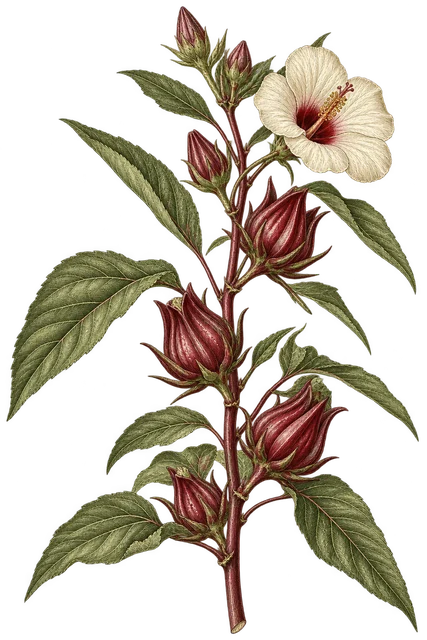
The crimson calyx drink is called karkade in Egypt. Food historian Jessica B. Harris connects Caribbean Christmas sorrel, often combined with ginger and other spices, with West African drinking traditions and Senegalese bissap rouge. These drinks belong to African and African-diaspora gatherings and holiday tables. Here sorrel means roselle, not the unrelated leafy sorrel; the fleshy red calyx surrounds the fruit, although shops often call it a flower.
Smithsonian NMAAHC / Jessica B. Harris: Caribbean Sorrel · Egyptian Drug Authority: Hibiscus sabdariffa monograph, pp. 111–117
Leaf vegetables beyond the red drink
Roselle leaves are eaten as a vegetable in parts of India and West Africa. Rutgers records their importance in Liberian food and describes young leaves combined with other vegetables and seasonings, a food tradition distinct from the familiar red calyx drink.
Rutgers NJAES: Roselle (Hibiscus sabdariffa L.) Production and Marketing in New Jersey
Stem fibre for cordage and sacks
Roselle stems supply the fibre called rosella hemp, used for sacks, twine and cords. Rutgers distinguishes the fibre-producing Hibiscus sabdariffa var. altissima from the food-focused var. sabdariffa; neither should be confused with kenaf, H. cannabinus.
NC State Extension: Roselle, listed as Sabdariffa gossypiifolia (previously Hibiscus sabdariffa) · Rutgers NJAES: Roselle (Hibiscus sabdariffa L.) Production and Marketing in New Jersey
The northern crop can be a leaf crop
Rutgers documents a New Jersey market for roselle leaves among Asian Indian customers, using the name gongura. This is a different harvest goal from Caribbean Christmas calyces. Its trial guidance shows why a plant can succeed as a summer vegetable even where autumn arrives before a large red-calyx crop.
Rutgers NJAES: Roselle (Hibiscus sabdariffa L.) Production and Marketing in New Jersey · UF/IFAS Gardening Solutions: Roselle
Growing notes
Hibiscus sabdariffa grown for leaves or fleshy calyces; excludes ornamental Chinese hibiscus and kenaf (H. cannabinus).
- Climate and season
- Frost-tender shrub, usually grown as an annual outside the tropics. UF lists zones 9–10 and notes frost damage. Plant out after the last spring frost; Florida’s April–May calendar is not a planting date for every latitude. [1]
- Cultivar and harvest goal
- Choose a food-use roselle selection and decide whether leaves or calyces are the goal. Rutgers distinguishes edible red and green calyx types from fiber-oriented material; its discussion also includes kenaf, a different species that this guide excludes. [2]
- Sun, soil and water
- Provide abundant sun, well-drained soil and supplemental water when rain is inadequate. Allow space for a shrub that can approach 7 feet. Early pruning encourages branches and additional flowering shoots. [1]
Growing sources and regional guidance
Growing notes reviewed 2026-10-12
Health topics: evidence and cautions
These notes describe a specific research context and preparation. A topic link is not a treatment recommendation.
Cardiovascular health · Support during care
Form and route: Brewed water infusion · oral
Roselle tea may modestly lower systolic blood pressure.
Evidence: small_randomized_trial
A six-week trial of 65 adults found a greater systolic reduction with tea than placebo.
Limits
Participants had mildly raised pressure and were not taking blood-pressure drugs. Diastolic differences were not significant. No heart-attack outcomes.
Cautions
- Monitor for dizziness and discuss regular use with blood-pressure medicines; ornamental hibiscus is not the same material.
Regional reading paths
These sourced notes describe cultivation, trade, food traditions or material history. A regional connection does not claim exclusive origin.
Africa
Cultivated and traditional use: Egypt and Sudan; wider African beverage use.
Tart calyx infusion, commonly called karkade; not ornamental hibiscus.
Identity & detailed reference
Identity
Hibiscus sabdariffa L. (roselle); the fleshy calyces around the developing fruit, often sold as hibiscus “flowers.” Kew currently treats this name as a synonym of Sabdariffa gossypiifolia (Mill.) M.M.Hanes & R.L.Barrett. Ornamental hibiscus species are not interchangeable.
Ingredient details, preparation and research
Source plant or material
Hibiscus sabdariffa L. (Kew accepted name: Sabdariffa gossypiifolia); food or medicinal calyces, not unspecified ornamental petals.
Plant family / material: Malvaceae (mallow family).
Forms and route
Fresh or dried calyces for tart drinks, sauces and preserves; oral infusions and manufactured aqueous extracts. Alcohol tinctures and mixed supplements are distinct preparations.
Vitamins and minerals
USDA’s raw-roselle food record lists 57 g of edible material per cup. An illustrative half-cup (28.5 g) of the edible raw material supplies about 14 kcal, 61 mg calcium, 15 mg magnesium and 3.4 mg vitamin C. These are calculated food values, not amounts in a strained tea, tincture or spoonful of syrup; cultivar and preparation vary.
Absorption and preparation
A six-volunteer study detected intact hibiscus anthocyanins in plasma, with peaks around 1.5 hours and very low urinary recovery of the intact pigments. That is not the percentage of all plant compounds absorbed: metabolites were incompletely captured. No validated fat, fasting or herb-pairing rule follows.
Practical preparation
Use food-grade, identified roselle calyces or a labeled tea bag and follow its water volume and steeping directions; strain and cool to a comfortable drinking temperature. For fresh culinary calyces, separate the seed capsules and wash the edible material. Do not substitute an ornamental flower or convert a tincture dropper into a tea-equivalent dose.
Food notes
Fresh chopped calyces can provide tartness in a sauce or preserve. Refrigerate fresh sauce and use within a few days, as UF/IFAS advises. Count sugar or honey separately; a strongly red cup does not establish a vitamin-C or mineral dose. The familiar red roselle ingredient is the fleshy calyx of Hibiscus sabdariffa that develops around the fruit after the blossom fades; it is not the delicate flower petals. Remove the seed capsule for calyx recipes. This card does not establish that every ornamental hibiscus flower is interchangeable with roselle. H. rosa-sinensis flower references concern a different species and plant material. Preserve the existing calyx-specific safety and medicine-interaction guidance.
Combination notes
Citrus, ginger or other flavorings can make a food beverage more enjoyable. Their presence does not establish greater absorption, stronger blood-pressure effects or medicinal synergy; adding several concentrated products can increase uncertainty.
Traditional and reported uses
- Culinary tradition: tart calyx drinks, syrups, sauces and preserves; Caribbean sorrel is a festive drink.
- Egyptian medicinal tradition: karkade as an adjunct in blood-pressure management.
- PROSEA records diuretic and digestive/stomachic calyx uses as attributed traditions. These do not establish treatment for kidney disease or a digestive diagnosis.
- A six-week human tea trial found a systolic blood-pressure benefit; evidence for that tea does not validate all extracts or replacement of prescribed treatment.
- Food-grade roselle calyces in drinks and preserves, clearly distinguished from petals and ornamental hibiscus.
Contraindications and cautions
- May lower blood pressure; review regular medicinal use with antihypertensives or existing low blood pressure. Continue prescribed treatment.
- A six-person human study found reduced simvastatin exposure with a hibiscus beverage. Ask a pharmacist before combining; the Egyptian Drug Authority also flags chloroquine and glucose-control precautions.
- Avoid medicinal use in pregnancy or breastfeeding because adequate safety information is lacking. Avoid known allergy.
- Tell the surgical team about medicinal use; the Egyptian Drug Authority advises stopping it two weeks before planned surgery. Sweetened drinks and syrups may add substantial sugar.
Similar items and how they compare
- Elderberry
Both make deeply colored food drinks with anthocyanin pigments.
Roselle uses calyces; elderberry uses appropriately processed ripe berries. Pigment similarity does not make their medicinal uses interchangeable.
- Marshmallow root
Both belong to the mallow family and contain plant polysaccharides.
Roselle calyces are tart and pigment-rich; marshmallow root is used for local mucilage contact. Family membership does not predict equivalent effects.
Plant identity, family and part
Roselle belongs to Malvaceae. The commercial red “flower” is primarily the fleshy calyx left around the fruit after the petals fall. Research usually retains the familiar name Hibiscus sabdariffa; Kew now accepts Sabdariffa gossypiifolia. This nomenclatural update does not permit substitution with H. rosa-sinensis or another ornamental hibiscus.
Food and medicinal traditions
UF/IFAS documents calyx use in Caribbean Christmas drinks, jams, sauces and teas. The Egyptian Drug Authority records a traditional adjunctive role in blood-pressure management. PROSEA records calyx-decoction diuretic and digestive/stomachic uses. These traditions remain part of the entry even where controlled clinical evidence is absent; they are not established treatments for fluid retention, kidney disease or gastrointestinal illness.
What the human tea trial found
McKay and colleagues randomized 65 adults with prehypertension or mild hypertension who were not taking blood-pressure-lowering medicines. The study compared three 240-mL tea servings daily with placebo for six weeks. Systolic pressure changed by −7.2 versus −1.3 mmHg; the between-group diastolic difference was not statistically significant. This is a description of a study, not a personal dose recommendation. Long-term cardiovascular outcomes and equivalence of tinctures were not established.
Constituents and laboratory claims
Anthocyanins contribute color and organic acids contribute tartness. A laboratory study found that an ethanolic extract inhibited several CYP drug-metabolizing enzymes in human liver microsomes. Cells or isolated enzymes from humans are still laboratory evidence, not a trial in people; the study does not prove that every cup causes all predicted drug interactions.
Absorption and human drug interaction
Intact anthocyanins were measurable after a defined extract in six volunteers, but low intact-pigment recovery does not describe the fate of all metabolites. Separately, six healthy volunteers in a randomized crossover study had about 35% lower overall simvastatin exposure with a hibiscus beverage. Favorable lipid effects in that paper’s rat experiment cannot be used to justify the human combination.
Realistic food nutrition
The USDA SR Legacy record is raw edible roselle, not brewed tea. Halving its measured cup weight of 57 g gives 28.5 g; scaling the per-100-g record gives approximately 14 kcal, 61 mg calcium, 15 mg magnesium and 3.4 mg vitamin C. A strained cup receives only the extracted fraction, for which these figures give no reliable estimate. Syrup and jam additionally depend on their sugar and water content.
Preparation and combinations
Choose identified food-grade calyces, remove the seed capsule from fresh material, and follow the tea product or food recipe. Fresh roselle sauce needs refrigeration. Adding culinary ginger or citrus is a flavor choice; this review found no basis to claim automatic medicinal synergy. A concentrated extract requires its own composition, instructions and safety review.
Safety in practice
Avoid known allergy and medicinal use during pregnancy/breastfeeding without qualified advice. Regular use warrants review for low blood pressure, antihypertensives, simvastatin, chloroquine or diabetes treatment. EDA also advises stopping medicinal hibiscus two weeks before surgery. Do not infer that an ordinary beverage and a concentrated supplement have identical interaction risks, and do not stop prescribed medication to make room for tea.
Culinary flowers and exact edible part
The familiar red roselle ingredient is the fleshy calyx of Hibiscus sabdariffa that develops around the fruit after the blossom fades; it is not the delicate flower petals. Remove the seed capsule for calyx recipes. This card does not establish that every ornamental hibiscus flower is interchangeable with roselle. H. rosa-sinensis flower references concern a different species and plant material. Preserve the existing calyx-specific safety and medicine-interaction guidance.
Entry sources
- Egyptian Drug Authority: Hibiscus sabdariffa monograph, 2024, pp. 111–117
- McKay et al. (2010): Placebo-controlled hibiscus-tea blood-pressure trial in 65 adults
- Kew: Sabdariffa gossypiifolia, accepted name with Hibiscus sabdariffa synonym
- Frank et al. (2005): Human hibiscus anthocyanin pharmacokinetics in six volunteers
- Showande et al. (2017): Hibiscus and simvastatin, separate rat and human interaction experiments
- Showande et al. (2013): Hibiscus extract and CYP enzymes in human liver microsomes
- UF/IFAS: Roselle, edible calyces and culinary preparation
- PROSEA (2001): Hibiscus sabdariffa, attributed calyx-decoction use
- PROSEA botanical handbook: Hibiscus medicinal uses, PlantUse transcription
- Kew: Althaea officinalis, accepted name and Malvaceae family
- USDA FoodData Central: SR Legacy Roselle, raw, FDC 168170; downloadable dataset
- Rutgers NJAES: Roselle (Hibiscus sabdariffa L.) Production and Marketing in New Jersey
- NC State Extension: Roselle, listed as Sabdariffa gossypiifolia (previously Hibiscus sabdariffa)
Reference entry 07 · Recorded content review: 2026-10-07 · Review scope and dates