


Key cautions
- Potential bleeding interactions with anticoagulants/antiplatelets; review with clinicians when taking immunosuppressants.
- Nausea, insomnia and liver-injury reports exist.
What’s inside
Polysaccharides and triterpenoids, including ganoderic acids, are important studied groups. Species and extraction change the chemical profile.
Uses in brief

- Longevity and auspicious art
- Restorative qi tonic
- Settling the mind
History, folklore and reported uses
History, folklore and traditional uses
Lingzhi has a visible life in Chinese art as well as materia medica. A Ming-period silk brocade in the Metropolitan Museum pairs lingzhi forms with longevity characters, showing how the fungus conveyed auspicious wishes. Such objects document symbolism; they cannot identify every depicted fungus to a modern species or demonstrate a longevity effect.
Traditional accounts describe restorative, calming and respiratory uses. The tough fruiting body is commonly prepared as a decoction rather than a vegetable dish. Modern naming adds another layer: East Asian cultivated red lingzhi is discussed as G. lingzhi or G. sichuanense, whereas European G. lucidum in the strict sense is distinct. Older medical names and contemporary product labels need to be read with that history in mind.
A closer look at its history
Longevity woven into cloth
A Ming silk fragment in the Metropolitan Museum pairs lingzhi shapes with shou, the character for longevity, in metallic thread. The object directly documents the fungus as an auspicious image. It does not identify a specimen to today’s taxonomic standard or prove lifespan extension.
A name with a scientific afterlife
Modern type-based and molecular work challenges the long-standing use of G. lucidum for Asian cultivated lingzhi. The disagreement is a useful part of the story: scientific names are evidence-based hypotheses and nomenclatural decisions, not merely translations of folk names.
Additional history reviewed 2026-10-09
Traditional, historical and reported uses
- Longevity and auspicious art
Historical recordWhy this label?
A dated Ming textile museum object and its interpretation document lingzhi longevity imagery as material history.
Lingzhi motifs accompanied longevity wishes in Chinese decorative arts.
- Restorative qi tonic
Traditional accountWhy this label?
The exact claim reports a materia-medica qi-tonic role, using concepts from the named medical tradition.
Traditional materia medica describes replenishing qi and supporting strength.
- Settling the mind
Traditional accountWhy this label?
The claim describes traditional spirit-mind and sleep indications rather than a clinical study.
Traditional use for insomnia, palpitations and related spirit-mind complaints.
- Respiratory tradition
Traditional accountWhy this label?
The claim reports a traditional respiratory use; the word historical alone does not identify an archival experiment.
Traditional use for cough and breathlessness belongs to the historical record, not a substitute for modern respiratory care.
- Modern immune and oncology research
Mixed/contextual sourcesWhy this label?
The attached MSK account covers preclinical immune/oncology experiments and small clinical adjunct studies; the broad extract-research claim spans both.
Characterized extracts are studied as adjuncts; commercially marketed immune-support supplements are not established cancer treatments.
Story sources
- Kew/CAS taxonomic study: cultivated Chinese lingzhi, 2012
- Nomenclatural discussion of G. lingzhi/G. sichuanense, 2023
- Metropolitan Museum: Ming textile with lingzhi and longevity characters
- Herbal Medicine: Ganoderma history and traditional applications
- MSK: Reishi mushroom
- Re-examination of the G. sichuanense holotype, 2023
Features and lookalikes to study
East Asian cultivated red lingzhi is usually treated as Ganoderma sichuanense / G. lingzhi; nomenclature has been disputed. European G. lucidum sensu stricto is distinct. “Reishi” products can contain other Ganoderma species.
Common names vary between regions and suppliers; the scientific scope above governs this card.
Morphology described in sources
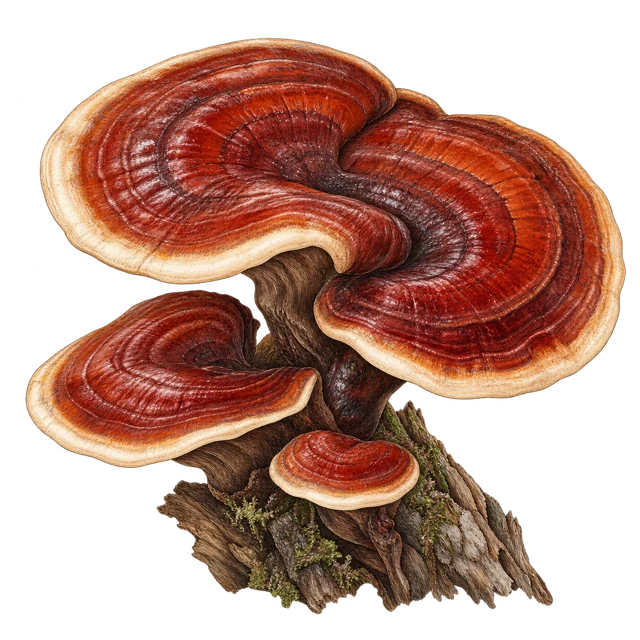
- Lacquered red-brown bracket or antler-like cultivation forms can suggest a Ganoderma group, but growth conditions change form. The underside is poroid; double-walled spores are an important microscopic genus character.
- Habitat and substrate
- See the source-linked morphology and comparison notes below; a separate habitat summary has not been verified for this card.
- Geographic scope
- A complete regional range is not established here. Broad common names and commercial labels can span different species.
- Season in the cited region
- No region-specific fruiting season has been verified for this card. Do not infer a local season from trade availability.
Ganoderma lucidum sensu stricto and other lacquered Ganoderma
European G. lucidum is distinct from the principal cultivated East Asian red lingzhi. Many species share red-brown glossy surfaces; host, geography, internal tissue and microscopic/genetic evidence matter.
The names G. lingzhi and G. sichuanense have been disputed. A glossy cap or an antler form does not identify species. A North American “reishi” may be G. tsugae, G. curtisii or another regional species.
Limits and regional differences
- For difficult or commercial material, voucher-based microscopy and DNA authentication are more informative than a retail name; powders cannot be authenticated by gross appearance. Species and extracts are not interchangeable clinical evidence.
- Educational comparison only. Neither this card, an illustration, a photograph, a spore-print colour nor a checklist establishes that a wild collection is safe to eat. A qualified local mycologist must assess uncertain material; do not taste an unknown fungus. Cooking does not reliably eliminate mushroom toxins.
Regional reading paths
These sourced notes describe cultivation, trade, food traditions or material history. A regional connection does not claim exclusive origin.
Asia
Cultural and cultivated: Chinese lingzhi appears in a Ming-dynasty textile with longevity characters; taxonomic research distinguishes cultivated Chinese lingzhi from European G. lucidum sensu stricto.
Cultural and herbal-history reference, including auspicious art. Longevity symbolism is not evidence of longer life or a recommendation to eat wild fungi.
Identity & detailed reference
Identity
East Asian cultivated red lingzhi is usually treated as Ganoderma sichuanense / G. lingzhi; nomenclature has been disputed. European G. lucidum sensu stricto is distinct. “Reishi” products can contain other Ganoderma species.
Ingredient details, preparation and research
Also known as: ling zhi; reishi; mushroom of immortality
Source plant or material
Ganoderma lingzhi / Ganoderma sichuanense (East Asian lingzhi); Tough fruiting bodies; separate mycelial, spore and extracted products.
Fungal family: Ganodermataceae; some classifications include this group in Polyporaceae
Forms and route
Tough fruiting bodies traditionally decocted rather than eaten like a vegetable; modern extracts, powders, mycelial material and spores differ chemically.
Vitamins and minerals
Woody lingzhi is generally taken as a decoction or manufactured product rather than a vegetable serving. It has no established role here as a dependable vitamin/mineral source.
Absorption and preparation
Traditional fruiting bodies are decocted. Water extracts, alcohol extracts, whole powders and spore products have different compositions; no universal absorption-enhancing preparation is established.
Traditional and reported uses
- Lingzhi motifs accompanied longevity wishes in Chinese decorative arts.
- Traditional materia medica describes replenishing qi and supporting strength.
- Traditional use for insomnia, palpitations and related spirit-mind complaints.
- Traditional use for cough and breathlessness belongs to the historical record, not a substitute for modern respiratory care.
- Characterized extracts are studied as adjuncts; commercially marketed immune-support supplements are not established cancer treatments.
Contraindications and cautions
- Potential bleeding interactions with anticoagulants/antiplatelets; review with clinicians when taking immunosuppressants.
- Nausea, insomnia and liver-injury reports exist.
- Spore powders may interfere with the CA72-4 tumor-marker test; disclose their use to the care team.
- This card is not a foraging identification guide. Unknown wild mushrooms should not be eaten.
Identity, fungal material and preparation
East Asian cultivated red lingzhi is usually treated as Ganoderma sichuanense / G. lingzhi; nomenclature has been disputed. European G. lucidum sensu stricto is distinct. “Reishi” products can contain other Ganoderma species. Tough fruiting bodies; separate mycelial, spore and extracted products. Traditional fruiting bodies are decocted. Water extracts, alcohol extracts, whole powders and spore products have different compositions; no universal absorption-enhancing preparation is established.
Constituents and food context
Polysaccharides and triterpenoids, including ganoderic acids, are important studied groups. Species and extraction change the chemical profile. Woody lingzhi is generally taken as a decoction or manufactured product rather than a vegetable serving. It has no established role here as a dependable vitamin/mineral source.
Traditional uses and evidence boundaries
Historical zhi categories do not correspond neatly to modern species. Human findings depend on the identified fungus and formulation; laboratory immune effects do not demonstrate generalized immune improvement.
Safety and product distinctions
Potential bleeding interactions with anticoagulants/antiplatelets; review with clinicians when taking immunosuppressants. Nausea, insomnia and liver-injury reports exist. Spore powders may interfere with the CA72-4 tumor-marker test; disclose their use to the care team.
Entry sources
- Kew/CAS taxonomic study: cultivated Chinese lingzhi, 2012
- Nomenclatural discussion of G. lingzhi/G. sichuanense, 2023
- Metropolitan Museum: Ming textile with lingzhi and longevity characters
- Herbal Medicine: Ganoderma history and traditional applications
- MSK: Reishi mushroom
- Re-examination of the G. sichuanense holotype, 2023
Reference entry 208 · Recorded content review: 2026-10-08 · Review scope and dates