


Key cautions
- Allergy and digestive upset are possible; long-term extract and interaction data are limited.
- Do not equate a food portion, gummy, myceliated grain and a studied standardized extract.
What’s inside
Beta-glucans and other polysaccharides, sterols and numerous small molecules. Hericenones are associated particularly with fruiting bodies; erinacines are associated mainly with mycelium. Strain, growth conditions and extraction influence composition. A constituent’s presence is not proof of benefit in people.
Uses in brief

- Culinary mushroom and traditional East Asian tonic.
- Preliminary, preparation-specific research on selected cognitive and mood outcomes.
History, folklore and reported uses
History, folklore and traditional uses
Lion’s mane brings a woodland food tradition into a notebook otherwise filled mostly with plants. Its hanging white spines explain the English name, while its Latin name, Hericium erinaceus, evokes a hedgehog. This is a fungus that breaks down wood, helping return nutrients to the forest. Kew records its Chinese name, hou tou gu, and its Japanese name, yamabushitake, along with its place in both cooking and traditional medicine. A fresh fruiting body on a dinner plate is the most tangible connection to that heritage.
In China, Kew describes a history of tonics and teas directed toward several organs within traditional medical practice; in Japan, medicinal use sits alongside mushroom dishes. Those accounts are broader than today’s concentration on memory and focus. The modern supplement story has taken the mushroom into powders, coffee blends and cultivated-mycelium extracts. Keeping those forms visible preserves the journey from food to tonic to manufactured ingredient, without imagining that every current product is the same material used in an older kitchen or apothecary.
Beyond its supplement reputation, lion’s mane has two grounded roles: a cooked culinary mushroom and a wood-decomposing woodland fungus. These connect the market-grown fruiting body with the organism’s forest ecology. Its Chinese gastric-ulcer tradition is also recorded in ethnopharmacological research, but laboratory work does not establish a treatment for ulcers or H. pylori infection.
A closer look at its history
A soup with a long literary afterlife
Historian Lu Di’s study of Chinese texts from 220–589 discusses an early description of houtou soup in Taiwan. The account presents it as a highly valued food and attributes relief from alcohol’s effects to it. The historian interprets houtou as H. erinaceus. This is evidence about historical food culture and belief, not proof of a hangover remedy or an exact modern species determination from the ancient text.
Different animals in the same mushroom
The English name sees a lion’s mane, while its scientific name invokes a hedgehog: both Hericium and erinaceus refer to that spiny animal. Such names record what observers noticed about the fruiting body, rather than reliable identification rules.
Cultivating food from plant residues
A 2024 cultivation experiment tested rice straw and corncob-based mixtures as alternatives to wood-heavy substrates, measuring mycelial growth and lignocellulose-degrading enzyme activity. This provides a concrete modern use: converting selected agricultural residues into a cultivation substrate. It is a production study, not evidence that wild fungi make contaminated waste safe or that household waste should be used to grow food.
A decomposer worth leaving in place
Its wood-decaying activity helps return nutrients to ecosystems. This ecological role is distinct from human medicinal claims. Commercially cultivated mushrooms allow culinary interest without encouraging removal of rare local wild fruiting bodies.
Additional history reviewed 2026-10-09
Traditional, historical and reported uses
- Digestive tonic and stomach complaints
Traditional accountWhy this label?
A practitioner monograph describes Chinese and Japanese digestive traditions.
Chinese and Japanese herbal practice used the mushroom for stomach complaints, including chronic gastritis and ulcers. Herbal Reality describes fruiting-body foods, teas and extracts within this digestive tradition.
- Restorative organ tonics
Traditional accountWhy this label?
Kew describes Chinese organ-tonic traditions.
Kew records Chinese hou tou gu tonics and teas directed toward the heart, liver, spleen, lungs and kidneys. These reflect traditional organ-system ideas and a broad restorative role, rather than five separate cures.
- Calming the spirit and mood
Traditional accountWhy this label?
Describes the Chinese shen-calming tradition and its modern continuation.
Herbal Reality describes hou tou gu as a Chinese shen-calming medicine, using mushroom preparations to settle the spirit-mind. Contemporary powder and extract use for stress and mood is also recorded by Memorial Sloan Kettering.
- Memory and concentration in modern herbal practice
Traditional accountWhy this label?
Practitioner sources document contemporary herbal cognitive-remedy practice.
Modern practitioners use fruiting-body powders, extracts and some cultivated-mycelium preparations for memory and concentration. Memorial Sloan Kettering records this use among the mushroom’s contemporary supplement applications.
- Immune-supporting supplements
Mixed/contextual sourcesWhy this label?
MSK documents supplement promotion rather than a specific investigation.
Memorial Sloan Kettering records the promotion of lion’s-mane supplements for immunity. Capsules, powders and liquid extracts belong to this modern usage, alongside the older food-and-tonic tradition.
Features and lookalikes to study
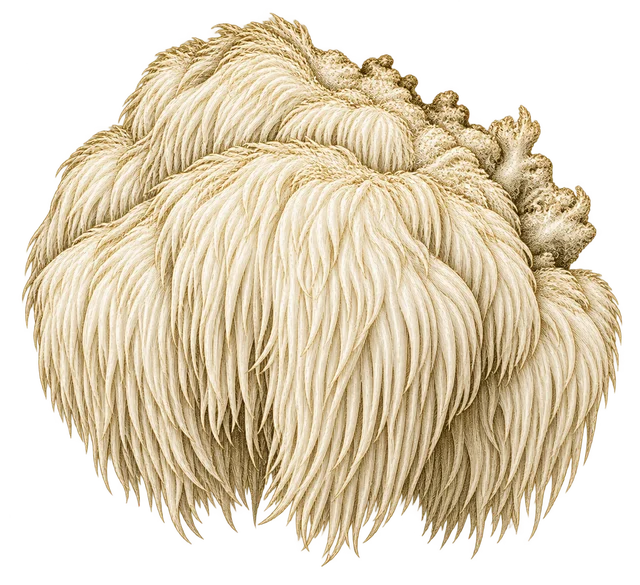
Hericium erinaceus (Bull.) Pers., an edible fungus with hanging white spines, also called yamabushitake or hou tou gu. The familiar mushroom is its fruiting body; cultured mycelium is a different fungal tissue.
Lion’s mane and bearded tooth commonly refer to H. erinaceus. ‘Hedgehog mushroom’ is ambiguous: it is also used for cap-and-stem Hydnum species. Common names do not establish scientific identity. Houtougu (‘monkey-head mushroom’) and yamabushitake are East Asian names found in the literature. Historical names and descriptions require interpretation; they are not equivalent to a preserved, DNA-verified modern specimen.
Morphology described in sources
- A mature fruiting body is a rounded, essentially unbranched mass with long downward-pointing teeth, rather than a cap with gills. It attaches to wood without a conventional stalk. White tissue can yellow with age; colour by itself is not diagnostic.
- Look at the underlying architecture, not just the hairy outline: a compact mature mass differs from the repeatedly branching framework of several relatives. Immature branched Hericium can initially look unbranched, so young material may remain indeterminate.
- Its mycelium digests wood, and fruiting bodies appear on dead hardwood or wounded living trees. The visible mushroom is a reproductive structure, not the entire organism.
- Habitat and substrate
- On standing deciduous trees and fallen hardwood trunks or logs.
- Geographic scope
- The cited Missouri field guide reports it statewide in Missouri; this is not its complete global range.
- Season in the cited region
- August–November in the cited Missouri account.
Hericium americanum
Mature H. americanum has a branched framework carrying long teeth. Young specimens may lack obvious branches and resemble H. erinaceus. In North America, the usual concept is eastern, largely east of the Great Plains; geography supports but cannot establish identification.
Inspect mature architecture and substrate with a local expert. Do not force a species name onto a young clump.
Hericium coralloides
Mature specimens have a more openly branched, coral-like framework with relatively short hanging teeth. Small or incomplete fruiting bodies can conceal the branching pattern.
Spore dimensions can help a mycologist separate closely similar branched Hericium; a white spore deposit alone cannot do so.
Hericium abietis
A branched conifer-associated western North American Hericium, especially in the Pacific Northwest and northern California. Its substrate and mature architecture differ from the usual H. erinaceus pattern.
The North American key is regional, not a worldwide identification rule. Juvenile forms and historical name misapplications complicate identifications.
Hydnum species, including the H. repandum name
These ‘hedgehog’ mushrooms have a cap and stalk, with teeth under the cap, unlike the pendant tooth mass of H. erinaceus.
Recognizing a different body plan does not identify the Hydnum species or determine whether a collection is suitable to eat.
Limits and regional differences
- The specialist and institutional sources used here emphasize confusion with other toothed fungi; they do not support inventing a particular deadly twin. That is not an assurance of safe identification. A resemblance, app label, common name, photograph or short checklist never clears a wild collection for eating.
- Microscopy is not automatically needed for every well-developed Hericium fruiting body, but immature, damaged or atypical material should remain unidentified when the defining architecture is absent. Expert assessment of mature morphology, host/substrate and region is essential for uncertain material. Microscopic spore measurements and sometimes molecular study are relevant to difficult species-level determinations; published molecular work has exposed misidentified and inconsistently named collections.
- Educational comparison only. Neither this card, an illustration, a photograph, a spore-print colour nor a checklist establishes that a wild collection is safe to eat. A qualified local mycologist must assess uncertain material; do not taste an unknown fungus. Cooking does not reliably eliminate mushroom toxins.
- Bearded Tooth
- The Genus Hericium
- Hericium americanum
- Lion’s mane mushroom: King of the jungle?
- Ancient Chinese People’s Knowledge of Macrofungi during the Period from 220 to 589
- Optimization of substrate formulation for Hericium erinaceus by replacing wood by straw and their effect on enzyme activities
- Mushrooms
Regional reading paths
These sourced notes describe cultivation, trade, food traditions or material history. A regional connection does not claim exclusive origin.
North America
Wild-harvested/cultivated: United States, including Pennsylvania.
Culinary mushroom; food and extracts are distinct.
Identity & detailed reference
Identity
Hericium erinaceus (Bull.) Pers., an edible fungus with hanging white spines, also called yamabushitake or hou tou gu. The familiar mushroom is its fruiting body; cultured mycelium is a different fungal tissue.
Ingredient details, preparation and research
Also known as: hou tou gu / monkey-head mushroom; yamabushitake; bearded tooth
Source plant or material
No plant: Hericium erinaceus. Products may contain fruiting body, cultured mycelium, a mixture, or fungal biomass together with remaining growth substrate.
Fungal family: Hericiaceae, a fungal taxonomic family in the order Russulales; not a plant family.
Forms and route
Fresh or dried culinary fruiting bodies; powders, teas, capsules, gummies and characterized extracts. Identify fruiting body versus mycelium, any retained grain/substrate, extraction method and measured constituents. Whole mushroom, myceliated grain and an erinacine-enriched mycelial extract are not equivalent products.
Food sources
Use reliably sourced culinary fruiting bodies cooked in a stir-fry, soup or other mushroom dish. These are food ideas, not studied cognitive treatments. No supplement-equivalent quantity of fresh mushroom is established.
Vitamins and minerals
Whole fruiting bodies contain minerals, but cultivation and dry-versus-fresh weight change reported values. A study of 19 growth substrates measured dried samples, so its numbers are not ready-made values for a cooked serving. No vitamin/mineral serving amount is assigned here; use verified product-specific data.
Absorption and preparation
Animal findings about erinacines entering the brain do not establish human brain exposure from a retail product. No special fat, tea, vitamin or herbal pairing has demonstrated superior clinical results. Extraction, fungal tissue and retained substrate are more informative label details than a generic absorption claim.
Traditional and reported uses
- Traditional/culinary use: an edible East Asian mushroom, also described in Chinese medical traditions as a tonic. This cultural history is distinct from modern disease-treatment claims.
- Human research: small trials have assessed cognition, mood and stress with different powders/extracts. Findings are preliminary, mixed and endpoint-specific.
- Laboratory research: nerve-growth signaling and neuroprotective effects motivate research, but do not demonstrate nerve regeneration, dementia prevention or treatment in humans.
Contraindications and cautions
- Digestive upset, nausea, diarrhea and rash have been reported. Allergic reactions are possible; avoid a product that previously caused a reaction.
- Long-term supplement safety and clinically meaningful drug interactions are incompletely characterized. A lack of reported interactions is not proof of compatibility.
- Review concentrated products during pregnancy/breastfeeding, for children, or alongside medicines. Culinary experience does not establish the safety of every extract or blend.
- Use reliably identified food mushrooms. For supplements, check the species, tissue, other ingredients and quality testing; a gummy’s total weight may largely represent its other ingredients.
Similar items and how they compare
- Ginkgo
Both are promoted for memory and concentration.
Ginkgo is a tree leaf with a more extensive but indication-specific evidence base and different interaction precautions.
- Other medicinal mushrooms
They can also contain beta-glucans and appear in blends.
Shared polysaccharides do not make species, fungal tissues, extracts or human study outcomes interchangeable.
Identity, fungal family and traditional use
Hericium erinaceus belongs to the fungal family Hericiaceae. Its white, hanging-spined fruiting body is eaten in East Asian cuisine. LiverTox also describes traditional Chinese tonic use, including stress-related purposes. This historical context need not meet a modern trial standard to be described, but it does not establish clinical efficacy. Cultured mycelium is the growing fungal network rather than the visible mushroom.
Fruiting body, mycelium and substrate
Analytical work finds different metabolites in fruiting bodies and mycelium. A 2025 study found substrate-dependent erinacine patterns in mycelium and no detectable erinacines in its tested fruiting bodies. Neither tissue is automatically best for every purpose. Check whether a product is isolated fungal material or includes residual grain, its extraction process and the actual measured marker amounts. A whole-powder weight is not an extract-equivalence calculation.
Nerve-growth experiments are not human regeneration
Cell and animal studies report effects involving nerve growth factor and other neurobiological pathways. Some erinacines have entered the brain in animal experiments. Human trials instead measure outcomes such as task performance or symptom scales; they have not demonstrated that an ordinary mushroom supplement repairs damaged human nerves. Claims about regeneration, brain delivery or treating neurodegenerative disease exceed the clinical evidence.
Older cognitive-impairment trials
Mori’s 2009 trial included 30 adults with mild cognitive impairment. Scores on a cognitive scale improved during 16 weeks of mushroom-powder treatment, then declined during the four weeks after stopping. A separate 2020 pilot used erinacine A-enriched mycelium for 49 weeks in people already diagnosed with mild Alzheimer disease and reported selected cognitive/functional findings. Small, specific trials are signals for further study, not proof of dementia prevention or equivalence across supplements.
Healthy-adult trials show mixed endpoints
A 2023 pilot in 41 healthy adults found faster performance on one Stroop task after a single administration; the reported 28-day stress result was a trend rather than conventional statistical significance, and other findings were null or unfavorable. In a 2025 crossover trial of 18 young adults, fruiting-body extract did not improve overall cognitive or mood composites; a pegboard task improved. Selected positive tasks should not be generalized to an overall memory boost.
Newer research remains provisional
A 2026 medRxiv preprint analyzed 109 adults from 150 randomized participants after an eight-week fruiting-body/mycelial-biomass intervention. One visual-attention/working-memory task and some subjective wellbeing trajectories favored the product, while composite cognition did not. The report was not peer reviewed in the version checked and was manufacturer-funded. It is an additional preliminary signal, not a basis for a universal efficacy or safety claim.
Safety, allergy and uncertainty
Clinical reports include abdominal discomfort, nausea, diarrhea and skin rash; hypersensitivity has also been described. LiverTox has not identified an established signal of clinically apparent liver injury, but limited surveillance and small trials cannot prove universal safety. Stop a product that causes an allergic reaction; breathing difficulty or swelling requires urgent care. Pregnancy, breastfeeding, child use and medicine combinations need specific review because concentrated-product evidence is sparse.
Food, nutrients and practical preparation
Culinary fruiting bodies can be cooked in soups or sautés and paired with ordinary foods for taste. This is not a validated nutrient-synergy or cognition regimen. Mineral analysis of dried mushrooms cultivated on 19 substrates showed variable composition. Do not turn those dry-weight measurements into fresh or cooked serving values without matching moisture and preparation data, or infer that a small extract capsule supplies a meaningful mineral serving.
Absorption and comparing a label with a study
No human evidence reviewed establishes a necessary fat, herb or vitamin companion for lion’s mane. A product may match a study’s species name while differing in tissue, substrate, extraction or marker content. Human brain concentrations and a reliable food-to-extract conversion remain unresolved. A gummy or tea therefore cannot inherit the findings of an erinacine-enriched mycelial product simply because both say lion’s mane.
Culinary, ecological and digestive context
Kew records Chinese and Japanese food traditions and the fungus’s wood-decay role. A primary ethnopharmacology study records traditional Chinese gastric-ulcer use while testing extracts experimentally. These histories complement, rather than establish, medical effectiveness.
Entry sources
- NIH LiverTox: Lion’s mane (updated 2024)
- Memorial Sloan Kettering Cancer Center: Lion’s mane mushroom
- Mori et al.: Yamabushitake and mild cognitive impairment, placebo-controlled trial (2009)
- Li et al.: Erinacine A-enriched Hericium mycelia in mild Alzheimer disease, pilot trial (2020)
- Docherty et al.: Acute and 28-day lion’s mane effects in young adults, pilot trial (2023)
- Surendran et al.: Acute standardized lion’s mane fruiting-body extract trial (2025)
- Corana et al.: Metabolites in Hericium erinaceus mycelium, primordium and sporophore (2019)
- Primary analytical study: Substrate and tissue effects on Hericium erinaceus erinacines (2025)
- Daoust et al.: Lion’s mane cognition and wellbeing trial, unreviewed medRxiv preprint (2026)
- Primary analytical study: Hericium fruiting-body minerals across cultivation substrates (2025)
- Royal Botanic Gardens Kew: Lion’s mane
- Primary ethnopharmacological study: traditional gastric-ulcer use, 2015
Reference entry 52 · Recorded content review: 2026-10-05 · Review scope and dates