


Key cautions
- Check the finished product: registration-exempt does not mean EPA has evaluated its effectiveness.
- Commercial food use is not permission to swallow concentrated essential oil, repellent products or candle fuel.
What’s inside
Citronellal, citronellol and geraniol are characteristic; proportions vary with grass type and processing.
Uses in brief

- Mosquito-repellent use: citronella oil is used in manufactured skin-applied repellents; EPA lists both registered products and qualifying registration-exempt products.
- Fragrance in formulated cosmetics, soaps and household products
- Industrial source of aroma chemicals
- Commercial food flavoring under appropriate conditions of use
- Finished mosquito-repellent and animal-deterrent products
History, folklore and reported uses
History, folklore and traditional uses
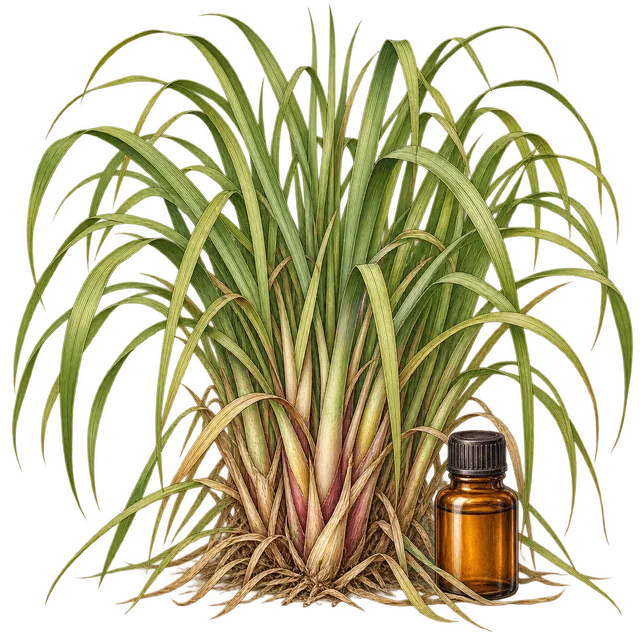
Citronella is a fragrant grass oil with a history that reaches well beyond mosquito products. Trade distinguishes Ceylon oil from Cymbopogon nardus and Java oil from C. winterianus. Both belong to the grass family, Poaceae. They are different materials from culinary lemongrass and the scented Pelargonium often sold as a mosquito plant.
Sri Lanka, formerly Ceylon, and Java are central to citronella’s commercial story. PROSEA describes expansion of Java’s industry around 1900. A 1946 US court opinion records extensive use of imported Ceylon citronella in kitchen and laundry soaps, including masking the odor of their raw materials.
Names also preserve that trade history: Ceylon citronella grass is associated with lenabatu, while Java citronella is also called winter’s grass and serai wangi. Native origin is less straightforward than these commercial names suggest: current Kew records place C. winterianus in western Malesia, while older economic-botany literature gives a different origin account. The regional oil names should not be treated as proof of a single botanical birthplace.
The oil’s fragrance, its usefulness as a source of industrial aroma chemicals, and its repellent applications are distinct purposes. Reports of folk remedies document cultural use, not clinical proof. Commercial food flavoring likewise does not make an aromatherapy bottle, candle fuel or repellent safe to swallow.
PROSEA records traditional leaf poultices for cuts and bruises, and extracts for digestive complaints and worms. These are historical plant preparations, not proven treatments or uses of bottled oil. Do not substitute concentrated oil for wound care or medical treatment.
Traditional, historical and reported uses
- Mosquito repellency in the documented preparation
Human researchWhy this label?
The claimed repellency is supported by a human bite-screening study of specified oil, alongside regulatory context; it does not transfer to candles, standing plants, or homemade preparations.
Mosquito-repellent use: citronella oil is used in manufactured skin-applied repellents; EPA lists both registered products and qualifying registration-exempt products. A human laboratory screening study found bite repellency from tested citronella oil. It does not establish a household dilution or a protection time for every bottle. Citronella is also sold in candles and other spatial formats; topical evidence cannot be transferred to those formats or to a pot of grass. Do not claim growing citronella grass protects a patio, or imply that candles, wristbands, oils and skin lotions have equivalent protection. No generic duration is given.
- EPA: Skin-Applied Repellent Ingredients
- EPA: Regulation of Skin-Applied Repellents
- NPIC: Oil of Citronella Fact Sheet
- EPA: Oil of Citronella Reregistration Fact Sheet (1997)
- Trongtokit et al. (2005): Comparative repellency of 38 essential oils against mosquito bites
- Matsuda et al. (1996): Citrosa plant identity and field evaluation
- Fragrance in perfumes, soaps and household products
Food or household practiceWhy this label?
The claim documents fragrance in perfumes, soaps and household products as a culinary, craft, gardening, or practical material use; it reports neither a treatment outcome nor measured nutrient content.
Citronella oil provides fragrance in perfumes, cosmetics, soaps and detergents. These scent applications belong together rather than being counted as separate remedies. Historical soap manufacture also used it to mask unpleasant base-material odors. Scenting a product does not establish disinfection or a health benefit.
- Raw material for industrial aroma chemicals
Food or household practiceWhy this label?
The claim documents raw material for industrial aroma chemicals as a culinary, craft, gardening, or practical material use; it reports neither a treatment outcome nor measured nutrient content.
Java citronella supplies industrial aroma-chemical feedstock. Its citronellal can be transformed into menthol; geraniol can yield citronellol and fragrance esters. These are manufacturing processes, not home preparations.
- Commercial food and beverage flavoring
Food or household practiceWhy this label?
The claim documents commercial food and beverage flavoring as a culinary, craft, gardening, or practical material use; it reports neither a treatment outcome nor measured nutrient content.
NPIC documents citronella oil as a flavoring in foods and drinks. US regulation lists citronella from Cymbopogon nardus among essential oils recognized as safe for their intended food use. This concerns appropriate food ingredients and conditions of use; it does not authorize swallowing retail essential oils or substituting citronella grass for culinary lemongrass.
- Animal-deterrent products
Food or household practiceWhy this label?
The claim documents animal-deterrent products as a culinary, craft, gardening, or practical material use; it reports neither a treatment outcome nor measured nutrient content.
EPA records a separate use in animal repellents, including products intended to discourage dogs and cats from selected outdoor areas. This is different from repelling mosquitoes from people. Historical registration records do not establish that every currently sold product works; follow the particular product’s label and never treat this as permission to apply concentrated oil to a pet.
- Agricultural pest-control preparations
Food or household practiceWhy this label?
The claim documents agricultural pest-control preparations as a culinary, craft, gardening, or practical material use; it reports neither a treatment outcome nor measured nutrient content.
PROSEA records citronella oil in mixed botanical pest preparations for Thai vegetable crops and citrus orchards. This documents regional practice, not a home spray recipe or proof of broad effectiveness. Use only authorized, appropriately labeled products.
Oil applications are distinguished from traditional leaf preparations and source-plant practices.
Historical-use additions reviewed 2026-10-08
Story sources
- EPA: Skin-Applied Repellent Ingredients
- EPA: Regulation of Skin-Applied Repellents
- NPIC: Oil of Citronella Fact Sheet
- EPA: Oil of Citronella Reregistration Fact Sheet (1997)
- Trongtokit et al. (2005): Comparative repellency of 38 essential oils against mosquito bites
- Matsuda et al. (1996): Citrosa plant identity and field evaluation
- PROSEA: Cymbopogon winterianus (de Guzman & Reglos, 1999)
- Kew Plants of the World Online: Cymbopogon winterianus
- Kew Plants of the World Online: Cymbopogon nardus
- EPA: Biopesticides Fact Sheet for Plant Oils (2001)
- 21 CFR 182.20: Essential oils and natural extractives
- United States v. Procter & Gamble Mfg. Co., 34 CCPA 71 (1946)
Identity & detailed reference
Identity
Citronella oil comes from Cymbopogon grasses. It is different from culinary lemongrass and from the scented Pelargonium sold as a “citronella” or “mosquito” plant.
Ingredient details, preparation and research
Also known as: Ceylon citronella oil (C. nardus); Java citronella oil (C. winterianus)
Source plant or material
Steam-distilled cut grass/leaves of citronella grasses; the Ceylon and Java types differ.
Plant family / material: Poaceae (grass family)
Forms and route
Commercial topical repellents and separate candles/spatial products. These formats require separate efficacy judgments.
Absorption and preparation
Repellency concerns exposure at the skin surface or an explicitly tested spatial formulation. It is not an oral absorption goal; food pairing, teas and supplements are not established substitutes.
Traditional and reported uses
- Mosquito-repellent use: citronella oil is used in manufactured skin-applied repellents; EPA lists both registered products and qualifying registration-exempt products.
- A human laboratory screening study found bite repellency from tested citronella oil. It does not establish a household dilution or a protection time for every bottle.
- Citronella is also sold in candles and other spatial formats; topical evidence cannot be transferred to those formats or to a pot of grass.
- Fragrance in perfumes, soaps and household products: Citronella oil provides fragrance in perfumes, cosmetics, soaps and detergents. These scent applications belong together rather than being counted as separate remedies. Historical soap manufacture also used it to mask unpleasant base-material odors. Scenting a product does not establish disinfection or a health benefit.
- Raw material for industrial aroma chemicals: Java citronella supplies industrial aroma-chemical feedstock. Its citronellal can be transformed into menthol; geraniol can yield citronellol and fragrance esters. These are manufacturing processes, not home preparations.
- Commercial food and beverage flavoring: NPIC documents citronella oil as a flavoring in foods and drinks. US regulation lists citronella from Cymbopogon nardus among essential oils recognized as safe for their intended food use. This concerns appropriate food ingredients and conditions of use; it does not authorize swallowing retail essential oils or substituting citronella grass for culinary lemongrass.
- Animal-deterrent products: EPA records a separate use in animal repellents, including products intended to discourage dogs and cats from selected outdoor areas. This is different from repelling mosquitoes from people. Historical registration records do not establish that every currently sold product works; follow the particular product’s label and never treat this as permission to apply concentrated oil to a pet.
- Agricultural pest-control preparations: PROSEA records citronella oil in mixed botanical pest preparations for Thai vegetable crops and citrus orchards. This documents regional practice, not a home spray recipe or proof of broad effectiveness. Use only authorized, appropriately labeled products.
Contraindications and cautions
- Check the finished product: registration-exempt does not mean EPA has evaluated its effectiveness.
- Use only a finished product labeled for its intended site and age; concentrated oil and experimental study preparations are not home-use instructions.
- An essential-oil study is not permission to apply neat oil. Stop use for skin irritation; follow product warnings for eyes, inhalation and children.
- Commercial food use is not permission to swallow concentrated essential oil, repellent products or candle fuel.
- Citronella oil can irritate skin and eyes and cause allergic skin reactions. Use a finished product as labeled; avoid neat-oil recipes.
- Pet-deterrent and agricultural uses are formulation- and site-specific. Do not apply concentrated oil to animals or improvise crop sprays.
- Traditional leaf or extract uses cannot establish the safety or effectiveness of essential oil for wounds, digestive illness or intestinal worms.
Similar items and how they compare
- Lemongrass
Related aromatic grasses
Culinary C. citratus is not citronella grass.
- Citronella-scented geranium
Frequently confused retail name
A Pelargonium plant, not the source of true citronella oil; field repellency claims failed.
Mosquito repellency and evidence
Human topical laboratory testing; separate commercial spatial uses. The oil has mosquito-repellent use and direct bite-test evidence; the exact finished formulation matters. Do not claim growing citronella grass protects a patio, or imply that candles, wristbands, oils and skin lotions have equivalent protection. No generic duration is given.
- EPA: Skin-Applied Repellent Ingredients
- EPA: Regulation of Skin-Applied Repellents
- NPIC: Oil of Citronella Fact Sheet
- EPA: Oil of Citronella Reregistration Fact Sheet (1997)
- Trongtokit et al. (2005): Comparative repellency of 38 essential oils against mosquito bites
- Matsuda et al. (1996): Citrosa plant identity and field evaluation
Evidence limits
Do not claim growing citronella grass protects a patio, or imply that candles, wristbands, oils and skin lotions have equivalent protection. No generic duration is given.
Entry sources
- EPA: Skin-Applied Repellent Ingredients
- EPA: Regulation of Skin-Applied Repellents
- NPIC: Oil of Citronella Fact Sheet
- EPA: Oil of Citronella Reregistration Fact Sheet (1997)
- Trongtokit et al. (2005): Comparative repellency of 38 essential oils against mosquito bites
- Matsuda et al. (1996): Citrosa plant identity and field evaluation
- PROSEA: Cymbopogon winterianus (de Guzman & Reglos, 1999)
- Kew Plants of the World Online: Cymbopogon winterianus
- Kew Plants of the World Online: Cymbopogon nardus
- EPA: Biopesticides Fact Sheet for Plant Oils (2001)
- 21 CFR 182.20: Essential oils and natural extractives
- United States v. Procter & Gamble Mfg. Co., 34 CCPA 71 (1946)
Reference entry 204 · Recorded content review: 2026-10-08 · Review scope and dates