


Key cautions
- For frequent use, check the species. Repeated large cassia-cinnamon portions can provide substantial coumarin and may harm the liver in susceptible people.
- Do not swallow dry cinnamon powder by the spoonful; aspiration can injure the lungs. Concentrated oils can irritate skin and mucous membranes.
What’s inside
Bark contains cinnamaldehyde-rich volatile oil and polyphenols, including procyanidins. Leaf oil may be eugenol-rich. Coumarin is generally much higher in cassia-type cinnamon than in C. verum. The whole bark supplies fiber and manganese in portion-dependent amounts.
USDA FoodData Central, SR Legacy: Spices, cinnamon, ground (FDC 171320) · EMA: Assessment report on Cinnamomum verum, bark and bark essential oil; historical use and composition
Uses in brief

- Aromatic seasoning for sweet and savory foods and drinks.
- Cinnamon bark has a documented traditional digestive use for bloating, mild gastrointestinal spasm and diarrhea.
- Biblical and historical fragrance, anointing and luxury-trade material; modern bark oil is a separate preparation.
In the King James Bible
In the King James Bible
Named material
Exodus names sweet cinnamon among the ingredients of the holy anointing oil. Song of Solomon places cinnamon in a garden of prized aromatics. The connection is to fragrant cinnamon material; the passages do not establish a particular modern Cinnamomum species.
Take thou also unto thee principal spices, of pure myrrh five hundred shekels, and of sweet cinnamon half so much, even two hundred and fifty shekels, and of sweet calamus two hundred and fifty shekels,
Exodus 30:23 (KJV)
Spikenard and saffron; calamus and cinnamon, with all trees of frankincense; myrrh and aloes, with all the chief spices:
Song of Solomon 4:14 (KJV)
Scripture and identification sources
Words & their stories
WORDS & THEIR STORIES
The name behind the KJV
Biblical Hebrew · Exodus 30:23 (KJV)
וְקִנְּמָן־בֶּשֶׂםwəqinnəmān-beśem
And fragrant cinnamon, in the anointing-oil ingredients.
Dictionary form: קִנָּמוֹן · בֹּשֶׂם · qinnāmōn · bōśem
The cinnamon noun has a shorter spelling and altered linking-form vowels here.
Biblical Hebrew · Song of Solomon 4:14 (KJV)
וְקִנָּמוֹןwəqinnāmōn
And cinnamon, among the poem’s garden aromatics.
Dictionary form: קִנָּמוֹן · qinnāmōn
Wə- means “and”; the noun otherwise matches the dictionary form.
What the language reveals
Two different settings
Exodus specifies cinnamon for a compounded sacred oil with olive oil; the Song uses its fragrance in garden imagery. A modern distilled cinnamon oil is not specified in either passage.
The ancient cinnamon name does not settle which modern Cinnamomum species or bark product was used.
History, folklore and reported uses
Sacred fragrance and scented rooms
Exodus 30:23 names sweet cinnamon in holy anointing oil. Song of Solomon 4:14 places it in a garden of aromatics, and Proverbs 7:17 names it among materials used to perfume a bed. The exact ancient Cinnamomum source remains uncertain.
King James Bible, public-domain complete text, Project Gutenberg eBook 10 · Lytton John Musselman, Old Dominion University: Cassia and Cinnamon
Bark, trade and the table
Cinnamon’s later history connects bark harvesting and Indian Ocean commerce. Sri Lankan Ceylon cinnamon became a major traded spice while cassia relatives circulated under overlapping names. EMA’s historical review records food seasoning, flavour enhancement and liqueurs. Bark, medicinal extracts and concentrated essential oil are distinct materials.
EMA: Assessment report on Cinnamomum verum, bark and bark essential oil; historical use and composition · Lytton John Musselman, Old Dominion University: Cassia and Cinnamon
Digestive traditions in Europe and Ayurveda
European records describe bark remedies for indigestion, bloating and mild digestive spasms. EMA also records Ayurvedic uses for vomiting and diarrhoea, alongside later European bark remedies for diarrhoea.
EMA: Assessment report on Cinnamomum verum, bark and bark essential oil; historical use and composition · EMA: Cinnamomi cortex, European herbal monograph and assessment
Health topics: evidence and cautions
These notes describe a specific research context and preparation. A topic link is not a treatment recommendation.
Diabetes and prediabetes · No benefit or possible harm
Form and route: Spice or oral bark supplement · oral
Cinnamon is not a proven diabetes treatment.
Evidence: inconsistent_human_evidence
NCCIH finds the evidence unclear, with major differences in species and products.
Limits
A result for one extract cannot establish a dose of kitchen cinnamon.
Cautions
- Cassia can contain liver-harming coumarin; concentrated use needs medicine and liver-risk review.
Regional reading paths
These sourced notes describe cultivation, trade, food traditions or material history. A regional connection does not claim exclusive origin.
Asia
Native: Sri Lanka; cultivated in southern India.
Dried inner bark flavours food.
Identity & detailed reference
Identity
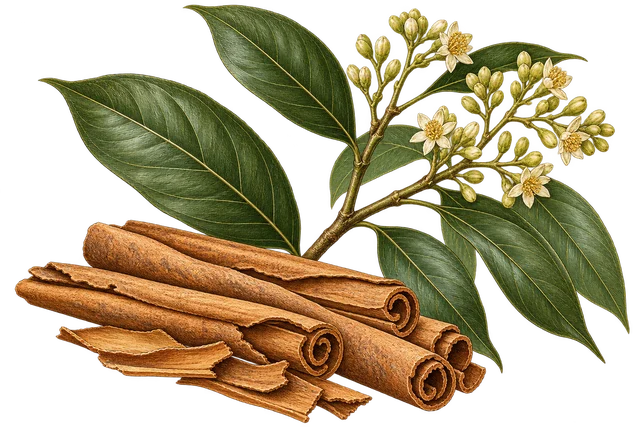
Cinnamon is dried aromatic bark from Cinnamomum species. Modern Ceylon cinnamon is Cinnamomum verum J.Presl; cassia-type products come from related species. The exact species of ancient biblical cinnamon is uncertain.
Ingredient details, preparation and research
Also known as: Ceylon cinnamon; True cinnamon (C. verum); Cinnamon bark
Source plant or material
Cinnamon is dried aromatic bark from Cinnamomum species. Modern Ceylon cinnamon is Cinnamomum verum J.Presl; cassia-type products come from related species. The exact species of ancient biblical cinnamon is uncertain. Parts used: Dried inner stem bark for the culinary spice. Leaf essential oil and bark essential oil are separate products and are not interchangeable with bark powder.
Plant family / material: Lauraceae (laurel family)
Forms and route
Bark quills or sticks, ground spice, food infusions and flavorings; standardized extracts and supplements. Distilled bark and leaf oils have different compositions and uses.
Vitamins and minerals
USDA ground-cinnamon reference: 1 teaspoon = 2.6 g (0.09 oz). A smaller 1/4-teaspoon seasoning portion (0.65 g, calculated from that measure) provides about 1.6 kcal, 0.35 g fiber, 6.5 mg calcium and 0.11 mg manganese. These are generic ground-spice data, not a Ceylon-only analysis or a recommended daily medicinal dose. Infused and removed sticks do not transfer all bark nutrients into a drink.
Absorption and preparation
Powder, water infusion, alcohol extract and distilled oil deliver different constituents. Coumarin in cinnamon is bioavailable; mixing cassia into food does not reliably remove its exposure. No proven household food pairing is established here to increase a therapeutic benefit. Use species and quantity, rather than an absorption claim, to guide culinary choices.
Practical preparation
Use clearly labeled food-grade bark. Ground powder cannot reliably be identified by appearance alone. Ceylon quills usually comprise many thin bark layers; cassia sticks are thicker, but a species label is more useful than guesswork. Stir powder into moist food rather than eating it dry.
Combination notes
Fruit, porridge and savory stews are flavor pairings. Adding cinnamon to a sugary food does not neutralize its sugar. No cinnamon-and-honey cure or universal absorption booster is established by these sources.
Traditional and reported uses
- Aromatic seasoning for sweet and savory foods and drinks.
- Cinnamon bark has a documented traditional digestive use for bloating, mild gastrointestinal spasm and diarrhea.
- Biblical and historical fragrance, anointing and luxury-trade material; modern bark oil is a separate preparation.
Contraindications and cautions
- For frequent use, check the species. Repeated large cassia-cinnamon portions can provide substantial coumarin and may harm the liver in susceptible people.
- Do not swallow dry cinnamon powder by the spoonful; aspiration can injure the lungs. Concentrated oils can irritate skin and mucous membranes.
- Cinnamon supplements should not replace diabetes treatment. Review them with your clinician, especially with liver disease, diabetes medicines or other regular medicines.
- Pregnancy and breastfeeding safety beyond normal food quantities is inadequately established; do not extrapolate culinary safety to extracts or oils.
Similar items and how they compare
- Cassia
Closely related aromatic bark sold as cinnamon.
Cassia-type cinnamon generally has more coumarin; biblical cassia is a separate named material.
- Clove
Another powerful aromatic spice used in food and perfumery.
Clove is a flower bud and is eugenol-rich; it is not cinnamon bark.
- Cinnamon leaf oil
Comes from a cinnamon tree and is used for fragrance.
Leaf oil often emphasizes eugenol rather than the cinnamaldehyde-rich bark profile; neither is a spoon-for-spoon substitute for the spice.
Modern plant versus ancient name
Kew accepts Cinnamomum verum, a Sri Lankan tree in Lauraceae. Commercial cinnamon also includes cassia relatives. EMA’s historical assessment explicitly notes the difficulty of identifying the original source behind ancient accounts. Exodus names sweet cinnamon as an aromatic ingredient; it cannot certify a modern bottle’s species or extraction method.
Traditional digestive role
EMA documents the long-standing use of C. verum bark for digestive complaints, including flatulence, gastrointestinal spasm and diarrhea. Its monograph concerns specified bark preparations; it is not a general approval of every cinnamon oil or supplement.
Human health research
NCCIH concludes that current research does not clearly support cinnamon for a health condition. Trials differ in species, plant material and product; promising changes in a metabolic marker do not make ordinary cinnamon a replacement for prescribed diabetes care.
Coumarin and frequent use
BfR estimates that about 2 g of average-coumarin cassia daily can reach the tolerable daily intake for a 60 kg adult; actual concentrations vary widely. This is an exposure example, not a universal safe-dose boundary. Ceylon cinnamon is the lower-coumarin choice for frequent larger culinary use.
Food portions and oils
A quarter teaspoon is a more realistic sprinkle than a 100 g comparison. Ground bark contributes some fiber and manganese, but essential oil supplies neither. Bark oil, leaf oil and extracts differ; concentrated preparations need their own label, route and safety assessment.
Evidence limits
- Generic USDA ground-cinnamon values do not identify Ceylon cinnamon or a particular cassia species.
- Clinical products and bark, leaf and oil preparations are not interchangeable.
Entry sources
- Kew Plants of the World Online: Cinnamomum verum J.Presl
- EMA: Assessment report on Cinnamomum verum, bark and bark essential oil; historical use and composition
- EMA: Cinnamomi cortex, European herbal monograph and assessment
- NCCIH: Cinnamon, usefulness and safety
- German Federal Institute for Risk Assessment: FAQ on coumarin in cinnamon and other foods
- USDA FoodData Central, SR Legacy: Spices, cinnamon, ground (FDC 171320)
- Lytton John Musselman, Old Dominion University: Cassia and Cinnamon
- King James Bible, public-domain complete text, Project Gutenberg eBook 10
- King James Bible: Exodus 30:23
- King James Bible: Song of Solomon 4:14
Reference entry 121 · Recorded content review: 2026-10-06 · Review scope and dates