


Key cautions
- Do not ingest; allergy and irritation are possible
- Pregnancy warrants professional advice.
- Do not apply essential oils to damaged skin. Keep bottles and diffuser liquids out of children’s reach. If oil is swallowed, contact a poison center promptly; breathing difficulty after exposure needs emergency care.
- EFSA’s assessment of the concentrated feed-flavour oil flags skin and eye irritation and skin and respiratory sensitization. This is a hazard assessment, not a measured rate of reactions to home diffusers. Stop exposure if the scent triggers coughing, wheezing or other symptoms; breathing difficulty needs urgent care.
What’s inside
The volatile mixture commonly centers on linalyl acetate and linalool. Flowering material, foliage, growing conditions and extraction produce different profiles; a sclareol-rich solvent extract is a different product from a distilled fragrance oil.
Kačániová et al. (2023): Salvia sclarea essential-oil chemistry and laboratory activities · Primary extraction study (2023): Essential oil and sclareol from clary-sage concrete
Constituents and cosmetic role
Linalyl acetate and linalool commonly predominate, alongside variable alpha-terpineol, geranyl acetate and sesquiterpenes. Sclareol is a relatively nonvolatile diterpene present in low/variable amounts in distilled oil and enriched by other extraction methods. Chemical and antimicrobial studies help characterize material, but the presence of a molecule does not prove estrogenic treatment activity or safe skin disinfection. The most defensible everyday role is fragrance.
Kačániová et al. (2023): Salvia sclarea essential-oil chemistry and laboratory activities · Primary extraction study (2023): Essential oil and sclareol from clary-sage concrete · European Commission SCCS: Clinical evidence on fragrance and essential-oil sensitization, Annex I
Reading a measured oil profile
EFSA’s six-batch GC–MS analysis reported linalyl acetate at 51.71–64.22%, linalool at 13.46–20.68% and sclareol at 0.32–1.18% of total detected chromatographic peak area. These are proportions of the analytical signal, not grams per 100 g of plant, nutrient servings or a dilution recipe. The assessed flowering-stem oils do not represent every bottle. EFSA evaluated an animal-feed flavour additive, not a human treatment or oral dose.
Uses in brief

- Herbaceous-floral fragrance in aromatic and formulated topical products
- Preliminary relaxation and menstrual-symptom research
History, folklore and reported uses
Identity and four commonly confused preparations
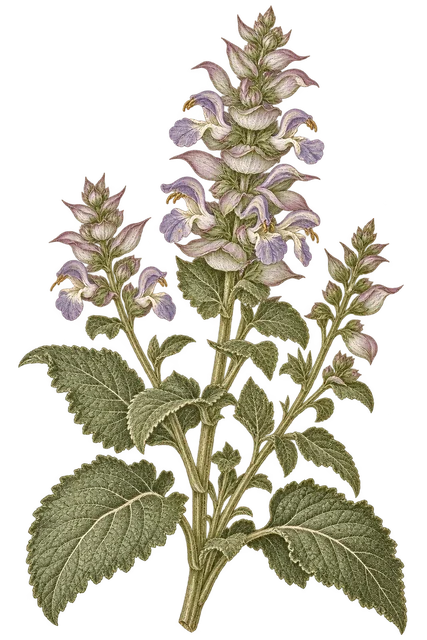
Kew accepts Salvia sclarea in Lamiaceae. SCCS describes its essential oil as a distillate of flowering tops and foliage. Entry 94 covers the herb; common sage is S. officinalis, and pressed clary-seed oil is a nonvolatile food lipid. A concrete or absolute made by solvent extraction is different again, particularly in its sclareol content. None is a dose-for-dose replacement for another.
Kew: Salvia sclarea, accepted name and Lamiaceae family · European Commission SCCS: Clinical evidence on fragrance and essential-oil sensitization, Annex I · Primary extraction study (2023): Essential oil and sclareol from clary-sage concrete
Garden leaves and the “clear eye” name
Clary sage was an aromatic garden herb before it became a familiar aromatherapy bottle. Monticello’s plant history describes centuries of cultivation in Britain and North America, where its broad leaves supplied seasoning and an alternative to common sage. Its older name ‘clear eye’ preserves a belief in vision-healing properties. That name belongs to the history of the herb and its preparations; it offers no reason to put the essential oil in an eye.
Thomas Jefferson Foundation, Monticello: Clary sage’s garden and household history · CSIR-CIMAP AromaDB: Salvia sclarea CIM-Chandni essential oil
From muscatel flavouring to modern aromatherapy
The scent opened another career. India’s CSIR-CIMAP aromatic-plant database describes distilled clary sage oil in perfumes and as a muscatel-like flavouring for wines, vermouths and liqueurs. The same database records contemporary aromatherapy uses for anxious feelings, sleep and menstrual discomfort. Those reports give the oil a place in present-day natural-care practice without making its reputation depend on an invented ancient distillation ritual. Its connected story runs from the texture and smell of a garden leaf to the work of flavourists, perfumers and modern practitioners.
Thomas Jefferson Foundation, Monticello: Clary sage’s garden and household history · CSIR-CIMAP AromaDB: Salvia sclarea CIM-Chandni essential oil
Anxiety, fear and nervous tension
CSIR-CIMAP’s aromatic-plant database records clary sage oil in aromatherapy for anxious feelings and fear. AromaWeb’s founder likewise describes using its herbaceous fragrance when feeling stressed.
CSIR-CIMAP AromaDB: Salvia sclarea CIM-Chandni essential oil · AromaWeb: Clary sage essential oil, uses attributed to aromatherapy authors
Sleep and evening relaxation
CIMAP separately records the distilled oil’s use for insomnia. This is the modern bedtime-aromatherapy branch of clary sage’s history.
CSIR-CIMAP AromaDB: Salvia sclarea CIM-Chandni essential oil
Menstrual discomfort
The same database records use for premenstrual symptoms and cramping. This preserves the oil’s well-known women’s-care reputation without turning it into a claim of hormone replacement or labor induction.
CSIR-CIMAP AromaDB: Salvia sclarea CIM-Chandni essential oil
Digestive cramping and wind
The AromaWeb profile, drawing on Purchon, Cantele and Lawless, includes flatulence, intestinal cramping and colic in clary sage oil’s practitioner repertoire. This concerns aromatic use of the distillate, separate from historical clary-herb drinks.
AromaWeb: Clary sage essential oil, uses attributed to aromatherapy authors · National Capital Poison Center: Essential oils can be poisonous when misused
Skin, scalp and hair preparations
AromaWeb also records clary sage oil in care for acne, mature skin, dandruff and hair loss. This topical beauty strand adds breadth beyond the oil’s relaxing scent.
AromaWeb: Clary sage essential oil, uses attributed to aromatherapy authors · National Capital Poison Center: Essential oils can be poisonous when misused
Muscatel flavouring for wines and liqueurs
India’s CSIR-CIMAP database records distilled Salvia sclarea essential oil as a muscatel flavouring for vermouths, wines and liqueurs. This is a food-industry application, not an instruction to ingest an aromatherapy product.
CSIR-CIMAP AromaDB: Salvia sclarea CIM-Chandni essential oil
Perfume composition
CSIR-CIMAP also records distilled clary-sage oil as a widely used perfume ingredient. This fragrance-manufacturing role concerns the oil itself, rather than isolated sclareol or whole-herb drinks.
CSIR-CIMAP AromaDB: Salvia sclarea CIM-Chandni essential oil
Regional reading paths
These sourced notes describe cultivation, trade, food traditions or material history. A regional connection does not claim exclusive origin.
Europe
Cultivated/distilled: southeastern France, especially Alpes-de-Haute-Provence.
Aromatic ingredient for fragrance formulations; not common-sage leaf or oil.
Identity & detailed reference
Identity
Salvia sclarea L. flowering-top and foliage essential oil in Lamiaceae. This volatile distillate is separate from clary herb/tea (entry 94), pressed clary-seed fixed oil, common sage (S. officinalis), and solvent-extracted concrete or absolute.
Ingredient details, preparation and research
Source plant or material
Salvia sclarea L.; essential oil distilled from flowering tops and foliage.
Plant family / material: Lamiaceae (mint family).
Forms and route
Steam- or hydrodistilled flower/foliage oil for perfumery, aroma and professionally formulated topical products. Solvent-extracted perfumery materials can retain much more sclareol; they are not interchangeable with the distilled oil.
Food sources
No food serving is assigned to this fragrance distillate. Food-grade clary herb is covered separately; essential oil should not be added to tea as a substitute.
Vitamins and minerals
A distilled essential oil is not a meaningful vitamin/mineral or omega-fat food source. Do not transfer nutrient values from culinary common sage or Salvia sclarea seed fixed oil. Topical or inhaled use supplies no established dietary nutrient serving.
Absorption and preparation
Human scent studies do not establish the absorbed amount of each constituent. Distilled oil, sclareol-rich absolute, herb tea and seed fixed oil have different chemistry and delivery. No validated food combination, dose conversion or method for maximizing therapeutic absorption is established for aromatic use.
Practical preparation
Use a labeled finished aroma or topical product; check Salvia sclarea, the plant part and extraction type. Follow its directions and storage/expiry label. No universal drops-to-milliliters conversion, oral regimen or home labor-induction recipe is supplied. Do not copy a research diffuser exposure without considering the product, device, ventilation and personal tolerance.
Combination notes
Lavender and clary sage share common fragrance molecules, but matching chemistry does not prove identical effects. Mixed-oil menstrual massage or pregnancy-footbath studies cannot isolate clary sage or prove synergy. Adding a carrier, food, alcohol or another supplement does not establish enhanced benefit.
Traditional and reported uses
- Herbaceous-floral, somewhat earthy fragrance in perfumery and finished massage or personal-care products. Traditional herb use is a separate entry and route.
- Short-term inhalation studies have investigated physiological relaxation, mood and menstrual symptoms. Findings are preliminary and do not establish treatment of depression, insomnia or hypertension.
- The small 2026 menstrual-symptom trial did not find between-condition changes in salivary estradiol, progesterone or cortisol. Hormone balancing, fertility enhancement and reliable labor induction are not established uses.
Contraindications and cautions
- Clary-sage contact allergy is reported. Avoid undiluted skin application, eyes and mucous membranes; stop for irritation or a fragrance reaction.
- Do not swallow cosmetic/aromatherapy oil. Pregnancy, breastfeeding and child use require individualized advice; do not self-induce labor with oil.
- If it makes you sleepy, lightheaded or unwell, stop and avoid driving or hazardous tasks while impaired. A claimed relaxing effect does not establish a predictable sedative dose or a proven interaction with alcohol or sedative medicines.
- A history of hormone-sensitive illness or current medicines merits product-specific clinical review. The available studies do not establish that ordinary aromatic use acts as estrogen or replaces prescribed hormone or mental-health treatment.
- Do not apply essential oils to damaged skin. Keep bottles and diffuser liquids out of children’s reach. If oil is swallowed, contact a poison center promptly; breathing difficulty after exposure needs emergency care.
- EFSA’s assessment of the concentrated feed-flavour oil flags skin and eye irritation and skin and respiratory sensitization. This is a hazard assessment, not a measured rate of reactions to home diffusers. Stop exposure if the scent triggers coughing, wheezing or other symptoms; breathing difficulty needs urgent care.
Similar items and how they compare
- Clary sage herb
The same Salvia sclarea source plant; see entry 94.
Leaf/flower food or extracts contain a different mixture; inhalation studies do not validate drinking the herb.
- Common sage
A related Salvia aromatic plant that is easily confused on labels.
Salvia officinalis has different volatile chemistry and medicinal assessments.
- Lavender essential oil
Often shares linalool/linalyl acetate and use in fragrance blends.
Distinct species and evidence; shared constituents do not establish equivalent clinical effects.
History belongs to the actual plant preparation
NC State Extension documents culinary leaves/flowers, beverage flavoring and historical digestive use for the herb. Those observations are relevant background, not trials of the concentrated oil. Modern aromatherapy’s relaxing-scent use should likewise be described as a practice and sensory preference rather than a proven therapy for all users.
A small procedural-stress trial
A 2013 controlled study randomized 34 women undergoing urodynamic examination to clary sage, lavender or almond-oil inhalation. Some short-term blood-pressure and breathing-rate comparisons favored clary sage. The specialized clinical setting, small groups and single exposure prevent extrapolation to sustained antihypertensive, anxiolytic or sedative treatment. An autonomic measurement is not a validated diagnosis or cure.
The 2014 menopausal-women experiment and correction
Twenty-two menopausal volunteers had blood biomarkers measured before and after inhaling clary-sage oil, with comparisons by depressive tendency. Cortisol decreased and plasma serotonin increased; this was not a placebo-controlled demonstration of lasting antidepressant benefit. A published erratum corrected mixed-up captions for Figures 1–4. The correction is noted here rather than ignoring the publication history or calling a caption correction a retraction.
The 2025 clinical trial does not establish antidepressant superiority
The three-arm diabetic-foot study analyzed 72 participants receiving one 30-minute exposure to clary-sage oil, isolated linalyl acetate or almond oil. The whole-oil group showed within-group anxiety and heart-rate decreases, but overall between-group comparisons for depression, anxiety and stress scores were not significant. Subgroup observations are exploratory, and an isolated constituent is not the complete oil. This does not support replacing depression treatment or applying oil to a diabetic wound.
The 2026 athlete pilot: symptoms without demonstrated hormone change
The randomized crossover study enrolled 20 female collegiate athletes and analyzed 12 completers. Each condition spanned one menstrual cycle; bedtime diffuser exposure lasted 60 minutes. Reported menstrual pain and some related symptoms were lower with clary sage than water, while salivary estradiol, progesterone and cortisol did not differ significantly between conditions. High attrition, tiny sample, detectable scent, self-reported adherence and no formal washout limit certainty. Salivary antioxidant capacity is a surrogate, not proof of an established mechanism or improved athletic performance.
Pregnancy and labor claims remain unproven
The 2017 feasibility study included only 11 term-pregnant women, with substantial saliva-measurement difficulties; it found no observed uterine contractions and no significant oxytocin advantage. A later nonrandomized footbath study using clary sage with lavender likewise found no significant between-group oxytocin or contraction change. These small studies neither establish labor induction nor broad pregnancy safety. Obstetric use belongs with the maternity team.
Allergy, alertness and interaction uncertainty
SCCS reports positive contact-allergy tests to clary-sage oil. Avoid known allergens and stop products causing rash. Interaction trials are inadequate: descriptions such as relaxing, sedating or estrogen-like should not be converted into a proven drug interaction, a guaranteed effect, or advice to change a prescription. Practical caution is warranted if exposure causes dizziness or sleepiness.
Nutrition, route and preparation
Use the product’s labeled aromatic or formulated topical route. No vitamin/mineral intake or dietary-fat contribution is established; chemistry from a seed oil or herb cannot fill that gap. Research exposures are not universal home recipes, and the study’s scent intensity is not a measured absorbed dose. More concentrated extraction or an added blend does not establish more benefit.
Entry sources
- Kew: Salvia sclarea, accepted name and Lamiaceae family
- European Commission SCCS: Clinical evidence on fragrance and essential-oil sensitization, Annex I
- Kačániová et al. (2023): Salvia sclarea essential-oil chemistry and laboratory activities
- Primary extraction study (2023): Essential oil and sclareol from clary-sage concrete
- NC State Extension: Salvia sclarea, edible herb and recorded historical uses
- Seol et al. (2013): Clary-sage or lavender inhalation during urodynamic examination
- Lee et al. (2014): Plasma serotonin and cortisol after inhalation in 22 menopausal women
- Lee et al. (2014): Erratum correcting mixed-up figure captions
- Son et al. (2025): Clary-sage oil versus linalyl acetate versus almond oil in diabetic-foot patients
- Applied Sciences (2026): Clary-sage inhalation crossover study in female collegiate athletes
- Publisher version notes for the 2026 clary-sage athlete trial
- Tadokoro et al. (2017): Feasibility pilot of clary-sage scent in 11 term-pregnant women
- Tadokoro et al. (2023): Nonrandomized aromatherapy-footbath study in term pregnancy
- IOP retraction notice: Clary-sage back massage and postpartum uterine involution
- National Capital Poison Center: Essential oils can be poisonous when misused
- National Cancer Institute: Aromatherapy with essential oils, evidence and safety
- CSIR-CIMAP AromaDB: Salvia sclarea CIM-Chandni essential oil
Reference entry 77 · Recorded content review: 2026-10-05 · Review scope and dates