


Key cautions
- Do not treat food use as proof that root, bark or concentrated extracts are safe. Avoid medicinal use during pregnancy or breastfeeding without specialist advice.
- Discuss supplements with a pharmacist, especially with diabetes medicines; proposed interactions are incompletely characterized. Stop for allergic symptoms.
What’s inside
Leaf polyphenols and glucosinolates accompany food nutrients; seed and root chemistry differs from leaf composition.
Uses in brief

- Leaves and immature drumstick pods are used as vegetables.
- Supplement claims for diabetes, cholesterol and infections have limited human evidence.
History, folklore and reported uses
History, folklore and traditional uses
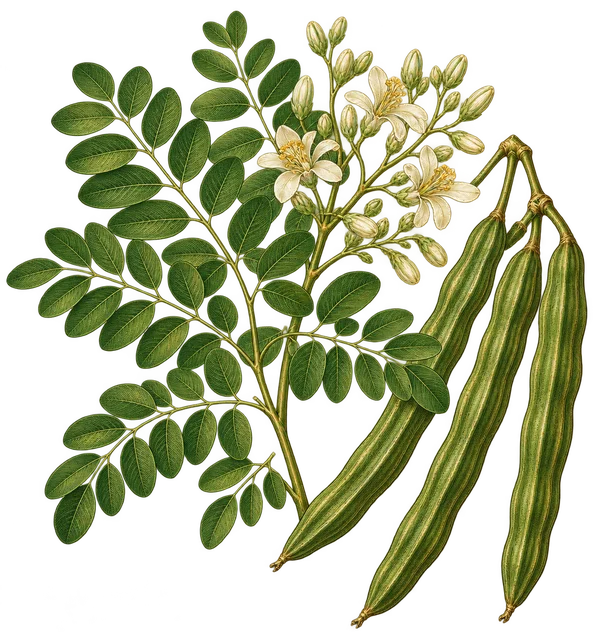
Moringa’s everyday food history is more concrete than its miracle-tree marketing. Across tropical kitchens, leaves are cooked as greens and immature pods appear in curries. These food practices concern selected plant parts, not a blanket endorsement of root or bark remedies.
Traditional, historical and reported uses
- Cooked leafy vegetable
Food or household practiceWhy this label?
The claim documents cooked leafy vegetable as a culinary, craft, gardening, or practical material use; it reports neither a treatment outcome nor measured nutrient content.
Young leaves are eaten as a vegetable in tropical regions.
- Drumstick curries
Food or household practiceWhy this label?
The claim documents drumstick curries as a culinary, craft, gardening, or practical material use; it reports neither a treatment outcome nor measured nutrient content.
Immature pods are used in curries; the long pods give the tree its drumstick name.
- Seed oil for perfumery and lubrication
Food or household practiceWhy this label?
The claim documents seed oil for perfumery and lubrication as a culinary, craft, gardening, or practical material use; it reports neither a treatment outcome nor measured nutrient content.
Singapore NParks records oil from mature Moringa oleifera seeds used in perfumery and as a lubricant. These are uses of an extracted material, separate from the leaves and immature pods eaten as vegetables.
- Living hedges and climbing-plant supports
Food or household practiceWhy this label?
The claim documents living hedges and climbing-plant supports as a culinary, craft, gardening, or practical material use; it reports neither a treatment outcome nor measured nutrient content.
NParks records Moringa oleifera planted as a hedge that provides wind protection, shade and support for climbing garden plants. This is a practical use of the living tree rather than a medicinal preparation.
Only specifically supported historical or culinary uses are included; tradition is not evidence of effectiveness.
Historical-use additions reviewed 2026-10-08
Women’s Health: traditions, evidence and cautions
Historical use does not establish benefit or safety. Pregnancy, breastfeeding and fertility care require particular caution: food, tea, essential oil and concentrated extract are not interchangeable. These records are not treatment, dosing or pregnancy-management instructions. Discuss supplements with a qualified clinician or pharmacist; do not delay evaluation of persistent symptoms.
Moringa leaf / malunggay
Moringa oleifera Lam.
- Plant part / material
- Leaf
- Preparation studied or reported
- Cooked food leaves, leaf powder and leaf extract; exclude root/bark.
LactMed describes Asian galactagogue use, particularly Philippine malunggay, alongside food use in Asia and Africa.
Lactation / milk-supply tradition
Positive pooled human signal with important limitations
Reported or traditional useLeaf foods and leaf preparations are used to support lactation.
What the evidence supportsThe July 2026 LactMed synthesis reports positive pooled milk-volume/prolactin findings. Studies differ in quality and formulation; long-term infant benefit remains understudied.
Short-term studies report no serious maternal/infant effects, but long-term safety is not established. LactMed advises caution in people at high risk of blood clots.
- Leaf findings do not establish safety or efficacy of root, bark, seed, or oil products.
- The cited lactation evidence does not establish medicinal-use safety during pregnancy; postpartum traditions must not be extrapolated to pregnancy.
Regional reading paths
These sourced notes describe cultivation, trade, food traditions or material history. A regional connection does not claim exclusive origin.
Africa
Introduced/cultivated: Africa, including Senegal and Nigeria.
Leaves used as a cooked green and dried leaf ingredient; exclude root and bark.
Identity & detailed reference
Identity
Moringa oleifera leaves and immature pods are food materials. Root, bark, seeds, oils and concentrated extracts require separate assessment.
Ingredient details, preparation and research
Also known as: Drumstick tree; Malunggay
Source plant or material
Moringa oleifera leaves and immature pods are food materials. Root, bark, seeds, oils and concentrated extracts require separate assessment.
Plant family / material: Moringaceae
Forms and route
Cooked leaves and tender pods; dried leaf powder, tea and extracts have different composition and serving sizes.
Vitamins and minerals
Assess the actual serving of cooked leaves, dried powder or pods separately. A small spoonful of powder is not equivalent to a large serving of fresh leaves, and tea does not retain the whole leaf’s nutrient content.
Absorption and preparation
Eating leaves supplies the food matrix; strained tea and extracts do not provide the same fiber or nutrients. No specific absorption-enhancement regimen is established.
Traditional and reported uses
- Leaves and immature drumstick pods are used as vegetables.
- Supplement claims for diabetes, cholesterol and infections have limited human evidence.
Contraindications and cautions
- Do not treat food use as proof that root, bark or concentrated extracts are safe. Avoid medicinal use during pregnancy or breastfeeding without specialist advice.
- Discuss supplements with a pharmacist, especially with diabetes medicines; proposed interactions are incompletely characterized. Stop for allergic symptoms.
Similar items and how they compare
- Olive leaf
Another tree-leaf supplement.
Moringa leaves are also eaten as a vegetable; olive leaf and olive oil evidence are separate.
Food and supplement evidence
Food leaves and pods have established culinary roles. MSK describes human supplement research as limited; preliminary metabolic findings do not establish a replacement for diabetes or cholesterol treatment.
Interactions and adverse effects
MSK records rare serious allergic/skin reactions and preclinical drug-interaction findings, whose clinical relevance is uncertain. Pregnancy and lactation need individualized advice; root and bark should not be inferred safe from edible leaves.
Nutrition interpretation
Botanical food status establishes that selected parts are eaten, not a universal nutrient dose. Use a reliable composition record or product label matching preparation and serving before making numerical nutrient claims.
Evidence limits
- No fixed nutrient quantities are given because the requested form and serving were unspecified.
Entry sources
- NParks: New Greens for Your Plate
- Memorial Sloan Kettering: Moringa oleifera
- Kew: Moringa oleifera
- Singapore NParks: Moringa oleifera, cultivation and ethnobotanical uses
Reference entry 199 · Recorded content review: 2026-10-07 · Review scope and dates