


Key cautions
- Do not use as cancer or infection treatment; nausea, vomiting and toxicity concerns limit use.
- Avoid medicinal use in pregnancy; discuss blood thinners, bleeding risk and surgery with a clinician.
What’s inside
Naphthoquinones including lapachol and beta-lapachone; amounts depend on material and extraction.
Uses in brief

- Traditional South American bark tea; antibacterial and anticancer laboratory findings do not establish human treatment benefit.
History, folklore and reported uses
History, folklore and traditional uses
Pau d’arco moved from South American bark teas into modern supplement and laboratory research. Botanical renaming from Tabebuia to Handroanthus can obscure product identity, and a familiar trade name does not confirm which tree supplied the bark.
Traditional, historical and reported uses
- Traditional bark tea
Traditional accountWhy this label?
The source reports South American medicinal inner-bark tea practice, not measured treatment benefit.
MSK records inner-bark tea use for a broad range of ailments in South America. Specific efficacy is not established by that history.
- Northeastern Brazilian topical preparations
Traditional accountWhy this label?
The monograph records northeastern Brazilian topical bark-or-wood herbal practice and makes no clinical outcome claim.
Fitoterapia Brasil’s Handroanthus impetiginosus monograph records bark-or-wood preparations used on skin and mucous membranes in northeastern Brazilian herbal practice. This is a material-specific reported use, separate from drinking inner-bark tea, and not a recommendation for home extraction or treatment.
Only specifically supported historical or culinary uses are included; tradition is not evidence of effectiveness.
Historical-use additions reviewed 2026-10-08
Regional reading paths
These sourced notes describe cultivation, trade, food traditions or material history. A regional connection does not claim exclusive origin.
South America
Native across parts of tropical South America, including Brazil, Bolivia, Paraguay and northwestern Argentina; associated with regional bark-based herbal traditions.
Historical inner-bark herbal reference. Laboratory findings do not establish treatment efficacy, and bleeding and other safety concerns preclude a casual-use recommendation.
Identity & detailed reference
Identity
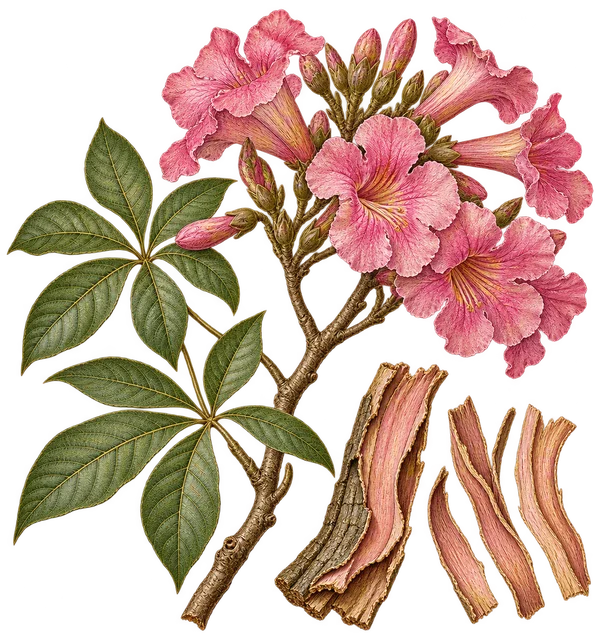
Inner bark sold as pau d’arco, lapacho or taheebo; often Handroanthus impetiginosus (older names Tabebuia impetiginosa / T. avellanedae). Trade names can include other species.
Ingredient details, preparation and research
Also known as: Lapacho; Taheebo; Ipê-roxo
Source plant or material
Inner bark sold as pau d’arco, lapacho or taheebo; often Handroanthus impetiginosus (older names Tabebuia impetiginosa / T. avellanedae). Trade names can include other species.
Plant family / material: Bignoniaceae
Forms and route
Inner-bark tea, powders and extracts. Isolated lapachol is not equivalent to bark tea.
Vitamins and minerals
No nutrient serving or nutritional benefit is assigned to the bark preparation.
Absorption and preparation
Laboratory compounds and bark infusions differ in composition and exposure. No home extraction or absorption-enhancing method is recommended.
Traditional and reported uses
- Traditional South American bark tea; antibacterial and anticancer laboratory findings do not establish human treatment benefit.
Contraindications and cautions
- Do not use as cancer or infection treatment; nausea, vomiting and toxicity concerns limit use.
- Avoid medicinal use in pregnancy; discuss blood thinners, bleeding risk and surgery with a clinician.
Similar items and how they compare
- Cat’s claw
Both are sold as South American medicinal bark products.
Cat’s claw is an Uncaria vine, with different constituents and cautions.
Material authentication
Inner bark and species identity should be documented. Botanical authentication references distinguish bark material; the broad trade name alone is insufficient.
Research and hazards
MSK notes limited human research despite laboratory activity. Lapachol did not produce improvement in a small leukemia study; animal work raises anemia and reproductive/genetic toxicity concerns. Possible bleeding interactions warrant caution.
Evidence limits
- No standardized household therapeutic dose is established.
- Do not infer bark-tea efficacy or safety from isolated compounds.
Entry sources
- Memorial Sloan Kettering: Pau D’arco
- Kew: Handroanthus impetiginosus accepted species
- AHPA Botanical Identity References: Handroanthus impetiginosus bark
- Fitoterapia Brasil: Handroanthus impetiginosus
Reference entry 196 · Recorded content review: 2026-10-07 · Review scope and dates