


Key cautions
- Avoid during pregnancy; breastfeeding safety is not established.
- Check first with autoimmune disease, before surgery, or with immune-suppressing, blood-thinning or blood-pressure medicines.
What’s inside
Oxindole alkaloids and other constituents vary with plant material and extraction; some marketed extracts are deliberately low in these alkaloids.
Uses in brief

- Longstanding Amazonian medicinal use; human evidence is inconclusive for arthritis or other health purposes.
History, folklore and reported uses
History, folklore and traditional uses
Indigenous Amazonian use predates today’s capsules and standardized extracts. NCCIH records centuries of use against illness, while modern assessments emphasize that the clinical studies remain too limited for a firm therapeutic conclusion.
Traditional, historical and reported uses
- Amazonian illness remedies
Traditional accountWhy this label?
The claim records Indigenous illness-remedy practice, without validating a modern product or disease indication.
NCCIH documents longstanding Indigenous use to ward off disease; it does not validate a specific modern product or indication.
- Purified extract investigated for arthritis
Human researchWhy this label?
A small randomized double-blind patient study investigated a defined purified extract alongside arthritis medicines, rather than retail products generally.
Mur and colleagues at Innsbruck University Hospital studied a highly purified pentacyclic-chemotype Uncaria tomentosa extract alongside existing rheumatoid-arthritis medication. This small preliminary study does not establish that retail cat’s-claw products are equivalent or effective; medicine interactions and the card’s pregnancy and immune-system cautions still apply.
Only specifically supported historical or culinary uses are included; tradition is not evidence of effectiveness.
Historical-use additions reviewed 2026-10-08
Regional reading paths
These sourced notes describe cultivation, trade, food traditions or material history. A regional connection does not claim exclusive origin.
South America
native; Amazonian South America, including Peru
Traditional bark preparations; clinical benefit remains unproven.
Identity & detailed reference
Identity
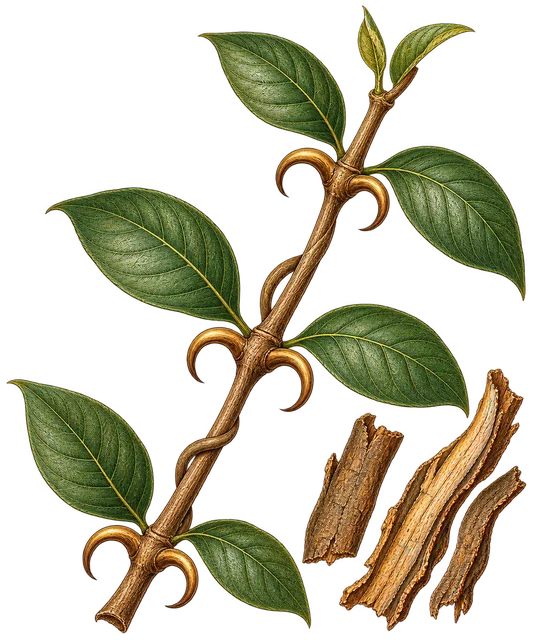
Uncaria tomentosa bark is the main commercial material; U. guianensis also shares the name. Unrelated plants called cat’s claw are not substitutes.
Ingredient details, preparation and research
Also known as: Uña de gato
Source plant or material
Uncaria tomentosa bark is the main commercial material; U. guianensis also shares the name. Unrelated plants called cat’s claw are not substitutes.
Plant family / material: Rubiaceae
Forms and route
Dried bark, decoctions, capsules and standardized extracts; species, part and extract standardization matter.
Vitamins and minerals
A medicinal bark preparation is not assigned a nutrient serving; no dependable vitamin/mineral contribution is claimed.
Absorption and preparation
Extracts with different alkaloid profiles are not interchangeable. No established food pairing makes them clinically equivalent.
Traditional and reported uses
- Longstanding Amazonian medicinal use; human evidence is inconclusive for arthritis or other health purposes.
Contraindications and cautions
- Avoid during pregnancy; breastfeeding safety is not established.
- Check first with autoimmune disease, before surgery, or with immune-suppressing, blood-thinning or blood-pressure medicines.
Similar items and how they compare
- Pau d’arco
Another tropical American bark preparation.
It comes from different trees and carries separate toxicity concerns; cultural geography does not make the herbs interchangeable.
Evidence and identity
Most U.S. preparations contain U. tomentosa, but U. guianensis also occurs in commerce. NCCIH finds no conclusive human evidence for any health purpose.
Preparation differences
EMA describes several extracts, including products with different oxindole alkaloid contents and a filtered aqueous preparation nearly free of them. A trial of one product cannot establish equivalence for another.
Safety boundaries
Immune effects may matter in autoimmune disease. Bleeding and medicine interactions are concerns, some theoretical; disclose use before surgery. Pregnancy use may be unsafe.
Evidence limits
- Common names do not verify species or alkaloid profile.
Entry sources
- NCCIH: Cat’s Claw
- EMA: Uncaria tomentosa bark assessment report
- NIH PubChem: Uncaria tomentosa taxonomy
- Mur et al. (2002): Randomized double blind trial of an extract from the pentacyclic alkaloid-chemotype of Uncaria tomentosa
- Memorial Sloan Kettering: Cat’s Claw
Reference entry 195 · Recorded content review: 2026-10-07 · Review scope and dates