


Key cautions
- Use only a finished repellent labeled for the intended person and use; a bottle of catnip oil or a homemade lotion does not inherit study protection claims.
What’s inside
Nepetalactone is important in ordinary catnip-oil research. A refined catmint ingredient described by EPA contains dihydronepetalactone and puleganic acid; these materials should not be silently merged.
Uses in brief

- Mosquito-repellent use: nepetalactone-rich catnip oil has been tested in lotions for reducing mosquito landings on people.
- Oil: formulation-specific insect-repellent research
- Herb context: cat enrichment and tea/food traditions
- Plant context: herb gardens and nectar-bearing flowers
History, folklore and reported uses
History, folklore and traditional uses
Catnip is a Eurasian mint-family herb that became familiar in gardens and households well before modern repellent formulations. Its broader story includes scented cat toys and leaf teas. These uses concern the plant or dried herb; they do not imply that concentrated catnip oil is suitable for pets or drinks.
Nepetalactone helps explain cats’ interest in the plant’s scent and is also important in ordinary catnip-oil repellent research. The shared chemistry does not make the preparations interchangeable: EPA’s refined catmint ingredient has different chemistry from ordinary essential oil, and human repellent lotions are not pet-enrichment products.
Traditional, historical and reported uses
- Mosquito repellency in the documented preparation
Mixed/contextual sourcesWhy this label?
The use combines human lotion and skin testing with a separate stable-fly/cattle-feedlot formulation study and regulatory context; results are preparation-specific.
Mosquito-repellent use: nepetalactone-rich catnip oil has been tested in lotions for reducing mosquito landings on people. An Eastern Uganda field study published in 2026 reported strong landing reduction from a particular lotion; older human-skin studies found weaker or species-dependent performance. Results belong to those preparations. EPA lists catnip oil among registered skin-repellent ingredients; this does not make every essential-oil bottle a registered repellent. Landing reduction is not a trial of malaria prevention. Botanical chemotype, refining, carrier and mosquito species materially affect the result. Do not transfer findings to standing plants or dried leaves. USDA researchers have also studied a wax-based catnip-oil formulation for deterring stable flies in cattle feedlots. This experimental use does not establish a safe household application to people or pets.
- Batume et al. (2026): Catnip essential-oil lotion field evaluation in Eastern Uganda
- Webb & Russell (2007): Catmint extract tested on human skin against Australian mosquitoes
- Chauhan et al. (2005): Feeding deterrent effects of catnip oil components against Aedes aegypti
- EPA: Skin-Applied Repellent Ingredients
- EPA (2010): Biopesticides Registration Action Document, Refined Oil of Nepeta cataria
- Kew: Nepeta cataria
- Scientific Reports publisher: catnip lotion study (online 14 March 2026; version of record 23 April 2026)
- Zhu et al. (2010): Repellency of a wax-based catnip-oil formulation against stable flies
Oil repellency is one purpose. The separate source-plant notes describe herb-based enrichment, culinary traditions, herbal history and gardening; they are not additional uses of concentrated oil.
Historical-use additions reviewed 2026-10-08
Story sources
- Batume et al. (2026): Catnip essential-oil lotion field evaluation in Eastern Uganda
- Webb & Russell (2007): Catmint extract tested on human skin against Australian mosquitoes
- Chauhan et al. (2005): Feeding deterrent effects of catnip oil components against Aedes aegypti
- EPA: Skin-Applied Repellent Ingredients
- EPA (2010): Biopesticides Registration Action Document, Refined Oil of Nepeta cataria
- Kew: Nepeta cataria
- Scientific Reports publisher: catnip lotion study (online 14 March 2026; version of record 23 April 2026)
- Texas A&M Veterinary Medicine: Feline Fine, the benefits of catnip
- University of Illinois Extension: Catnip
- University of Kentucky: Catnip, CCD-CP-50 (2017)
- University of Wisconsin Extension: Catnip, Nepeta cataria (revised August 2026)
- Butler University Friesner Herbarium: Nepeta cataria, citing Grieve (1931)
- Zhu et al. (2010): Repellency of a wax-based catnip-oil formulation against stable flies
Identity & detailed reference
Identity
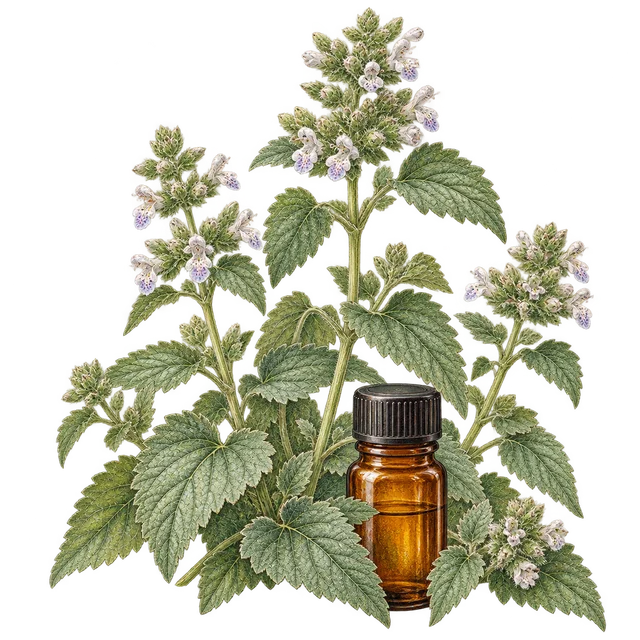
Catnip is Nepeta cataria. The mosquito research concerns extracted oil and finished formulations, not cat toys, tea, or a living catnip plant. Refined catmint oil used in some regulatory records differs chemically from ordinary nepetalactone-rich essential oil.
Ingredient details, preparation and research
Source plant or material
Essential oil from aerial tissues, including leaves and stems; refined catmint-derived repellent materials are separately processed.
Plant family / material: Lamiaceae (mint family)
Forms and route
Experimental formulated essential-oil lotions; separately, registered products using specified catnip-derived repellent ingredients. Match the exact label and material.
Absorption and preparation
Repellency concerns exposure at the skin surface or an explicitly tested spatial formulation. It is not an oral absorption goal; food pairing, teas and supplements are not established substitutes.
Traditional and reported uses
- Mosquito-repellent use: nepetalactone-rich catnip oil has been tested in lotions for reducing mosquito landings on people.
- An Eastern Uganda field study published in 2026 reported strong landing reduction from a particular lotion; older human-skin studies found weaker or species-dependent performance. Results belong to those preparations.
- EPA lists catnip oil among registered skin-repellent ingredients; this does not make every essential-oil bottle a registered repellent.
- USDA researchers have also studied a wax-based catnip-oil formulation for deterring stable flies in cattle feedlots. This experimental use does not establish a safe household application to people or pets.
Contraindications and cautions
- Use only a finished product labeled for its intended site and age; concentrated oil and experimental study preparations are not home-use instructions.
- A human repellent is not automatically appropriate for a pet; keep concentrated oils away from ingestion and eyes.
- Do not transfer herbal tea, food or cat-toy practices to concentrated catnip oil or refined repellent ingredients. Historical medicinal uses do not establish a treatment or child-safe preparation.
Similar items and how they compare
- Peppermint essential oil
Another mint-family oil tested against mosquitoes
Menthol/menthone chemistry differs from catnip’s nepetalactones.
Mosquito repellency and evidence
Human field landing catches (2026), human-skin tests (2005/2007). The recent formulated lotion reduced landings; older preparations were less reliable across mosquito species. Landing reduction is not a trial of malaria prevention. Botanical chemotype, refining, carrier and mosquito species materially affect the result. Do not transfer findings to standing plants or dried leaves.
- Batume et al. (2026): Catnip essential-oil lotion field evaluation in Eastern Uganda
- Webb & Russell (2007): Catmint extract tested on human skin against Australian mosquitoes
- Chauhan et al. (2005): Feeding deterrent effects of catnip oil components against Aedes aegypti
- EPA: Skin-Applied Repellent Ingredients
- EPA (2010): Biopesticides Registration Action Document, Refined Oil of Nepeta cataria
- Kew: Nepeta cataria
- Scientific Reports publisher: catnip lotion study (online 14 March 2026; version of record 23 April 2026)
Evidence limits
Landing reduction is not a trial of malaria prevention. Botanical chemotype, refining, carrier and mosquito species materially affect the result. Do not transfer findings to standing plants or dried leaves.
Entry sources
- Batume et al. (2026): Catnip essential-oil lotion field evaluation in Eastern Uganda
- Webb & Russell (2007): Catmint extract tested on human skin against Australian mosquitoes
- Chauhan et al. (2005): Feeding deterrent effects of catnip oil components against Aedes aegypti
- EPA: Skin-Applied Repellent Ingredients
- EPA (2010): Biopesticides Registration Action Document, Refined Oil of Nepeta cataria
- Kew: Nepeta cataria
- Scientific Reports publisher: catnip lotion study (online 14 March 2026; version of record 23 April 2026)
- Texas A&M Veterinary Medicine: Feline Fine, the benefits of catnip
- University of Illinois Extension: Catnip
- University of Kentucky: Catnip, CCD-CP-50 (2017)
- University of Wisconsin Extension: Catnip, Nepeta cataria (revised August 2026)
- Butler University Friesner Herbarium: Nepeta cataria, citing Grieve (1931)
- Zhu et al. (2010): Repellency of a wax-based catnip-oil formulation against stable flies
Reference entry 205 · Recorded content review: 2026-10-08 · Review scope and dates