


Key cautions
- Never substitute ornamental sweet pea, Lathyrus odoratus, or other unidentified Lathyrus flowers, pods or seeds.
- Flower color or a sweet taste is not proof of species. Keep ornamental and edible pea plantings clearly separated.
What’s inside
Pods and immature peas contain carbohydrate, fiber and vitamins; these food constituents are not concentrated medicinal compounds.
Uses in brief

- Whole edible pods used raw or briefly cooked; identified pea flowers used as a garnish.
History, folklore and reported uses
History, folklore and traditional uses
Penn State places snap peas alongside snow peas and shelling peas within Pisum sativum. The contrast is practical: the pod itself is part of a snap-pea meal. Illinois Extension describes edible-pod harvest and kitchen use, while Calflora and NC State draw a firm boundary around ornamental sweet pea. The word sweet therefore belongs to two very different gardening conversations and cannot carry the identification by itself.
Traditional, historical and reported uses
- Whole-pod vegetable
Food or household practiceWhy this label?
The claim documents whole-pod vegetable as a culinary, craft, gardening, or practical material use; it reports neither a treatment outcome nor measured nutrient content.
Illinois Extension records edible-podded peas, including sugar snap types, for fresh kitchen use.
- Pea-flower garnish
Food or household practiceWhy this label?
The claim documents pea-flower garnish as a culinary, craft, gardening, or practical material use; it reports neither a treatment outcome nor measured nutrient content.
University of Minnesota lists P. sativum flowers for salads. This does not include ornamental sweet pea.
Only specifically supported uses are included; historical or culinary use is not clinical proof.
Story sources
Identity & detailed reference
Identity
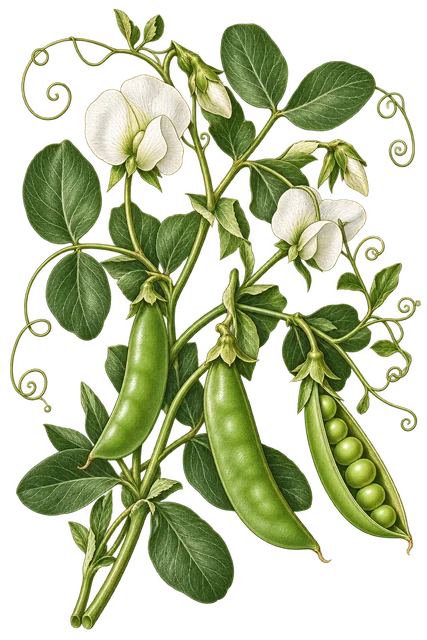
Sugar snap peas are edible-podded Pisum sativum cultivars. Pods with immature seeds are the main food; flowers are a separate garnish.
Ingredient details, preparation and research
Source plant or material
Pisum sativum L., edible-podded snap cultivars; Sugar snap peas are edible-podded Pisum sativum cultivars. Pods with immature seeds are the main food; flowers are a separate garnish.
Plant family / material: Fabaceae
Forms and route
Fresh or cooked pods with peas; flowers from confirmed food-grown P. sativum. Ornamental sweet peas are excluded.
Vitamins and minerals
Iowa State’s snap-pea guidance highlights vitamins A, C and K but supplies no measured portion in the cited fact sheet. Do not apply dry split-pea or shelled-pea figures to whole snap pods.
Absorption and preparation
No special absorption technique is established. Ordinary food preparation is appropriate; a flower garnish does not supply a pod-sized nutrient portion.
Practical preparation
Wash, trim and remove strings when present. Eat confirmed tender snap pods raw or cook briefly as a recipe directs. Use only known food pea flowers; avoid unidentified garden volunteers.
Traditional and reported uses
- Whole edible pods used raw or briefly cooked; identified pea flowers used as a garnish.
Contraindications and cautions
- Never substitute ornamental sweet pea, Lathyrus odoratus, or other unidentified Lathyrus flowers, pods or seeds.
- Flower color or a sweet taste is not proof of species. Keep ornamental and edible pea plantings clearly separated.
Similar items and how they compare
- Snow peas
Also edible-podded Pisum sativum.
Snow peas are harvested flatter; snap pods are fleshy and rounded.
- Ornamental sweet peas
Similar-looking climbing legumes.
Lathyrus odoratus is not food; do not taste-test to distinguish it.
The important exclusion
NC State labels Lathyrus odoratus poisonous and recommends keeping it away from edible peas. Calflora advises not eating any part. This distinction applies to flowers as well as pods and seeds.
Nutrition stays with its plant part
The cited snap-pea sheet concerns edible pods. Flowers, dried peas and shelled green peas require different serving and composition records.
Entry sources
- Penn State Extension: A gardener’s guide to peas
- Illinois Extension: Peas, home vegetable gardening
- Iowa State University Extension: Sugar snap peas
- NC State Extension: Lathyrus odoratus, sweet pea
- Calflora: Lathyrus odoratus, do not eat any part
- University of Minnesota Extension: Edible flowers
Reference entry 188 · Recorded content review: 2026-10-07 · Review scope and dates