


Key cautions
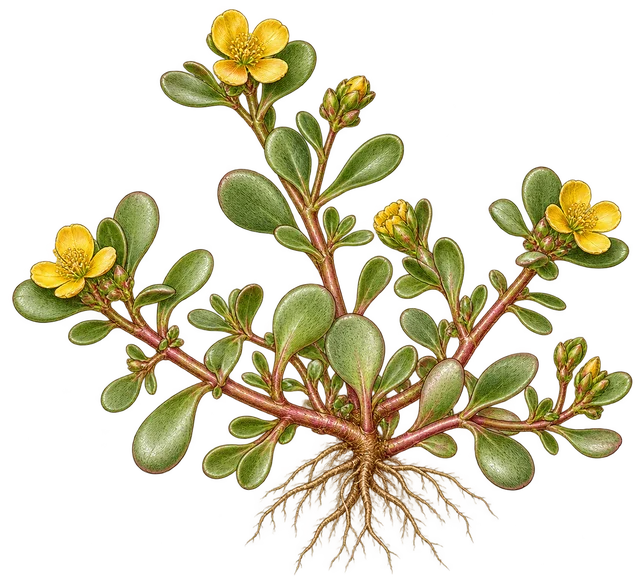
- Toxic spurges can be confused with purslane; do not use this card as specimen identification.
- Contains oxalates. Ask first with kidney stones, kidney disease or a prescribed low-oxalate diet.
What’s inside
Alpha-linolenic acid (ALA), beta-carotene and other food constituents vary with plant part and cultivar; oxalates are also present.
Uses in brief

- Leaves and tender stems provide tart flavor and crunch in salads or cooked dishes.
History, folklore and reported uses
History, folklore and traditional uses
Mississippi State’s Forgotten Foods series describes purslane moving between weed and vegetable, with raw, sautéed and soup uses. Its appeal is concrete: a fleshy texture and a pleasantly sour taste. The separate laboratory story concerns ALA in its leaves. Keeping those stories distinct avoids turning an interesting salad ingredient into an exaggerated omega-3 treatment claim.
Traditional, historical and reported uses
- Raw salad ingredient
Food or household practiceWhy this label?
The claim documents raw salad ingredient as a culinary, craft, gardening, or practical material use; it reports neither a treatment outcome nor measured nutrient content.
Mississippi State records common purslane served raw in salads.
- Cooked vegetable
Food or household practiceWhy this label?
The claim documents cooked vegetable as a culinary, craft, gardening, or practical material use; it reports neither a treatment outcome nor measured nutrient content.
The same source records sautéed and soup preparations.
Only specifically supported uses are included; historical or culinary use is not clinical proof.
Story sources
Identity & detailed reference
Identity
Common purslane, Portulaca oleracea; this food card covers succulent leaves and tender stems, not ornamental portulacas or spurge.
Ingredient details, preparation and research
Source plant or material
Portulaca oleracea L.; Common purslane, Portulaca oleracea; this food card covers succulent leaves and tender stems, not ornamental portulacas or spurge.
Plant family / material: Portulacaceae
Forms and route
Fresh salad greens or cooked vegetable; seeds and concentrated extracts are outside the preparation guidance.
Vitamins and minerals
A 2000 analysis found 1.5–2.5 mg total fatty acids per gram of fresh leaves, roughly 60% ALA. This is composition research, not a universal label or fish-oil equivalent.
Absorption and preparation
The cited Australian study did not detect long-chain omega-3s. Leaf ALA content cannot be translated directly into an equivalent EPA/DHA dose.
Practical preparation
Choose identified culinary purslane, wash, and use the leaves and tender stems in ordinary food quantities. Cooking does not certify an unidentified plant as safe.
Traditional and reported uses
- Leaves and tender stems provide tart flavor and crunch in salads or cooked dishes.
Contraindications and cautions
- Toxic spurges can be confused with purslane; do not use this card as specimen identification.
- Contains oxalates. Ask first with kidney stones, kidney disease or a prescribed low-oxalate diet.
Similar items and how they compare
- Lamb’s quarters
Both are sometimes cultivated or collected as leafy foods.
Purslane is succulent and has a different fatty-acid profile.
- Spurge
Can share a low spreading growth habit.
Euphorbia species are unsafe substitutes; no single sap test replaces expert identification.
Lookalike risk
Mississippi State warns that prostrate spurge can cause vomiting and diarrhea. The University of Arizona also stresses correct identification and responsible sourcing.
Nutrition in perspective
The cited analysis measured fresh leaves, stems and seeds separately. This card reports only the leaf findings and does not copy seed-oil percentages onto a handful of greens.
Individual oxalate advice
Stone-prevention diets depend on stone type and individual findings. Do not restrict dietary calcium on your own or treat this plant card as an individualized kidney diet.
Entry sources
- Mississippi State University Extension: Forgotten foods, common purslane
- University of Arizona Cooperative Extension: Let’s talk about purslane
- Liu et al. (2000): Fatty acids and beta-carotene in Australian purslane varieties
- National Kidney Foundation: Kidney stone diet plan and prevention
Reference entry 181 · Recorded content review: 2026-10-07 · Review scope and dates