


Key cautions
- Discard spoiled berries and wash under running water before eating.
- For shelf-stable jam, follow a tested recipe and its full canning process; a cooked sauce is not automatically pantry-stable.
What’s inside
Water, naturally occurring sugars, dietary fiber, vitamin C and anthocyanin pigments. Amounts differ with species, growing conditions and processing.
Uses in brief

- Eat washed berries fresh or add them to cereal and other meals.
- Use in pies, muffins, cooked sauces or savory salads.
History, folklore and reported uses
History, folklore and traditional uses
Maine’s wild-blueberry history begins well before its canning factories. University of Maine Extension credits Wabanaki people with managing and harvesting blueberry fields, including burn-pruning. That account belongs specifically to the wild-lowbush landscape and should not be presented as the history of every modern highbush cultivar.
Canning and later freezing carried the short harvest into other seasons. The kitchen repertoire also widened: alongside muffins and pies, extension recipes place blueberries in savory chicken salads. Fresh eating, baking, sauces, preserves and mixed savory dishes make useful, documented food categories.
Traditional, historical and reported uses
- Fresh table fruit
Food or household practiceWhy this label?
The claim documents fresh table fruit as a culinary, craft, gardening, or practical material use; it reports neither a treatment outcome nor measured nutrient content.
Whole ripe berries are eaten out of hand or added to breakfast foods.
- Pies and muffins
Food or household practiceWhy this label?
The claim documents pies and muffins as a culinary, craft, gardening, or practical material use; it reports neither a treatment outcome nor measured nutrient content.
Blueberries are baked into pastry and batter-based foods.
- Cooked dessert sauce
Food or household practiceWhy this label?
The claim documents cooked dessert sauce as a culinary, craft, gardening, or practical material use; it reports neither a treatment outcome nor measured nutrient content.
Purdue describes a stovetop berry sauce served hot or cold.
- Jam for the pantry
Food or household practiceWhy this label?
The claim documents jam for the pantry as a culinary, craft, gardening, or practical material use; it reports neither a treatment outcome nor measured nutrient content.
A tested blueberry-spice jam preserves the fruit in a spread. Use the source’s full method.
- Savory mixed salads
Food or household practiceWhy this label?
The claim documents savory mixed salads as a culinary, craft, gardening, or practical material use; it reports neither a treatment outcome nor measured nutrient content.
University of Maine Extension pairs blueberries with cooked chicken and vegetables in a chilled salad.
Five distinct culinary applications are documented. The Wabanaki heritage paragraph concerns Maine wild blueberries; no generalized traditional-medicine claims are made.
Story sources
Regional reading paths
These sourced notes describe cultivation, trade, food traditions or material history. A regional connection does not claim exclusive origin.
North America
Native/cultivated: United States and Canada; Maine wild-blueberry example.
Fresh, frozen or preserved fruit.
Identity & detailed reference
Identity
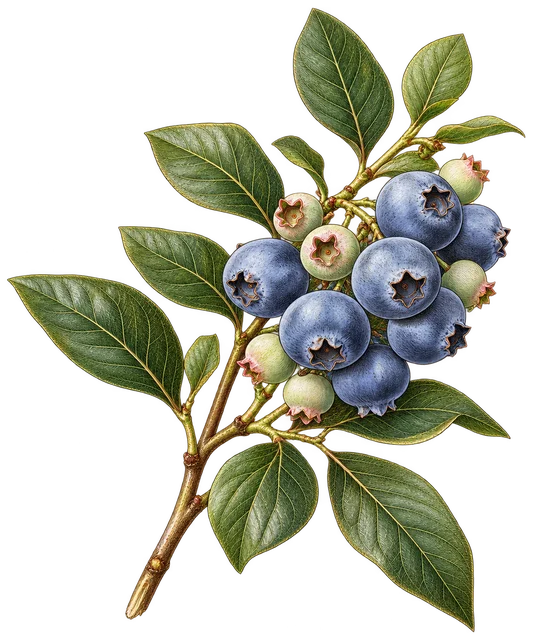
Edible blueberry fruits. Highbush, lowbush and rabbiteye blueberries are related crop groups; this broad food card does not treat them as one chemically identical cultivar.
Ingredient details, preparation and research
Also known as: Highbush blueberry; Lowbush blueberry; Blueberry
Source plant or material
Blueberry shrubs, including Vaccinium corymbosum (highbush blueberry).
Plant family / material: Ericaceae (heath family)
Forms and route
Fresh or frozen whole berries; cooked sauce, baked fruit and jam. Sweetened preserves and strained juice are separate food forms.
Vitamins and minerals
Whole blueberries contribute carbohydrate, fiber and vitamin C. Unsweetened whole fruit is the reference here; the sugar and fruit content of syrups, jams and flavored products vary.
Absorption and preparation
The cited food guidance supports ordinary eating and cooking, with no special fat pairing or extraction step specified. Pigment content alone does not establish how much reaches a particular tissue or a treatment benefit.
Practical preparation
Choose sound berries, refrigerate in a shallow container and rinse shortly before use. Freeze surplus in suitable freezer packaging. Refer to the linked preservation method before canning.
Food notes
Ripe whole fruit, including edible skin and small seeds; leaves and concentrated extracts are outside this food profile.
Combination context
Purdue lists lemon, cinnamon, vanilla and peach as flavor partners; these are culinary pairings rather than proven absorption enhancers.
Traditional and reported uses
- Eat washed berries fresh or add them to cereal and other meals.
- Use in pies, muffins, cooked sauces or savory salads.
- Preserve a harvest with freezing or a tested jam recipe.
Contraindications and cautions
- Discard spoiled berries and wash under running water before eating.
- For shelf-stable jam, follow a tested recipe and its full canning process; a cooked sauce is not automatically pantry-stable.
Similar items and how they compare
- Bilberry
Another Vaccinium fruit.
A related but different botanical material; do not substitute a bilberry supplement study for evidence about ordinary blueberries.
- Cranberries
Also members of Vaccinium.
Much tarter and often sweetened or juiced; their urinary-tract research does not apply automatically to blueberries.
Which blueberry is meant
Kew describes V. corymbosum as a North American shrub in Ericaceae. Purdue distinguishes highbush, rabbiteye and lowbush market groups, so a single food name can cover more than one crop type.
Color and food composition
Anthocyanins help account for the blue-purple color. The presence of these compounds is a composition fact; this card does not adopt older promotional claims that a serving prevents cancer, heart disease or memory loss.
Preserving with a tested method
The National Center provides a specific blueberry-spice jam formula and processing instructions. Changing a jam into a lower-sugar sauce changes the preparation, so its original shelf-storage instructions should not be assumed to apply.
Evidence limits
- Nutrition is qualitative; no USDA serving calculation or quantitative nutrient profile is asserted.
Entry sources
- Kew Plants of the World Online: Vaccinium corymbosum L.
- Purdue Extension FoodLink: Blueberry
- University of Maine Extension: Wild Blueberries, Bulletin 4263
- University of Maine Extension: About the Maine Wild Blueberry
- National Center for Home Food Preservation: Blueberry-Spice Jam with Pectin
- FDA: Selecting and Serving Produce Safely
Reference entry 167 · Recorded content review: 2026-10-07 · Review scope and dates