


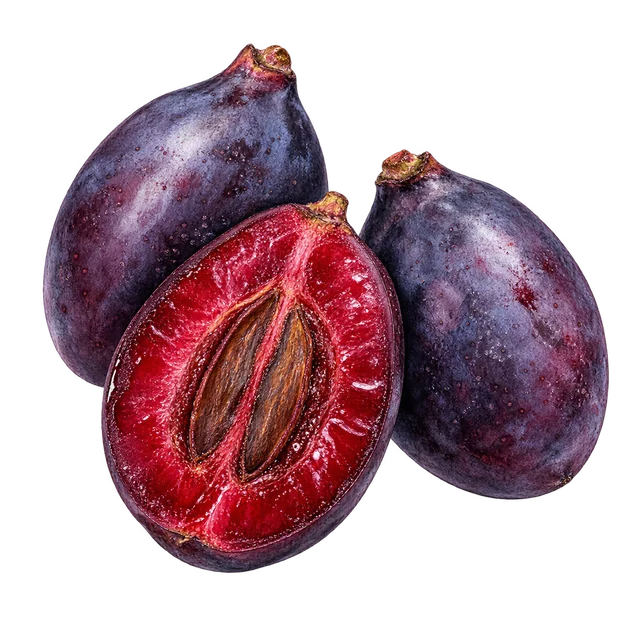
Key cautions
- Use identified food-grade fruit, not an ornamental or wild lookalike.
- Keep prepared foods under the storage conditions specified by the maker; a traditional ingredient does not make an unvalidated preserve shelf-stable.
What’s inside
Juicy acidic flesh with deep red-purple pigments; whole-fruit composition differs from purified pigment or antioxidant extracts.
Uses in brief

- Preserves and chutneys
- Sauces and cultured-food flavouring
History, folklore and reported uses
History, folklore and traditional uses
Davidson plum links eastern Australian rainforest species with present-day native-food cultivation. Commercial processors use its colour and sharp flavour, while species identification keeps distinct regional plants from collapsing into one vague plum category.
Traditional, historical and reported uses
- Preserves and chutneys
Food or household practiceWhy this label?
Sources document this named food or material use; no therapeutic outcome is claimed.
AgriFutures records jams and chutneys, where the fruit’s tartness and colour are useful. Added sugar and other ingredients belong to the finished-food calculation.
- Sauces and cultured-food flavouring
Food or household practiceWhy this label?
Sources document this named food or material use; no therapeutic outcome is claimed.
The fact sheet also records sauces and yoghurt as uses for the fruit. A fruit-flavoured yoghurt is a mixed product, not evidence of a fermented Davidson-plum tradition.
2 narrowly supported uses; no clinical efficacy or universal preparation is inferred.
Historical-use additions reviewed 2026-10-09
Regional reading paths
These sourced notes describe cultivation, trade, food traditions or material history. A regional connection does not claim exclusive origin.
Australia & Oceania
native; Australia, eastern rainforest regions
Tart fruit for preserves.
Identity & detailed reference
Identity
Davidsonia jerseyana and D. pruriens; tart edible fruit, not a Prunus plum. Species should be named on ingredient specifications.
Ingredient details, preparation and research
Source plant or material
Davidsonia jerseyana and D. pruriens; tart edible fruit, not a Prunus plum. Species should be named on ingredient specifications.
Plant family / material: Cunoniaceae
Forms and route
Fresh or frozen pulp; food-grade fruit powder; cooked sauces and preserves.
Vitamins and minerals
The government food reference names D. pruriens. It should not silently be applied to every Davidsonia species, concentrated powder or sweetened finished product.
Absorption and preparation
Cooking, drying, straining and added ingredients change the food that is actually eaten. No special medicinal absorption claim or extract-to-food conversion is established.
Practical preparation
Remove non-food stones and follow a tested culinary recipe or product directions. Acid taste alone is not a validated preservation process.
Traditional and reported uses
- AgriFutures records jams and chutneys, where the fruit’s tartness and colour are useful. Added sugar and other ingredients belong to the finished-food calculation.
- The fact sheet also records sauces and yoghurt as uses for the fruit. A fruit-flavoured yoghurt is a mixed product, not evidence of a fermented Davidson-plum tradition.
Contraindications and cautions
- Use identified food-grade fruit, not an ornamental or wild lookalike.
- Keep prepared foods under the storage conditions specified by the maker; a traditional ingredient does not make an unvalidated preserve shelf-stable.
A useful food property, not a health promise
The fact sheet emphasizes acidity, colour and food manufacturing. Those support culinary selection; they do not establish that the fruit prevents disease or that a laboratory antioxidant assay predicts an effect in people.
Species-specific composition
Native-food composition research specifically sought data on an additional Davidson-plum species. That need reinforces the distinction between D. pruriens and D. jerseyana and between fruit pulp and extracts.
Evidence limits
This is a food/material reference, not evidence of disease treatment. Geographic and customary-use records do not establish a medicinal dose. Nutrient quantities are omitted unless a matching food form and serving have been verified.
Entry sources
- AgriFutures: Focus on Davidson Plum
- DAFF: Australian native foods
- AgriFutures: Native Foods Compositional Data for FSANZ Nutritional Panel Calculator
- DAFF: Australian fruit, nut and vegetable composition cards
Reference entry 478 · Recorded content review: 2026-10-09 · Review scope and dates